India’s EV sales surge, but charging network still lags demand
EV sales are accelerating, but charging access is still the weak link. India’s next EV test is reliability: apartments, highways and fleets need chargers that actually work.
Sales are outrunning charging confidence
India’s EV market is growing fast enough to look healthy on paper, but the real stress test is whether drivers can charge without friction. Federation of Automobile Dealers Associations data show electric passenger vehicle retail rose 75.1% year over year to 23,506 units in April 2026, electric two-wheelers climbed 60.7% to nearly 149,000 units, and electric three-wheelers reached 64,549 units. Overall auto retail hit 26,11,317 units, the highest-ever April in the federation’s records, a sign that demand across the market remains strong even as charging anxiety lingers.
That mismatch matters because EV adoption is no longer just about early buyers willing to tolerate inconvenience. It is now moving toward families, apartment dwellers, office commuters and commercial users who need charging to be predictable, nearby and fast. The question is shifting from whether India can sell more EVs to whether the infrastructure can support everyday use at scale.
The everyday charging gap is where confidence breaks
The sharpest evidence comes from the kind of practical problem that does not show up in sales tables. A Gurugram EV owner who once lived in a home with convenient shared charging later moved into a setting where the system’s weak spots became impossible to ignore. Basement chargers were not allowed, public charging pods were unavailable, workplace chargers were limited, and long waits made routine charging inconvenient.
That experience captures why charging access is becoming the deciding factor for consumers who already like the idea of an EV. Home charging works well for some owners, but many urban households live in apartments or gated communities where installation rules, parking layouts and building approvals complicate the equation. If charging requires planning every trip around a queue, an elevator, or a neighbor’s unplugged cable, the vehicle can start to feel dependable only until the battery warning light appears.
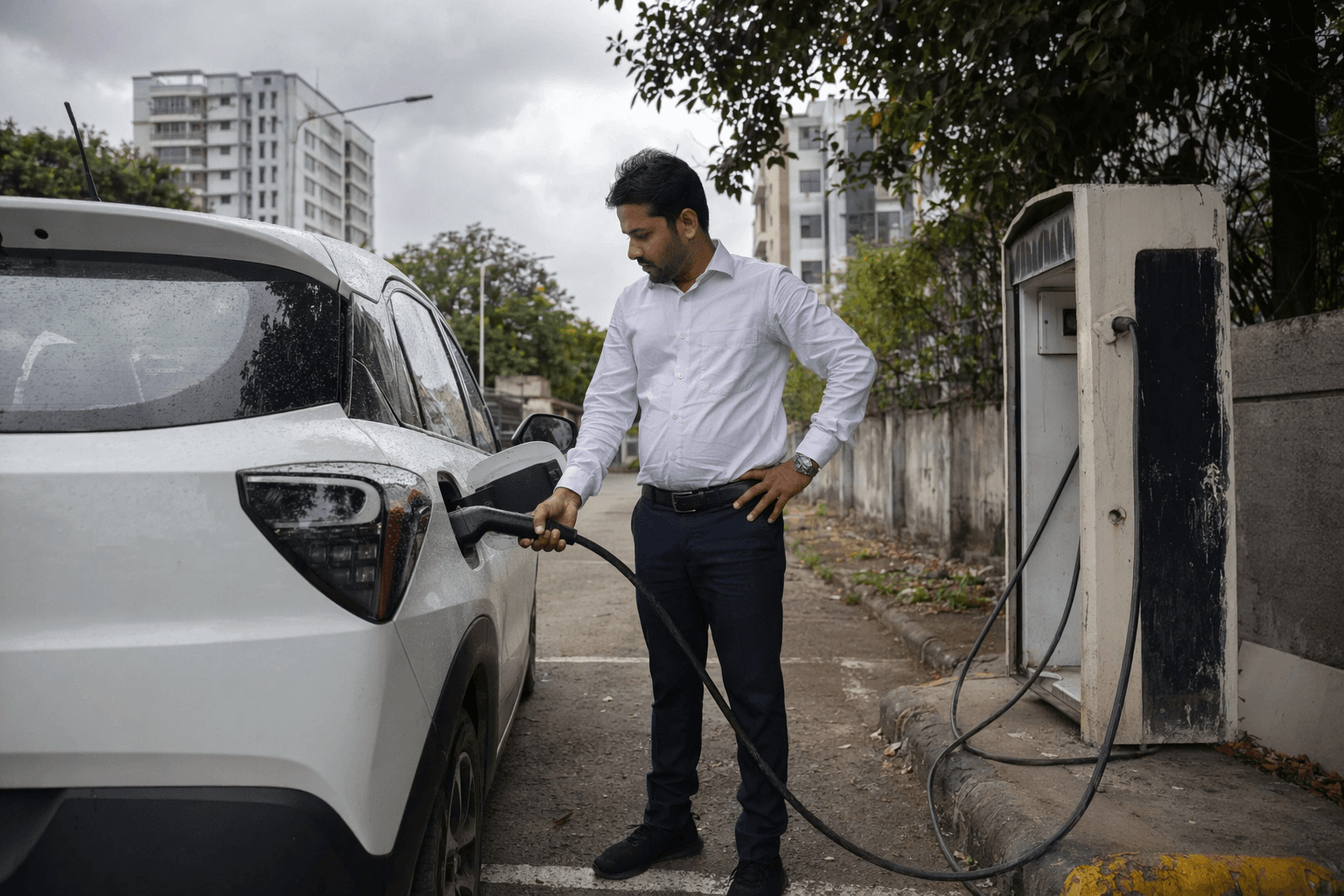
The problem is even sharper for highway travelers and fleet operators. Long-distance drivers need fast chargers that are available when they arrive, not simply listed on a map. Fleet users need uptime and throughput, because a vehicle sitting at a dead charger is not just inconvenient, it is lost revenue.
The network has expanded, but the map is uneven
India has added public chargers quickly, yet the distribution still leaves important gaps. Government figures showed 12,146 public EV charging stations were operational across the country as of February 2, 2024. By August 1, 2025, the total had risen to 29,277 public EV charging stations, and a December 16, 2025 government reply said 29,151 charging stations had been installed over the previous five years.
That December update also showed the network is split between 8,805 fast chargers and 20,346 slow chargers. The mix matters because a larger headline number does not automatically translate into usable access for commuters, intercity drivers or commercial fleets. Slow chargers may suit some overnight parking situations, but they do little for a highway traveler on a tight schedule or a delivery operator trying to keep vehicles moving.
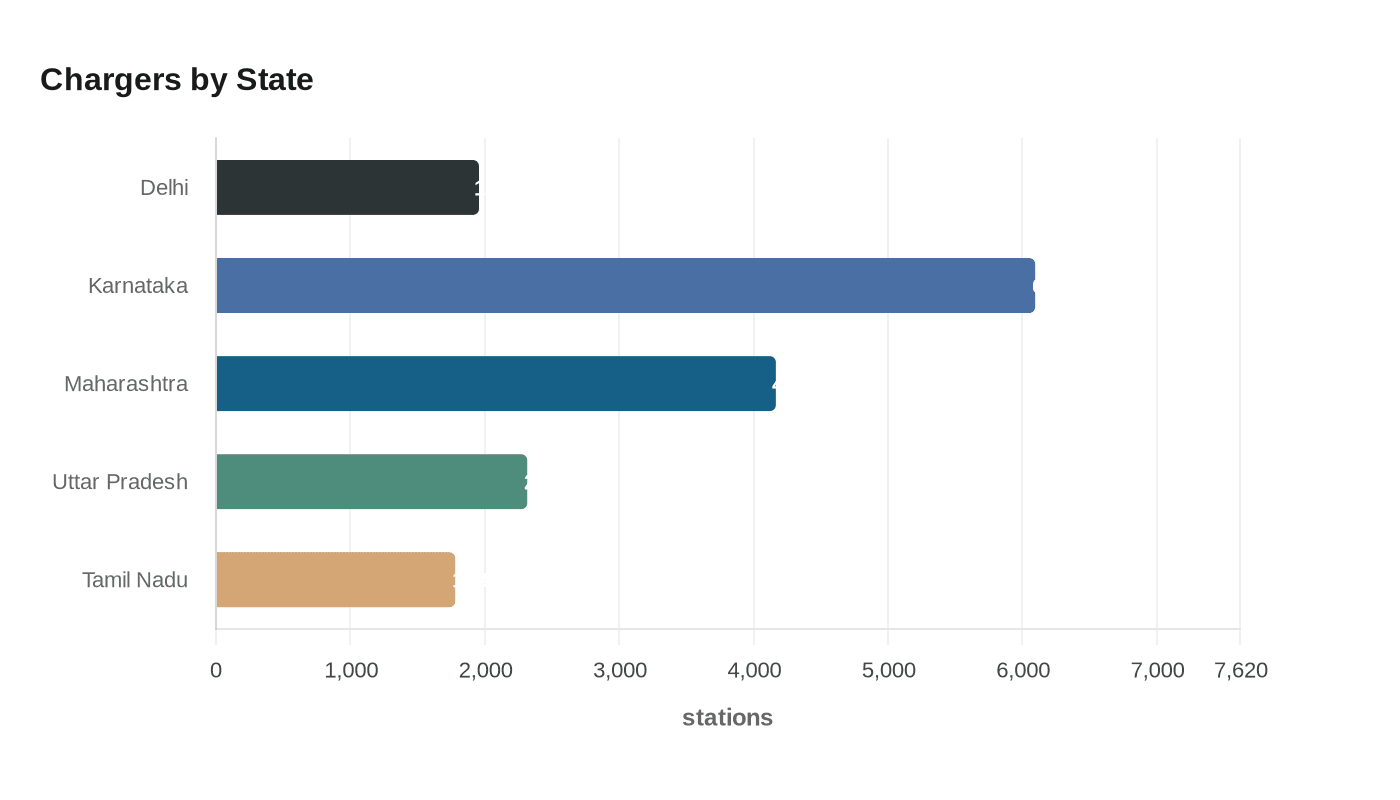
The regional spread is uneven as well. The government’s December 2025 reply said Delhi had 1,957 charging stations, Karnataka 6,096, Maharashtra 4,166, Uttar Pradesh 2,316 and Tamil Nadu 1,780. Those figures show meaningful buildout in large states and major urban markets, but they also underline how concentrated the rollout remains.
Reliability, not just rollout, is the real bottleneck
The next phase of the EV market is less about announcing new chargers and more about making existing ones work consistently. Industry analysts and policy voices have increasingly focused on uptime, predictable performance and resilience in hot, high-use and voltage-variable conditions. That is the level of reliability required if public charging is to feel as routine as a fuel station stop.
A 2024 briefing note from the Indian Energy and Climate Initiative and the Institute for Energy Economics and Financial Analysis argued that India’s public charging reliability is weakened by outdated technology, underutilisation and inadequate incentives for operations and maintenance. The note called for upgrades to existing sites, newer technology and stronger incentives for consistent uptime. It also traced the first public charging rollout under the FAME policy to 2015, when 520 charging stations were set up across the country.
That history is instructive. India has moved from an initial small rollout to a much larger network, but the market has now reached a stage where technical standards, maintenance practices and service expectations matter as much as the number of installed plugs. In other words, scale without reliability can still leave drivers stranded.
Policy is moving, but the placement problem remains
Government policy has clearly moved to support the next stage of buildout. Under PM E-DRIVE, Rs 2,000 crore has been set aside for public charging infrastructure, within a broader scheme outlay of Rs 10,900 crore. The Ministry of Power’s guidelines also make clear that setting up a charging station is an unlicensed activity, opening the door for private players to install chargers more easily.
That policy direction is important, but the harder question is whether it is solving the right bottlenecks. Earlier government responses have stressed that charging-station needs vary by geography and EV usage. NITI Aayog’s handbook says demand depends on vehicle composition, running patterns, terrain, urbanisation and charging technology, and it notes that there is no global consensus on how many charging points are required per EV.
That is the right lens for India. A charging plan for a dense apartment district is not the same as one for a highway corridor or a logistics hub. The country does not just need more chargers; it needs the right type of charger in the right place, backed by maintenance that keeps them operational.
The next phase will be decided by last-mile reliability
The EV transition in India will not be won by sales momentum alone. April’s record retail numbers show consumer interest is real, but the charging system still has to prove it can support apartment residents, highway travelers and fleet operators without forcing them to gamble on access every day.
If housing societies, workplace operators, utilities and charging companies can solve that last-mile reliability problem, EV adoption can move from promising to durable. If they cannot, the market will keep growing, but consumer confidence will remain one outage, one queue and one missed charge away from hesitation.
This article was produced by Prism’s automated news system from verified source data, official records, and press releases, then run through automated quality and moderation checks before publishing. The system is built and supervised by the people who set the standards it runs under. Read our full AI policy.
Did this article answer your question?

