India’s global capability centres slow hiring as AI and uncertainty bite
India’s offshore tech hubs are slowing hiring as AI and uncertainty push some planned centres from 5,000 workers down to 2,000.

India’s global capability centres are hiring more cautiously as AI and geopolitical uncertainty push multinational firms to rethink how much white-collar work they want to park offshore. The shift is already visible in the numbers: some hiring plans are being cut by 30% to 50%, and centres originally designed for more than 5,000 employees are being trimmed to about 2,000.
Lalit Ahuja, founder and chief executive of ANSR, said the industry has entered a period of clear caution, with companies choosing smaller initial teams and more flexible staffing models instead of committing to large permanent headcounts. Ahuja said the logic is straightforward: firms can add people later, but layoffs are far harder. ANSR counts FedEx, Target and Lowe’s among its clients, giving the warning weight across retail, logistics and other global operations that have long used India as a base for finance, technology and engineering work.

The broader significance is bigger than a hiring pause. AI is starting to change what global capability centres are for. The work inside these hubs is moving away from pure execution and toward functions such as AI, product, cloud, governance and cybersecurity, a shift that will alter the mix of jobs available in India’s white-collar labour market. The first roles under pressure are likely to be the repeatable, process-heavy tasks that once filled large teams of analysts, coordinators and support staff. What emerges instead are smaller centres built to manage transformation, supervise systems and handle higher-value decision support.
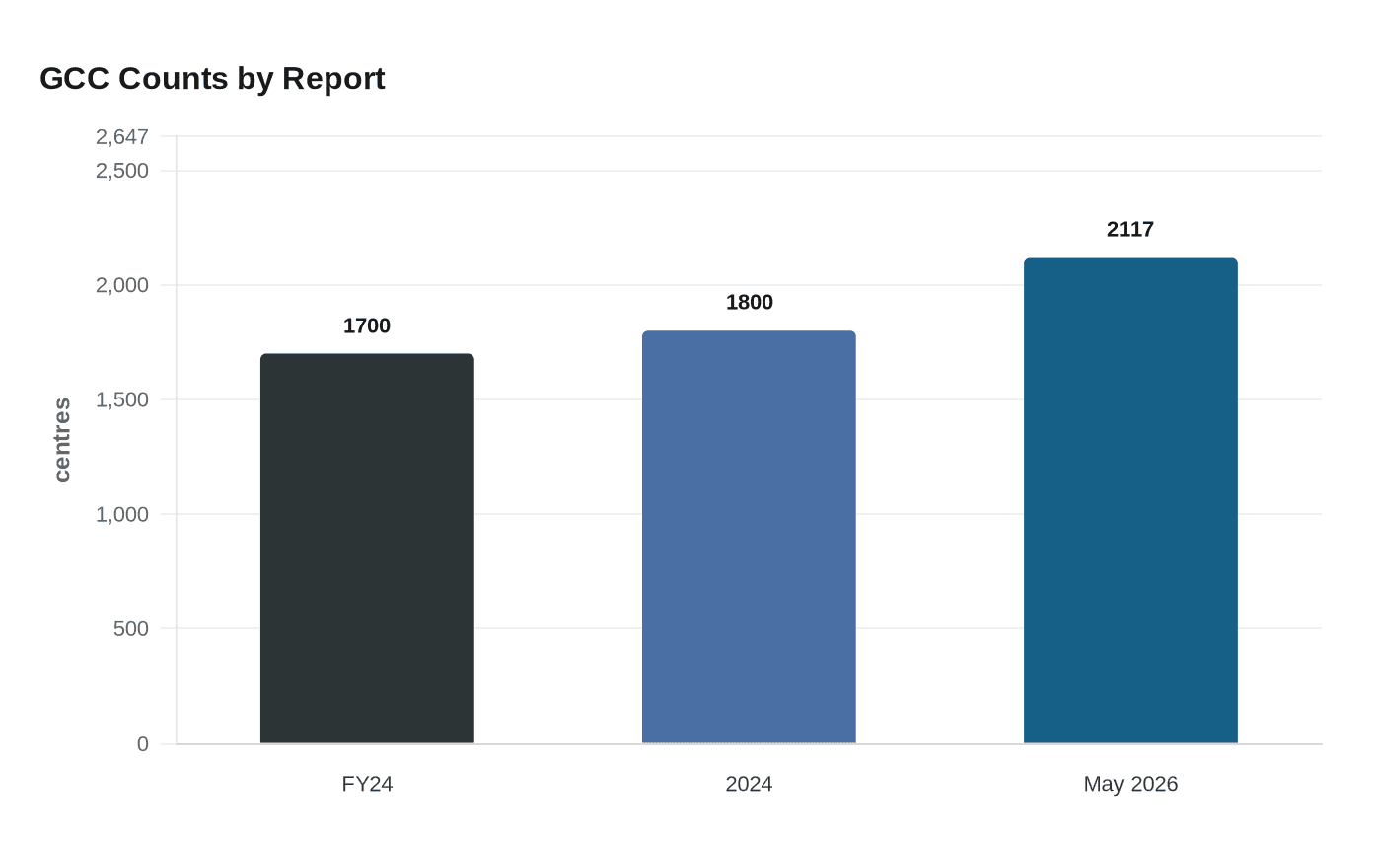
That matters because India has become the world’s dominant GCC base. Nasscom’s 2024 annual report said the country hosted more than 1,800 centres, generated $64.6 billion in revenue and employed about 1.9 million people. Nasscom-Zinnov’s 2024 landscape report put the FY24 count at 1,700 centres and projected 2,100 to 2,200 centres and 2.5 million to 2.8 million workers by 2030. More recent Nasscom-Zinnov reporting released in May 2026 raised the bar further, saying India now hosts 2,117 GCCs across 3,728 units, employs about 2.36 million professionals and generated $98.4 billion in revenue in FY26.
The industry is still expanding, but it is no longer expanding in the old way. Nasscom’s 2026 summit framed GCCs as moving from execution to ownership and as the enterprise’s “intelligent stabilisers,” a description that captures the new model taking shape. India remains central to multinational cost strategy, but the next phase looks less like mass outsourcing and more like a selective build-out of smaller, AI-heavy centres designed to do more with fewer people.
This article was produced by Prism’s automated news system from verified source data, official records, and press releases, then run through automated quality and moderation checks before publishing. The system is built and supervised by the people who set the standards it runs under. Read our full AI policy.
Did this article answer your question?
%3Amax_bytes(150000)%3Astrip_icc()%2FCertificate-of-deposit-2301f2164ceb4e91b100cb92aa6f868a.jpg&w=1920&q=75)