Indo-Pacific nations deepen defense ties as doubts about U.S. grow
Indo-Pacific states are hardening backup defense ties as doubts about U.S. focus grow. Japan’s export overhaul shows the hedge is becoming industrial, not just diplomatic.

Indo-Pacific governments are moving to build defense options that do not depend entirely on Washington, a quiet but consequential shift driven by China’s military rise and fresh uncertainty over how much attention the United States will keep on Asia. The pivot was on display around the Shangri-La Dialogue in Singapore, where U.S. Defense Secretary Pete Hegseth pressed regional partners to shoulder more of the burden even as he argued Washington could handle more than one strategic challenge at once.
The concern in the room was not whether the United States remains central. It was whether American attention can stay fixed when conflict in Iran and other global pressures keep pulling U.S. leaders elsewhere. Regional officials responded with a hedge: keep the U.S. security umbrella, but strengthen the backup arrangements now.
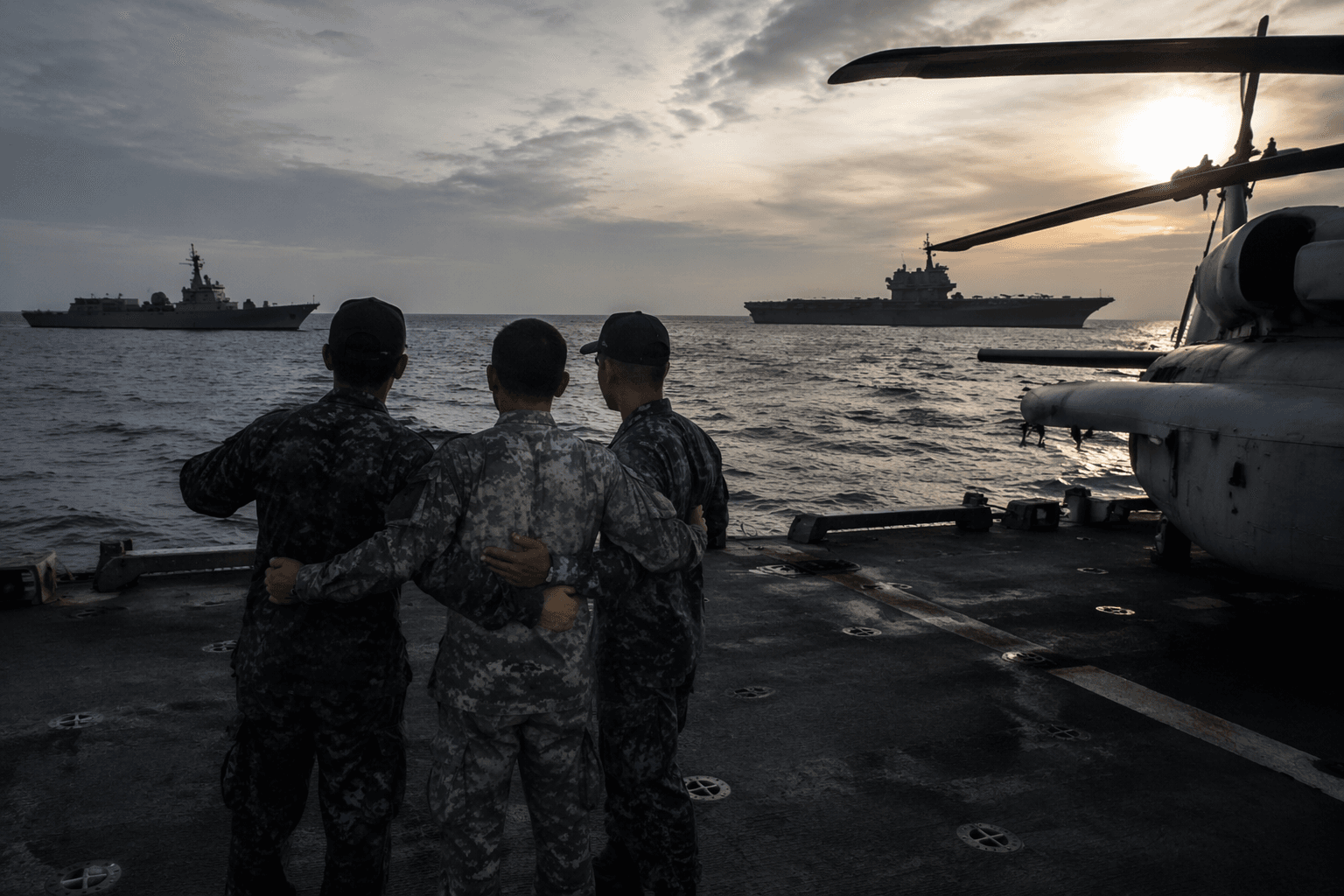
Japan is pushing that logic furthest. Its defense leadership says U.S. commitment remains firm, yet Tokyo is also presenting itself as a connecting point for broader regional cooperation. In April, Japan unveiled its biggest overhaul of defense export rules in decades, removing long-standing restrictions on overseas sales of warships, missiles and other military equipment. That matters because it turns the hedge from a diplomatic posture into an industrial one, giving Japan more room to supply partners and help build the logistics and production base behind faster rearmament.
The Philippines is taking the same lesson in a different direction. Its defense secretary said countries need to scale their own capabilities quickly and work more closely with partners such as Japan, Australia, Canada and New Zealand. That kind of networked cooperation is meant to complicate China’s calculations by making regional states less isolated and harder to pressure one by one.

Singapore’s defense minister argued that flexible coalitions of the willing are becoming more important, a sign that the region is drifting toward a more decentralized security order. The United States still sits at the center of that system, but Indo-Pacific governments are no longer waiting for Washington to settle its priorities before acting. They are building a denser web of ties, one designed to deter China and to keep the region from being left exposed if American attention shifts again.
This article was produced by Prism’s automated news system from verified source data, official records, and press releases, then run through automated quality and moderation checks before publishing. The system is built and supervised by the people who set the standards it runs under. Read our full AI policy.
Know something we missed? Have a correction or additional information?
Submit a Tip