Iran Conflict Ceasefire Will Still Drive Up Farm Costs and Food Prices
Despite the US-Iran ceasefire, fertilizer plants are shut down and mine clearance could take months, locking in grocery price pain through summer.
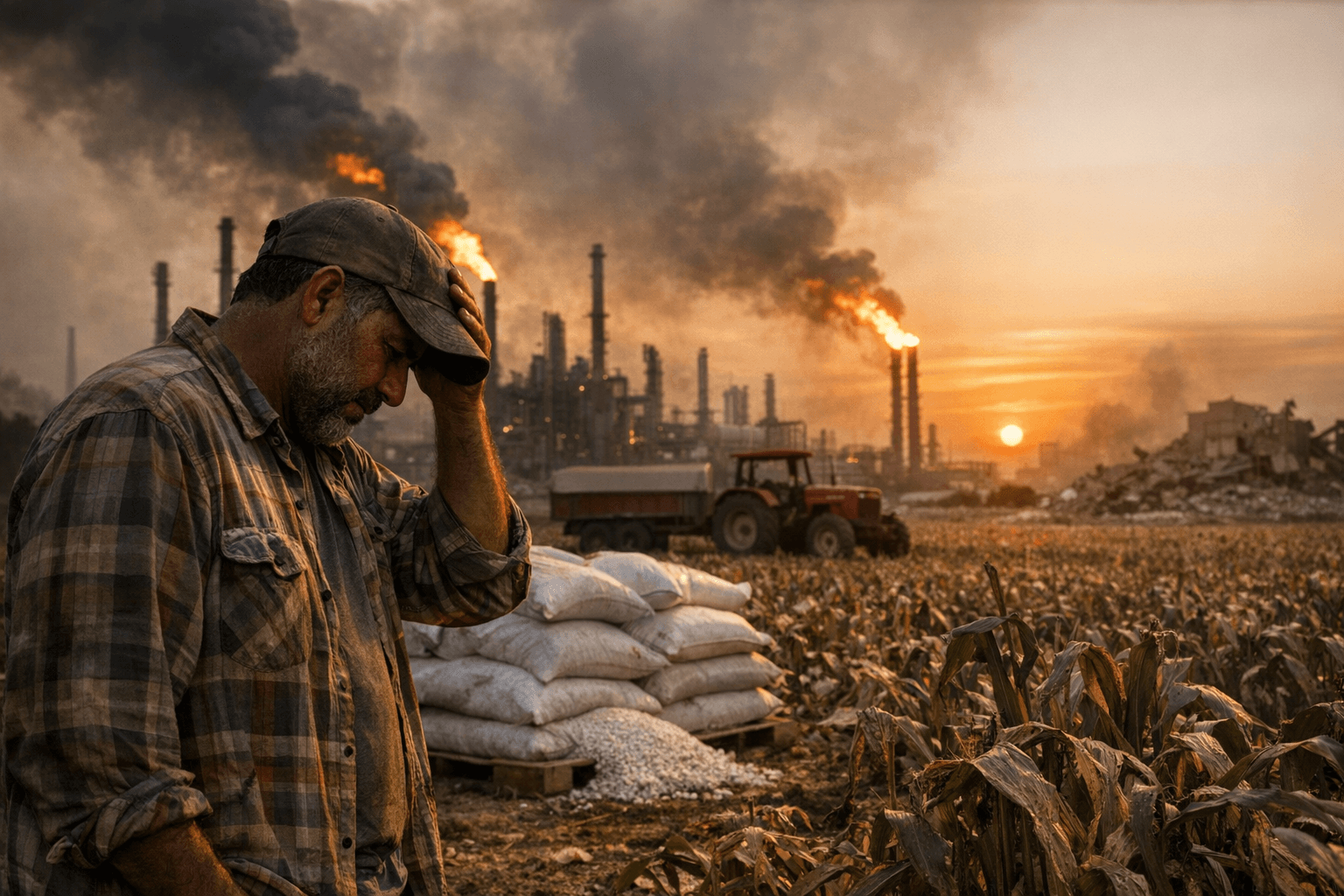
The two-week ceasefire between the United States and Iran announced Tuesday offered relief to financial markets, but farmers and food economists say the pipeline from Middle East conflict to American supermarket shelves runs months long, and the damage to input costs is already locked in.
The Strait of Hormuz, through which roughly one-third of global fertilizer trade moves, was effectively closed when U.S. airstrikes began in late February. Phosphate and nitrogen-based fertilizer prices surged between 20 and 45 percent, according to commodity analytics platform ChAI, on top of a 22 percent year-on-year increase already accumulated before the first bombs fell, according to Bureau of Labor Statistics data. The Council on Foreign Relations estimated that fertilizer accounts for up to 25 percent of agricultural commodity production costs, making the disruption among the most severe to food production since Russia's 2022 invasion of Ukraine.
Even if the Hormuz truce holds, mine clearance, insurance reassessment, and logistics normalization are measured in weeks to months, not days. Fertilizer plants have already declared force majeure and shut down. The World Food Program estimates the impact of energy prices on food prices peaks approximately four months after an oil price shock, meaning costs baked in during the spring planting window will not reach grocery shelves until late summer at the earliest.
The timing is what makes the disruption so damaging. Jason Lewis of Lewis Family Farms in south central Nebraska was already conserving nitrogen fertilizer before the conflict, squeezed by three consecutive years of high production costs and weak crop prices. The strait's closure turned conservation into a lifeline. In Marshall County, Alabama, farmer Bevel, who grows corn, wheat, cotton, and hay across 1,800 acres, calculated that higher diesel prices alone had added $14 per acre to equipment costs, a $30,000 overrun on top of his normal expenses. An Illinois corn farmer told HuffPost the combined hit from fertilizer and fuel would cost him an additional $100,000 just to plant this year's crop.
Corn and wheat bear the sharpest exposure. The USDA's Prospective Planting report projects corn and wheat acreage will each fall 3 percent in 2026 compared with 2025, and the department now forecasts the smallest U.S. wheat harvest since 1919. Those acreage cuts tighten grain supply through the rest of the year with cascading consequences: as corn and wheat prices climb, the cost of feeding cattle, hogs, and dairy cows rises on a secondary lag, pushing meat and milk prices higher months after the initial grain shock.
Anne Villamil, an economics professor at the University of Iowa, pointed out that even domestic fertilizer producers cannot escape the conflict's reach. "Energy prices are an input," she said, "and so even if you're producing it in the U.S., if the cost of your inputs goes up, then it's going to be an increase in price to the farmers who want to buy it." Farmers can cut fertilizer application rates, shift acres to less input-intensive soybeans, or draw down equity built in better years. Each of those adjustments has a ceiling.
U.S. food prices were already running at 3.1 percent annual inflation in February before the conflict began. The FAO's Food Price Index then rose 2.4 percent in March alone, reaching 128.5 points. Agriculture Secretary Brooke Rollins told PBS News that "everything was on the table" to provide relief, and 54 agricultural groups wrote to President Trump calling for "much-needed market relief for America's farmers." Neither response addresses the fundamental problem: the corn, wheat, and dairy supply chains have already absorbed weeks of elevated input costs, and the checkout line will eventually reflect every dollar of it.
This article was produced by Prism’s automated news system from verified source data, official records, and press releases, then run through automated quality and moderation checks before publishing. The system is built and supervised by the people who set the standards it runs under. Read our full AI policy.
Did this article answer your question?

