Iran-U.S. Ceasefire Shaken by Strikes Hours After Taking Effect
Lebanon declared a day of mourning hours after a ceasefire took effect, as Israel struck 100 Hezbollah targets in 10 minutes, killing at least 200.
The ceasefire was barely hours old when the bombs fell anyway.
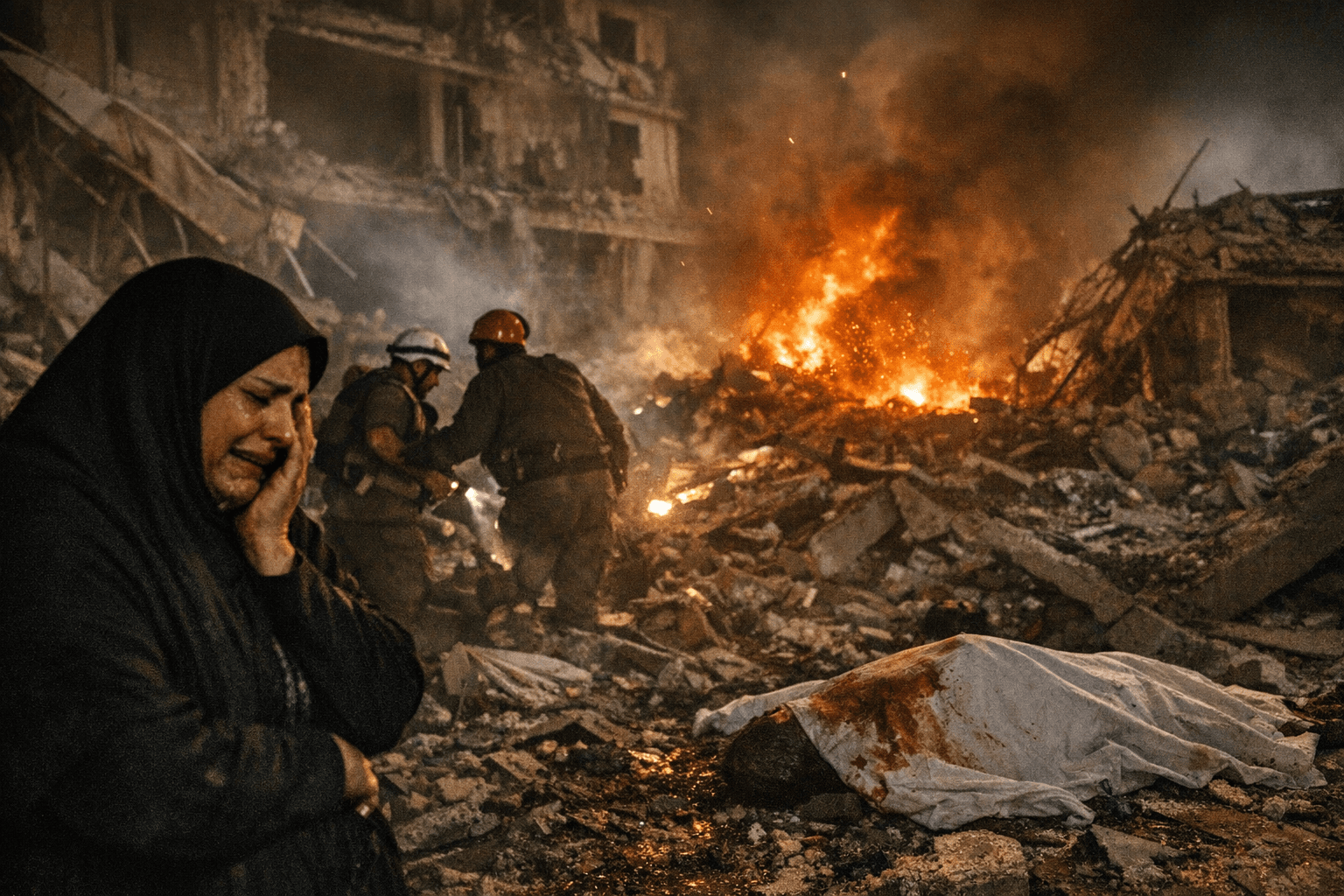
On the morning of April 8, the day Pakistani Prime Minister Shehbaz Sharif announced a U.S.-Iran truce to halt more than 40 days of coordinated U.S.-Israeli strikes, Israel's military struck approximately 100 Hezbollah targets in Beirut in under 10 minutes. Lebanese officials described it as the largest single-day assault on the country since the war began. By nightfall, at least 200 people were dead and more than 1,000 injured. Lebanon declared a national day of mourning.
This is the central paradox of the deal brokered in Islamabad: a ceasefire can exist on paper while a war continues on the ground. The political agreement between Washington and Tehran does not bind every actor in the conflict, and that gap between diplomatic language and tactical reality is already costing lives.
Israeli Prime Minister Benjamin Netanyahu declared that Lebanon was not covered by the ceasefire terms, a position echoed by U.S. officials but immediately disputed by Pakistan and condemned by Australian Prime Minister Anthony Albanese and French President Emmanuel Macron, who has been coordinating with more than 15 nations to reopen the Strait of Hormuz. The divergence exposed the deal's first structural flaw: the parties who signed it disagree on what it covers.
Iran's response was immediate. Tehran launched dozens of missiles and drones at the UAE, Kuwait, Qatar, and Saudi Arabia. Kuwait's army reported significant damage to oil facilities, power stations, and water desalination plants. People were injured by falling debris in Bahrain and the UAE, where the country's main gas complex caught fire. Saudi Arabia's critical east-west oil pipeline was also attacked. Jordan's military said it intercepted two Iranian missiles within a single 24-hour window. Near Baghdad, Iranian-backed militias kept up drone attacks on the Baghdad Diplomatic Support Center and the international airport.
Iran's Lavan oil refinery was struck around 10 a.m. local time on April 8, after the ceasefire had already taken effect. Israel denied responsibility, leaving the attack's origin unresolved. Iran's Revolutionary Guard Corps threatened a response to continued Israeli strikes in Lebanon, and Iran's U.N. Ambassador in Geneva, Ali Bahreini, made clear his government's posture: "We are not putting any trust in the other side. Our military forces are keeping their preparedness ... but meanwhile, we will go for negotiations to see how serious the other side is."
That negotiating process is scheduled to begin in Islamabad on April 10, with Vice President JD Vance leading the U.S. delegation. The talks face an immediate and potentially insurmountable obstacle: uranium enrichment. President Trump declared there will be "no uranium enrichment" and said Iran's stockpile of 60% enriched uranium, believed buried under the heavily damaged Isfahan facility since U.S.-Israeli strikes in June 2025, would be "unearthed and secured in a joint U.S.-Iranian effort." Iranian officials have listed any ban on enrichment as a red line and Tehran has not publicly committed to abandoning the program. Iran's 10-point peace proposal, which Trump acknowledged as "a workable basis on which to negotiate," also demands the lifting of U.S. sanctions, the release of frozen Iranian assets, and a withdrawal of U.S. forces from the region.
Financial markets moved sharply on the ceasefire announcement regardless of the violence continuing on the ground. Oil prices fell below $100 per barrel on the news, though they remained well above pre-war levels, reflecting the market's bet that the Strait of Hormuz, whose reopening Iran agreed to as part of the truce, would stay navigable. Global stock markets surged. Trump, posting on Truth Social, warned that all U.S. military personnel and assets would remain in position "until such time as the REAL AGREEMENT reached is fully complied with."
The human cost of the conflict since February 28 is substantial. The U.S.-based rights group HRANA puts the total killed at nearly 3,400, including more than 1,600 civilians. Over 1,500 of those deaths occurred in Lebanon. Twenty-three Israelis and 13 U.S. service members have been killed, with two more Americans dying of non-combat causes.
Analysts see the deal's architecture as deliberately ambiguous. Robert Geist Pinfold, a lecturer in international security at King's College London, compared it to the Gaza ceasefire model, warning that "all sides seem to have basically agreed to disagree and have kicked a lot of their disagreements into the long grass." Omer Citrinowicz, a nonresident fellow with the Atlantic Council's Middle East Programs, noted that "the push for talks originated in Washington" rather than Tehran, suggesting the U.S. may be under greater pressure than Iran to see the truce hold.
There is one thin thread of historical precedent. The Twelve-Day War ceasefire, brokered by the U.S. and Qatar on June 24, 2025, came after Iran launched 14 missiles at Al Udeid Air Base in response to American strikes on Iranian nuclear facilities, and it ultimately held. Whether this more complex and more violent conflict can follow the same trajectory will depend in large part on whether Vance can get both parties talking in Islamabad on April 10 before the tactical situation makes diplomacy irrelevant.
This article was produced by Prism’s automated news system from verified source data, official records, and press releases, then run through automated quality and moderation checks before publishing. The system is built and supervised by the people who set the standards it runs under. Read our full AI policy.
Did this article answer your question?


