Iran's Rulers Claim Victory in Survival, But Next Crisis Looms
Iran's theocratic rulers are selling survival as triumph, but 40 days of war left the regime's nuclear sites shattered, its navy gone, and a wounded new supreme leader unseen in public.
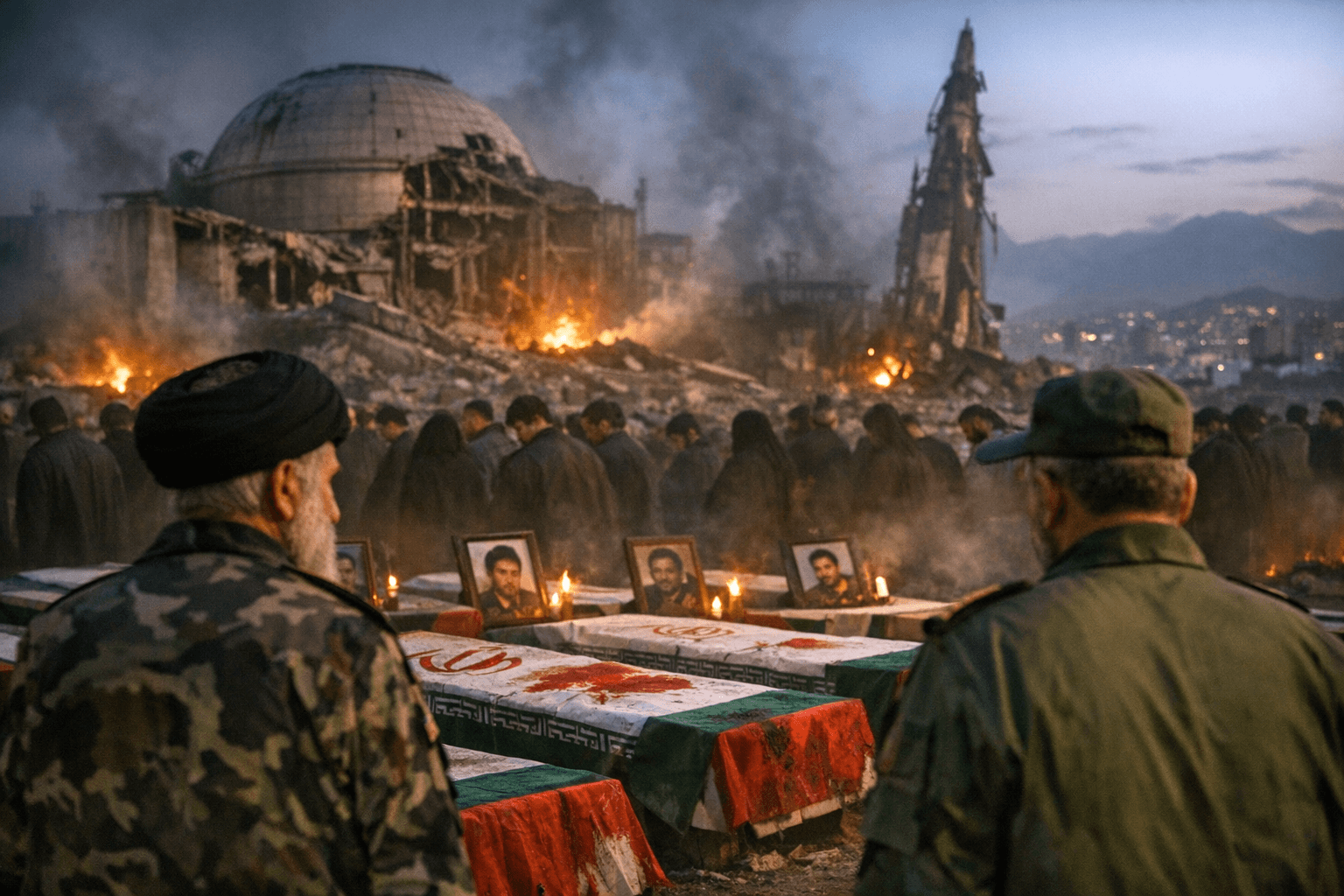
Iran's Supreme National Security Council declared it had achieved "a great victory and forced the United States to accept its 10-point plan" when a Pakistan-brokered ceasefire halted 40 days of U.S.-Israeli bombardment on April 8. The triumphalist framing was immediate and coordinated: Iranian state television broadcast the truce as a "historic and crushing defeat" of both Washington and Jerusalem, and pro-government demonstrators filled Enqelab-e-Eslami Square in Tehran within hours of the announcement. The gap between that narrative and the physical reality on the ground is where the next crisis is already forming.
The costs of survival were severe. The U.S. military struck more than 13,000 targets across Iran in under six weeks. The nuclear enrichment facilities at Fordow, Natanz, and Isfahan were struck using GBU-57 A/B bunker-buster bombs. Iran's navy in the Gulf of Oman was effectively destroyed. Human Rights Activists in Iran confirmed at least 1,221 military deaths, while Iran International placed the security forces toll at 4,700. Defense Minister Aziz Nasirzadeh, IRGC commander Mohammad Pakpour, and top spy Maj. Gen. Majid Khademi were all killed in Israeli airstrikes. So was Ali Larijani, the regime's most capable nuclear negotiator.
Most consequentially, Supreme Leader Ali Khamenei was assassinated on the war's first day, February 28. His son Mojtaba, who assumed the title of Supreme Commander, is believed to have been wounded in the same strike and has not appeared in public since the war began. The IRGC has nonetheless issued statements in his name, most recently declaring that "the enemy has always been deceitful, and we have no trust in his promises." Whether Mojtaba commands genuine institutional authority or is being managed by IRGC hardliners around him remains the central unanswered question as negotiators prepare to meet in Islamabad on April 10.
Iran enters those talks holding one card it did not hold before February 28: control of the Strait of Hormuz. As former U.S. Ambassador Daniel Fried noted, Iran is now demanding that vessels notify its military before transiting the strait, a condition without precedent. "So we are already starting out from behind," Fried said. "If your principal objective is to restore the status quo, you're not winning." Oil fell to $94 per barrel after the ceasefire announcement as markets priced in the re-opening of the waterway, but the leverage is structural, not temporary.
Tehran's 10-point negotiating framework is expansive by design: it demands the lifting of all primary and secondary sanctions, release of frozen Iranian assets, formal U.S. acceptance of uranium enrichment, withdrawal of American combat forces from the region, full compensation for war damages, and a binding UN Security Council resolution ratifying all terms. Iranian officials had initially vowed not to negotiate at all, yielding to pressure from Pakistani mediators and, reportedly, from Beijing, only after weeks of strikes. The maximalist demand list now serves as the regime's domestic proof that it negotiates from strength, not defeat.
U.S. Defense Secretary Pete Hegseth called the military campaign a "capital V military victory," and Trump's top general, Dan Caine, was careful to describe the ceasefire as a pause, warning that combat could resume if no final agreement is reached within two weeks. Those two framings, Washington's military success and Tehran's political survival, are both accurate, and they describe a situation with no stable equilibrium. The IRGC's proxies remain in the field: Israel continued strikes on Hezbollah in Lebanon within hours of the ceasefire announcement, and Iran accused Washington of violations before the first day was out.
Back home, Tehran remains far from its prewar rhythm. Authorities crushed mass protests in January before the war began, and no uprising has materialized since. But the combination of a new, untested supreme leader not seen in public, a shattered ballistic missile arsenal, nuclear sites of uncertain operational status, and a sanctions structure that remains intact pending negotiations gives the regime every incentive to accelerate whatever program it can reconstitute quietly. The victory being sold in Tehran is real enough as political theater. The conditions that produced this war have not been resolved; they have been compressed into a two-week window in Islamabad.
This article was produced by Prism’s automated news system from verified source data, official records, and press releases, then run through automated quality and moderation checks before publishing. The system is built and supervised by the people who set the standards it runs under. Read our full AI policy.
Did this article answer your question?


