Iran War Disrupts Frankincense Trade, a Middle East Staple for Millennia
Salalah port, gateway for the world's finest frankincense from Oman's Dhofar, suspended operations in March as the Iran war's shipping collapse hit one of history's oldest trade routes.
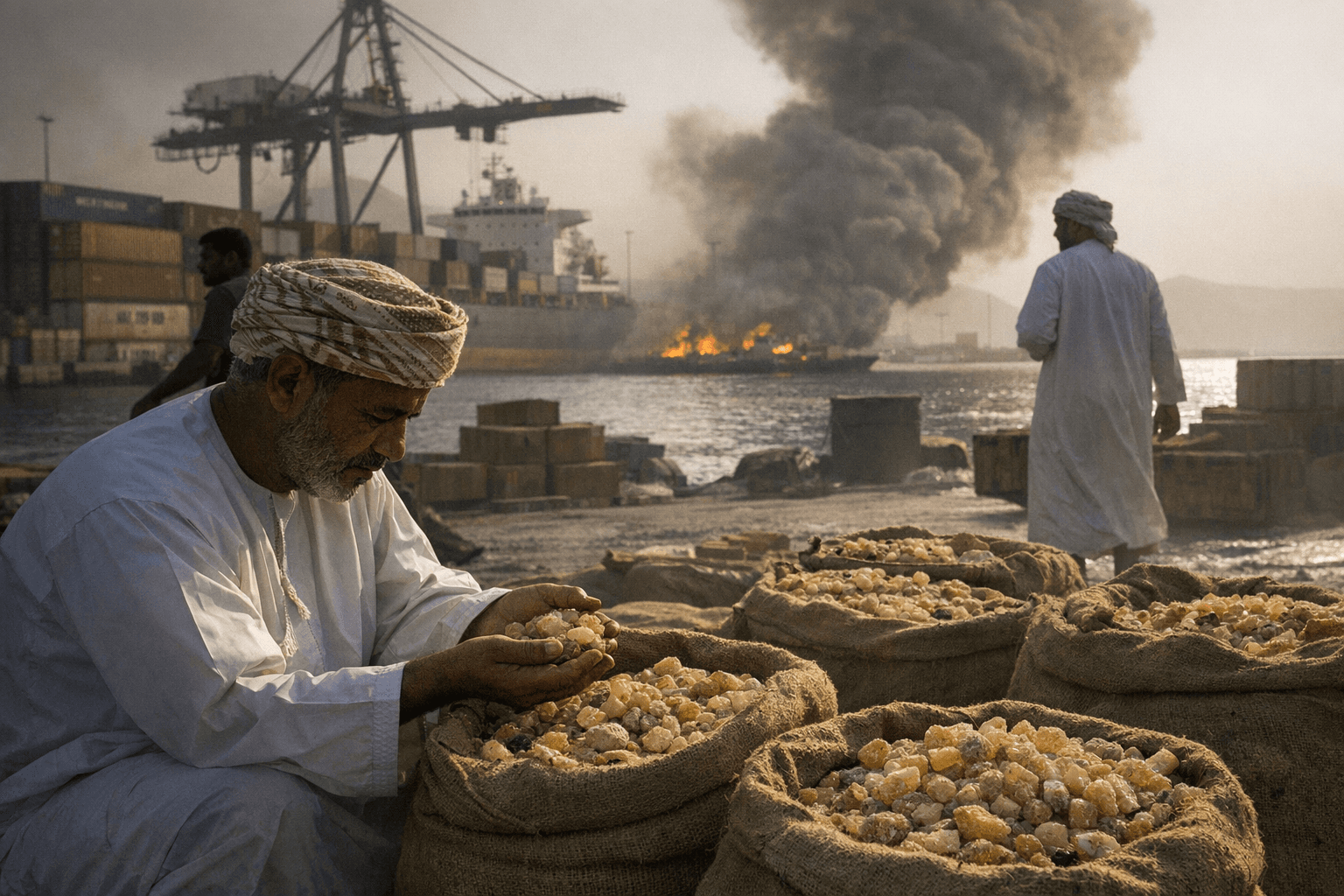
The world has been tracking oil prices and tanker movements since U.S. and Israeli airstrikes on Iran began February 28. Wholesale traders dealing in frankincense, one of the oldest continuously traded commodities on earth, are watching the same chokepoints with equal alarm.
Frankincense production is centered in Oman's Dhofar region, where groves of Boswellia sacra trees in Wadi Dawkah produce what traders consider the gold standard of the resin, and in the Bari and Sanaag highlands of Somalia, where Boswellia carterii provides a lighter, more citrus-forward grade. Those supply points feed a trade network that UNESCO recognized in 2000 as a World Heritage Site, tracing routes from Arabia to Italy, Spain, Britain, France, Holland, and the United States that date unbroken to at least the 10th century BCE.
That network now runs through two threatened maritime chokepoints. The Strait of Hormuz, which in peacetime handles roughly 20 percent of global seaborne oil trade, saw tanker traffic collapse after the war began, dropping 70 percent before falling to near zero as Iran launched 21 confirmed attacks on merchant vessels. On March 11, Salalah port in Oman's Dhofar governorate, the primary export gateway for Omani frankincense, suspended operations after vessels anchored there came under attack. Jebel Ali in Dubai, the Gulf's largest container transshipment hub and a critical relay point in the resin's journey to European buyers, also halted operations following drone strikes.
A wholesale trader captured the bind plainly in the Institute for Supply Management's monthly services survey: "The U.S.-Israel military operations against Iran have created significant uncertainty for our Omani frankincense imports. Threats to close the Strait of Hormuz and rising war-risk surcharges are pressuring regional logistics costs, even for air freight."
Major carriers including Maersk, Hapag-Lloyd, and CMA CGM restricted or halted bookings through the Strait of Hormuz region as of early March. Rerouting around the Cape of Good Hope adds considerable delays to delivery schedules, effectively removing vessel capacity as ships spending additional time at sea cannot service other routes. Oil benchmarks rose roughly 60 percent between the start of hostilities and the end of March, pulling freight costs and war-risk insurance premiums upward across every commodity moving through the Gulf. The fragrance industry, which sources frankincense for luxury perfumes sold primarily in Europe and North America, faces the same compounding logistics costs now burdening agricultural and pharmaceutical shippers throughout the region.
Religious institutions that rely on frankincense for ceremonial rites face the same supply constraints. The resin that clears Dhofar travels to European buyers through a chain of Omani port brokers, transshippers at Jebel Ali, and container lines now rerouted thousands of miles off course. Payments at each node carry sanctions-risk exposure that has tightened further since the war began, adding compliance overhead that smaller traders cannot easily absorb.
Concern is also mounting over another critical maritime chokepoint: the Bab el-Mandeb. If that chokepoint were shut, along with the Strait of Hormuz, a quarter of the world's energy supply would be blocked. Iran-aligned Houthi forces in Yemen already disrupted Red Sea shipping during the 2023-2025 Israel-Hamas conflict, and a top adviser to Iran's leadership has raised the prospect of closing the passage again.
On April 4-6, Iran advanced legislation to impose formal tolls on vessels traversing the Strait of Hormuz while still permitting humanitarian passage and limited ship movements. The draft bill would establish a legal framework recognizing Iran's control of the waterway and charging fees for safe passage. If enacted, that toll structure would create a permanent cost layer on every shipment entering or leaving the Gulf, from supertankers to the small cargo consignments of Boswellia resin that Dhofar harvesters have been sending toward Mediterranean markets since the Phoenicians first established the Incense Route more than three thousand years ago.
Know something we missed? Have a correction or additional information?
Submit a Tip