Iran war drives up UK household costs as families feel budget squeeze
Iran’s war was already showing up in British shopping baskets and fuel tanks, with one family’s hospital trips and rising petrol bills mirroring a wider inflation shock.

Britain’s latest inflation squeeze is not only a numbers story in Westminster. It is landing in the family car, the weekly shop and the household energy bill, as British families told BBC Panorama how the Iran war was reshaping their monthly budgets.
BBC Panorama’s episode, Iran War: The Cost at Home, aired on BBC One at 20:00 on Monday, 27 April 2026. It focused on ordinary spending decisions that have become harder to manage, from fuel for essential journeys to supermarket costs and other day-to-day outgoings. One family, Naomi and Mike Brewer, described how hospital trips had altered their fuel spending, a reminder that geopolitical shocks can quickly become domestic financial strain.
The pressure is building against a still-sticky inflation backdrop. The Office for National Statistics said consumer price inflation in the UK was 3.3% in March 2026, with the release published on 22 April. Petrol prices have also remained elevated: the average UK price stood at 158.7p per litre in March, the highest since November 2023. For families already balancing rent, food and transport, that matters because every refill narrows the margin left for food shopping, childcare and bills.

Economists are warning that the damage could persist well beyond the headlines. The Resolution Foundation estimated that higher energy prices linked to the conflict could leave the median working-age household £480 worse off in 2026 than it would have been without the war. Simon Pittaway of the think tank said the poorest fifth of households could see average income growth slow to 1.2% this year, down from a pre-war forecast of 2.8%. That gap points to a sharper hit for lower-income families, who spend a larger share of their income on essentials and have less room to absorb price shocks.
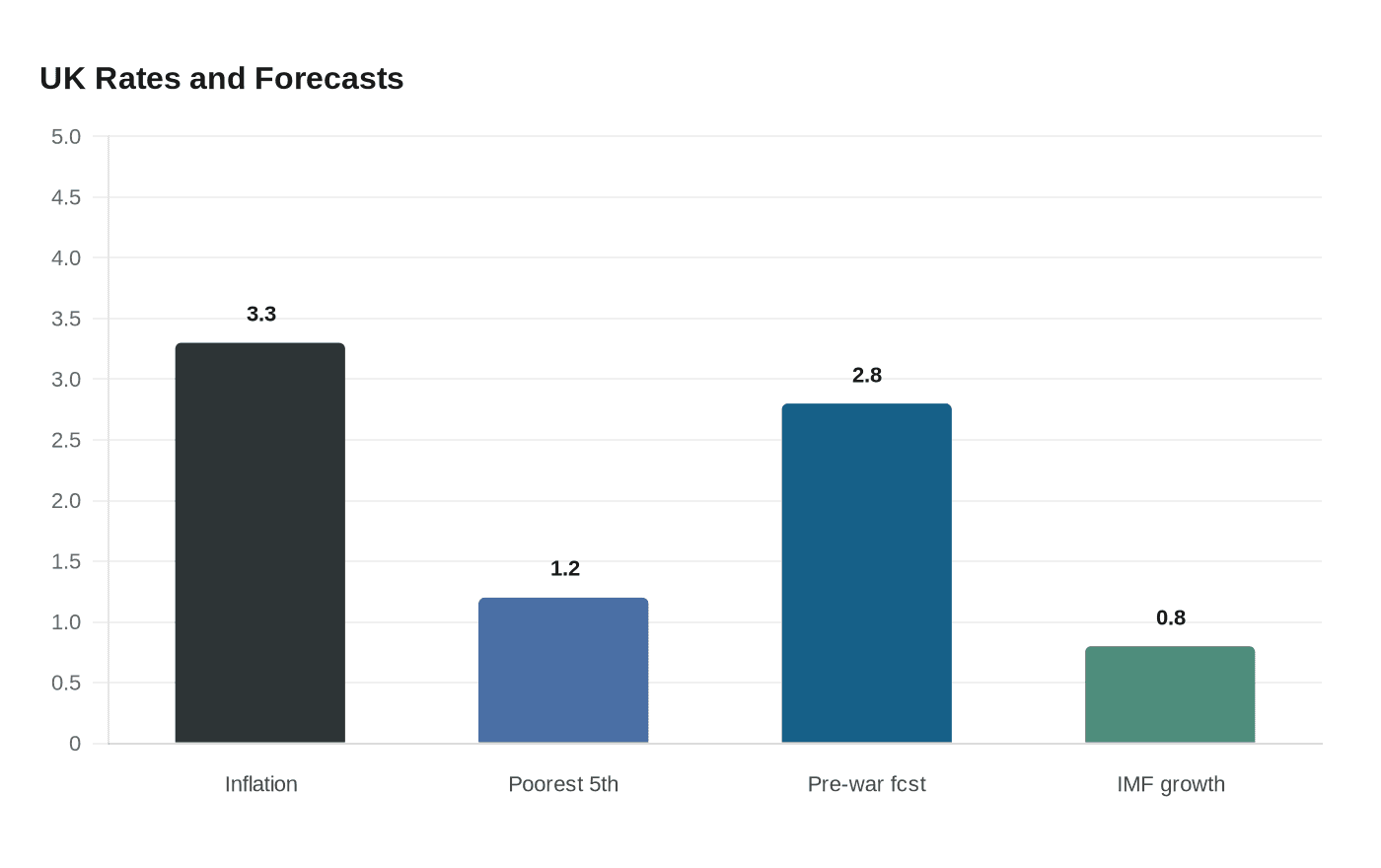
The International Monetary Fund has also warned that the Middle East war is disrupting the global economy through higher commodity prices, firmer inflation expectations and tighter financial conditions. In its April 2026 World Economic Outlook, the fund projected UK growth of just 0.8% this year, one of the sharpest downgrades among advanced economies. IMF chief economist Pierre-Olivier Gourinchas has pointed to the wider spillover from conflict into prices and credit conditions, while Rachel Reeves has said families and businesses are bearing the cost of instability. For households, the war is no longer distant geopolitics. It is the weekly bill coming due.
This article was produced by Prism’s automated news system from verified source data, official records, and press releases, then run through automated quality and moderation checks before publishing. The system is built and supervised by the people who set the standards it runs under. Read our full AI policy.
Did this article answer your question?

