Iranian Missiles Strike Towns Near Israel's Dimona Nuclear Site, Piercing Air Defenses
Ballistic missiles hit Dimona and Arad after interceptors failed, sending over 100 people to emergency care as Israel probes a stunning air-defense breakdown.

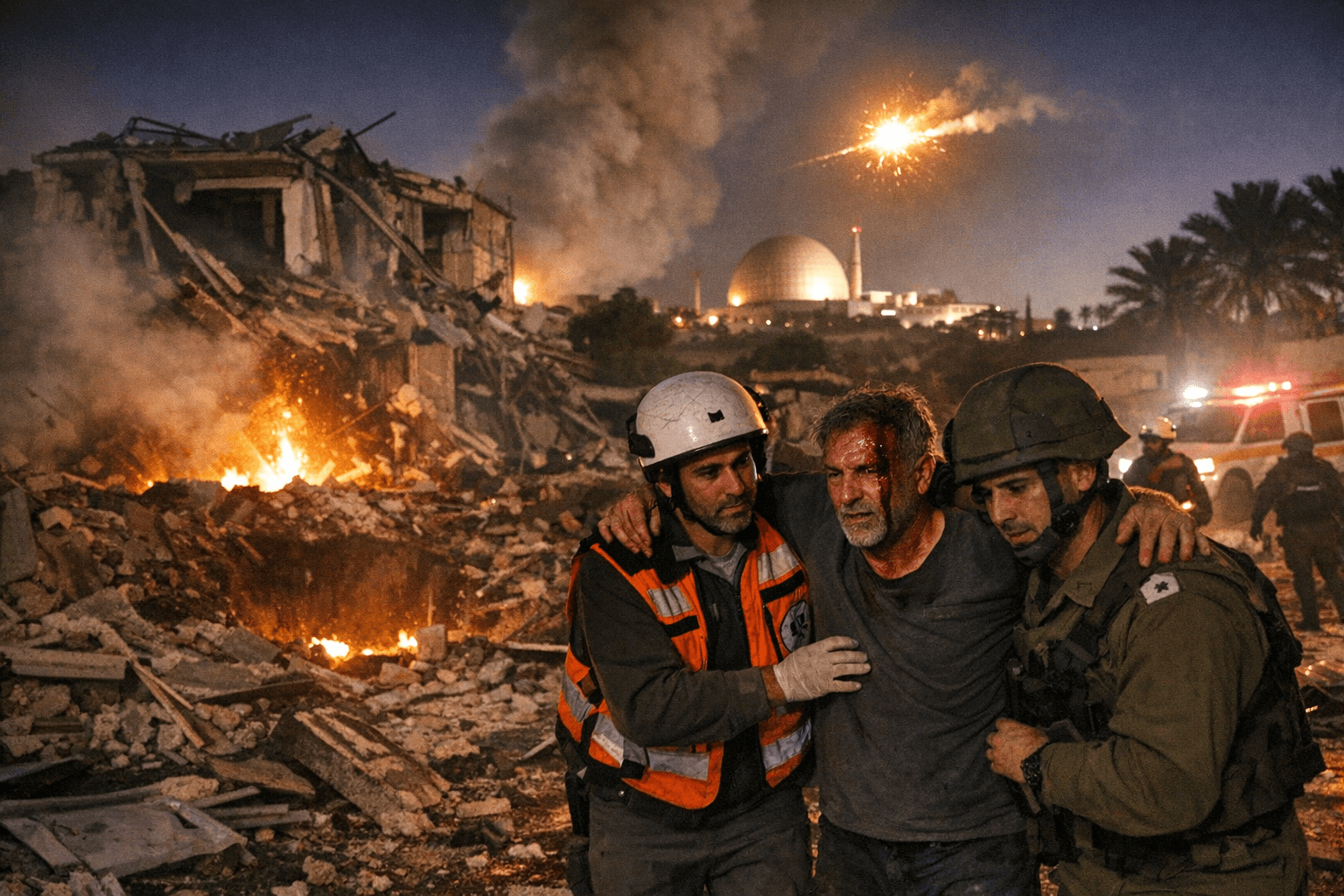
Iranian missiles struck two southern Israeli towns near the country's most sensitive nuclear site on Saturday, wounding more than 100 people and raising urgent questions about the failure of Israel's celebrated air-defense systems to stop the attack.
Iranian state TV said Tehran launched the strikes against Dimona and the nearby town of Arad as a direct response to a reported attack on Iran's Natanz nuclear facility earlier that day. Israel's ambulance service said it was treating 40 people in Dimona, including 37 with mild injuries and a 10-year-old boy in serious condition. In Arad, 68 people were being treated, among them 47 with mild injuries and 10 in serious condition. Other outlets reported higher totals: Firstpost cited at least 84 wounded in Arad and 33 in Dimona, while Al Jazeera reported emergency services were treating at least 70 people in Arad alone. Casualty tallies remained fluid as hospitals continued receiving patients.
Yakir Talkar, an emergency medical technician on the scene in Arad, described the aftermath in stark terms. "This is a very severe scene," he said, adding there were "many wounded with varying degrees of injury."
The strikes exposed a critical gap in Israel's air defenses. Israeli firefighters said interceptors were launched in both Dimona and Arad but failed to neutralize the incoming threats, resulting in two direct hits by ballistic missiles carrying warheads "weighing hundreds of kilograms." The Israeli military confirmed that air-defense systems had been activated but failed to intercept the missiles. Israel is now investigating how the ballistic missiles penetrated what has long been considered one of the world's most sophisticated air-defense networks. Air-raid sirens sounded across the country, and explosions were heard as far away as Jerusalem.
The Shimon Peres Negev Nuclear Research Center, colloquially known as the Dimona reactor, sits approximately eight miles (13 kilometers) outside the town. The facility has long been accepted as housing Israel's undeclared nuclear arsenal, though Israeli governments have officially maintained ambiguity on that question for decades. The International Atomic Energy Agency said it was not aware of any damage to the research center following the strikes. On the earlier Natanz incident that Iran cited as justification, the IAEA separately confirmed "no increase in off-site radiation levels."
IAEA Director General Rafael Grossi called for de-escalation, stating that "maximum military restraint should be observed, in particular in the vicinity of nuclear facilities."
Residential buildings were hit and fires broke out in both towns. Social media posts from Al Jazeera described dozens of buildings destroyed, though that scale of destruction was not independently confirmed in official reporting.
The strikes land at a moment of intense regional volatility. Social posts circulating alongside coverage of the Dimona and Arad attacks referenced a reported US-Israeli air strike on Dezful in Iran's Khuzestan province, though no direct link between that event and Saturday's missile attack has been established in official reporting.
Israel has yet to issue a formal military response. With an air-defense investigation underway, the Dimona attack has shattered assumptions about the reliability of Israeli missile shields against a determined Iranian ballistic strike, a calculation that will now reshape strategic planning across the region.
This article was produced by Prism’s automated news system from verified source data, official records, and press releases, then run through automated quality and moderation checks before publishing. The system is built and supervised by the people who set the standards it runs under. Read our full AI policy.
Did this article answer your question?


