IRENA says solar and wind with batteries can deliver cheap 24/7 power
Solar and wind paired with batteries can now beat new gas on cost in prime regions, forcing planners to rethink what 24/7 power should cost.

The cheap-power debate has shifted from whether wind and solar can compete to whether they can do so around the clock. The International Renewable Energy Agency said on May 6 that solar and wind paired with battery storage can already deliver cost-effective, round-the-clock electricity in the best resource regions, a claim that pushes the energy transition into new territory: firmness as well as price.
In its report, 24/7 renewables: The economics of firm solar and wind, IRENA estimated firm levelized costs for solar-plus-storage at $54 to $82 per megawatt-hour in high-quality regions. That range sits below the agency’s comparison of $70 to $85 per MWh for new coal in China and well under the more than $100 per MWh it cited for new gas globally. IRENA said the battery revolution, along with falling costs for solar photovoltaic systems, wind power and storage, has changed the economics of the power system.
That matters for more than climate targets. IRENA said these hybrid systems can also support artificial intelligence and data centres, which require uninterrupted supply. If utilities and grid operators can secure that reliability with lower-cost renewables and batteries, the pressure rises to retire fossil assets sooner and to redesign market rules around storage, transmission and flexible demand rather than around always-on thermal plants.
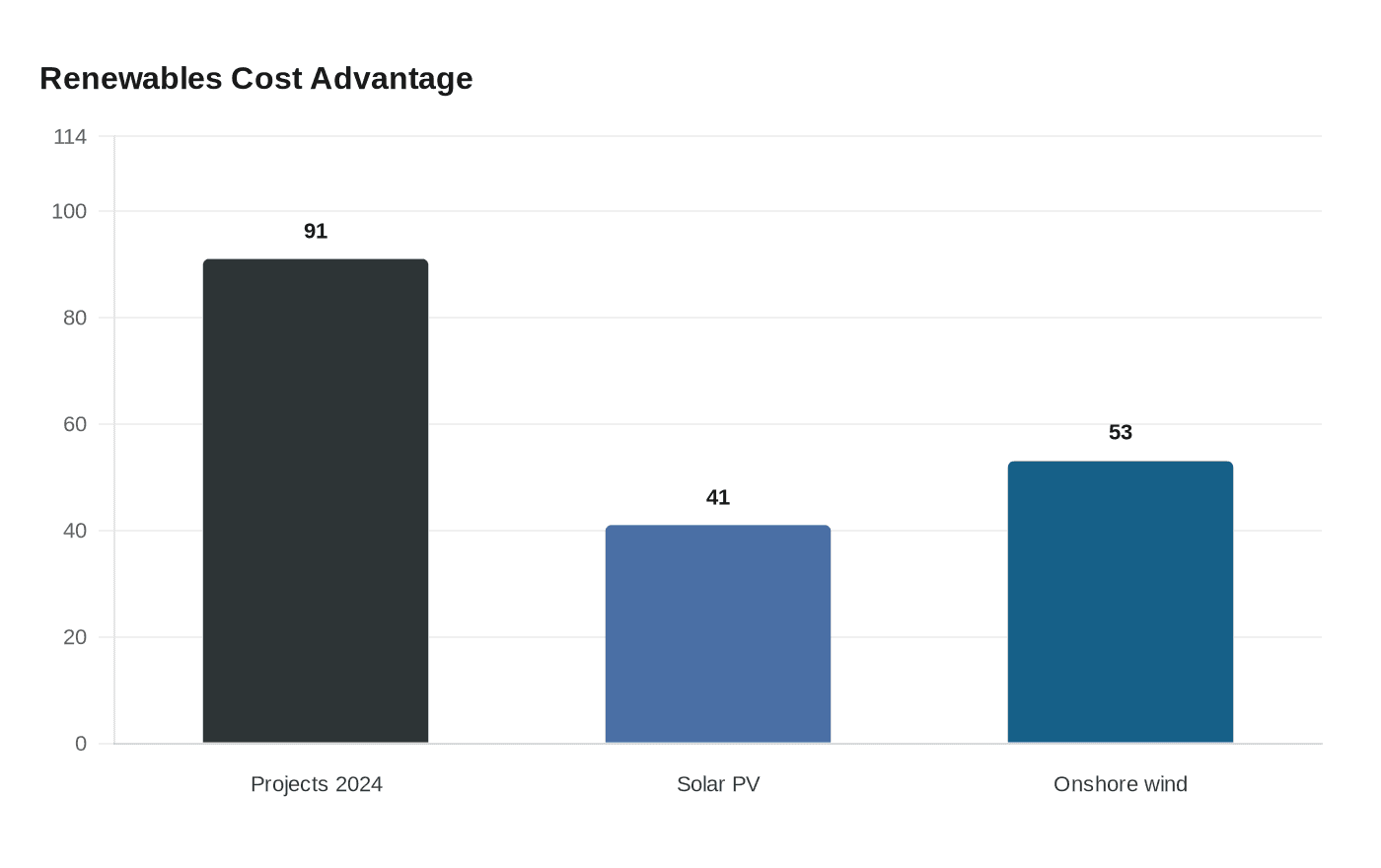
The new report builds on IRENA’s earlier finding that renewable energy is not just getting cheaper, but widening its cost advantage. On July 22, 2025, the agency said 91% of renewable projects commissioned in 2024 were cheaper than fossil-fuel alternatives. It said solar PV was, on average, 41% cheaper than the lowest-cost fossil-fuel option, while onshore wind was 53% cheaper. In 2024, onshore wind remained the cheapest source of new renewable electricity at $0.034 per kilowatt-hour, followed by solar PV at $0.043.
IRENA said 582 gigawatts of renewable capacity were added in 2024, avoiding about $57 billion in fossil-fuel use. Across all operating renewables, the agency said avoided fossil-fuel costs reached up to $467 billion in 2024. But it also warned that grid integration, financing constraints, permitting delays, limited grid capacity and trade and raw-material bottlenecks could slow deployment, especially in capital-constrained markets. Cost pressures are likely to persist more in Europe and North America than in Asia, Africa and South America, making the next policy fight less about whether renewables are competitive and more about how fast systems can be built to make them reliable.
This article was produced by Prism’s automated news system from verified source data, official records, and press releases, then run through automated quality and moderation checks before publishing. The system is built and supervised by the people who set the standards it runs under. Read our full AI policy.
Did this article answer your question?