Israel Claims Killing of Iran's Revolutionary Guards Intelligence Chief
Israel killed IRGC spy chief Maj. Gen. Majid Khademi in a dawn Tehran airstrike, eliminating one of the three most senior surviving commanders in Iran's Revolutionary Guards.

The Israeli Air Force killed Maj. Gen. Majid Khademi, head of intelligence for Iran's Islamic Revolutionary Guard Corps, in a precision strike at dawn Monday in Tehran, a targeted killing that stripped one of the most secretive and consequential security organizations in the Middle East of the officer who ran its spy networks, counterintelligence operations, and domestic surveillance apparatus.
Israel announced that Khademi was killed in a precision strike that also eliminated Quds Force special operations commander Asghar Bagheri. Khademi had been considered one of the three most senior surviving officials in the IRGC. Many top IRGC and Iranian Intelligence Ministry officials were assassinated by the IDF on February 28, and some in the weeks since, but Khademi had managed to evade Israeli attacks.
As intelligence chief of the IRGC, Khademi led one of the most powerful and opaque security bodies in Iran. The organization reports directly to the country's supreme leader and plays a central role in intelligence gathering, counter-espionage, and internal surveillance. Before his appointment, Khademi headed the Guard's Intelligence Protection Organization, charged with internal surveillance and counterintelligence, and held senior roles in Iran's defense ministry. According to the IDF, Khademi was appointed to his position after the assassination of Muhammad Khatami in Operation "Am Kalavi."
The IDF confirmed Khademi's killing, accusing him of helping advance terrorist attacks abroad and overseeing surveillance of Iranian civilians as part of the regime's crackdown on domestic protests. Israeli Defense Minister Israel Katz said Khademi was "directly responsible" for the deaths of Israeli citizens. As part of his role, he worked to gather intelligence to form an intelligence picture for the regime's senior echelons during Operation "Roar of the Harrier."
The IRGC intelligence arm is one of Iran's most powerful security bodies, with a central role in domestic surveillance to counter foreign influence, and often operating in parallel with the civilian intelligence ministry. The organization, designated a terrorist group by the U.S. and several allies, oversees Iran's ballistic missile program, regional proxy militias, and internal security apparatus. Khademi's death leaves a command vacuum at precisely the node where those functions converge, degrading Iran's ability to coordinate intelligence assessments for its leadership at a moment of acute military pressure.
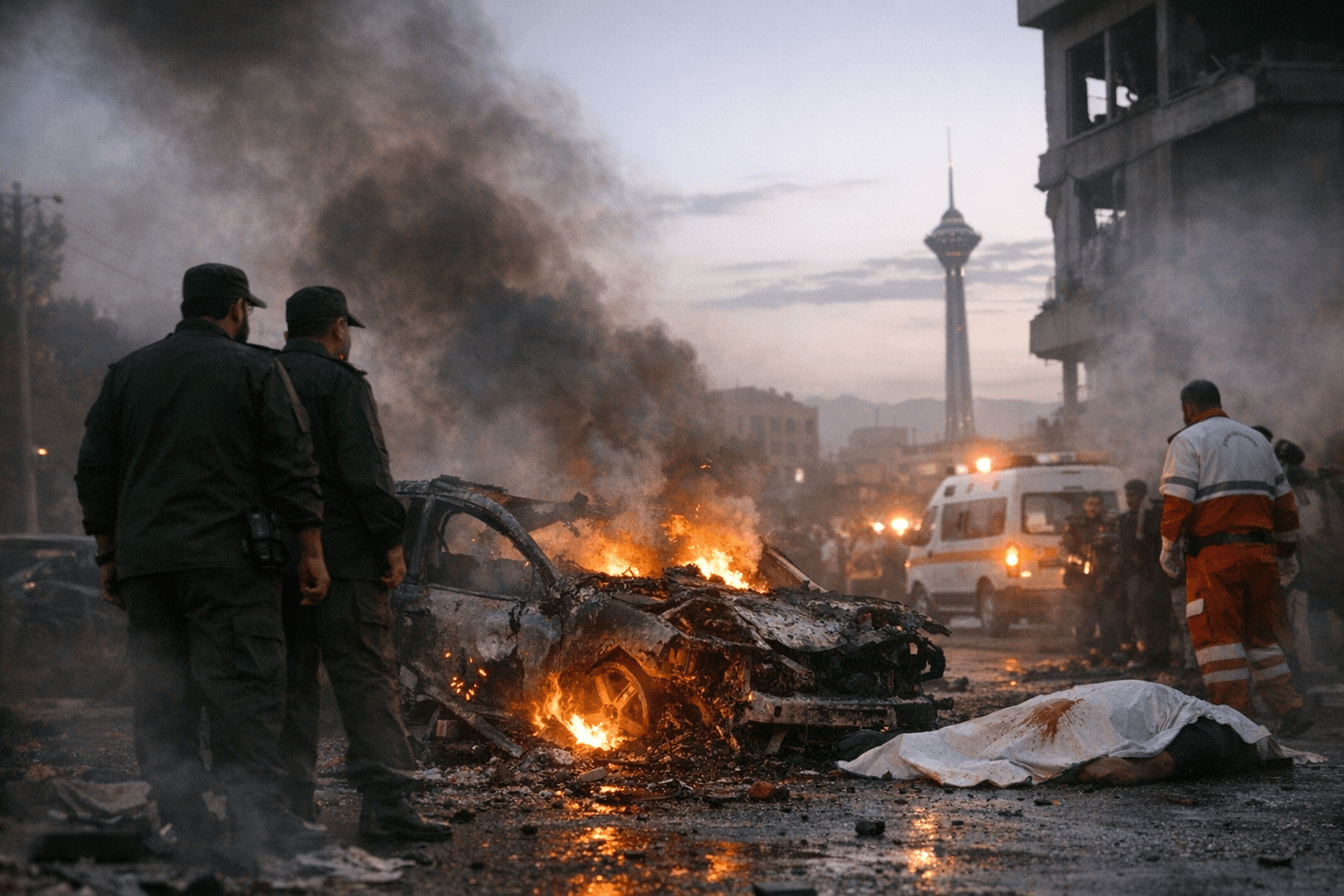
The IRGC, in a statement carried by the IRGC-affiliated Tasnim News Agency, said that Khademi was killed in what it described as a "criminal terrorist attack" carried out by an "American-Zionist enemy." Tehran has responded with missile and drone attacks on Israeli targets, as well as reported strikes on Gulf energy sites and other regional assets. Mediators are reportedly pushing a 45-day ceasefire proposal that includes reopening the Strait of Hormuz, a critical waterway for global oil shipments that Iran has threatened to disrupt.
U.S. President Donald Trump's deadline for Tehran to reopen the Strait of Hormuz loomed as mediators circulated a new ceasefire proposal. Explosions rang out in Tehran and low-flying jets could be heard for hours as the capital was pounded. In a post on his Truth Social platform, Trump threatened further strikes on Iranian energy and transport infrastructure if Iran failed to make a deal and reopen the Strait by Tuesday. Iran answered with a warning of a "more severe and expansive" response if those strikes materialized.
A proposal for a 45-day ceasefire was described as "one of many things being discussed," a senior White House official told NBC News. Trump has not signed off on the idea. An adviser to the president of the United Arab Emirates warned that a deal that failed to rein in Iran's nuclear program and its missiles and drones would pave the way for "a more dangerous, more volatile Middle East."
Khademi's killing represents the most significant structural blow yet to the IRGC's command since the conflict began in late February. With the officer who ran Iran's spy networks now gone and a ceasefire still unsigned, the immediate question is whether Tehran retaliates with the one lever it has not yet fully activated: a full closure of the Strait of Hormuz, through which roughly 20 percent of the world's traded oil passes.
This article was produced by Prism’s automated news system from verified source data, official records, and press releases, then run through automated quality and moderation checks before publishing. The system is built and supervised by the people who set the standards it runs under. Read our full AI policy.
Did this article answer your question?