Israel extends powers to curb foreign broadcasters, critics warn
Israel’s parliament extended a temporary law through Dec. 31, 2027 that gives the communications minister authority to restrict or close foreign broadcasters deemed a threat to state security. Critics say the move widens executive reach, weakens judicial oversight, and could chill independent reporting from Israel to international audiences.

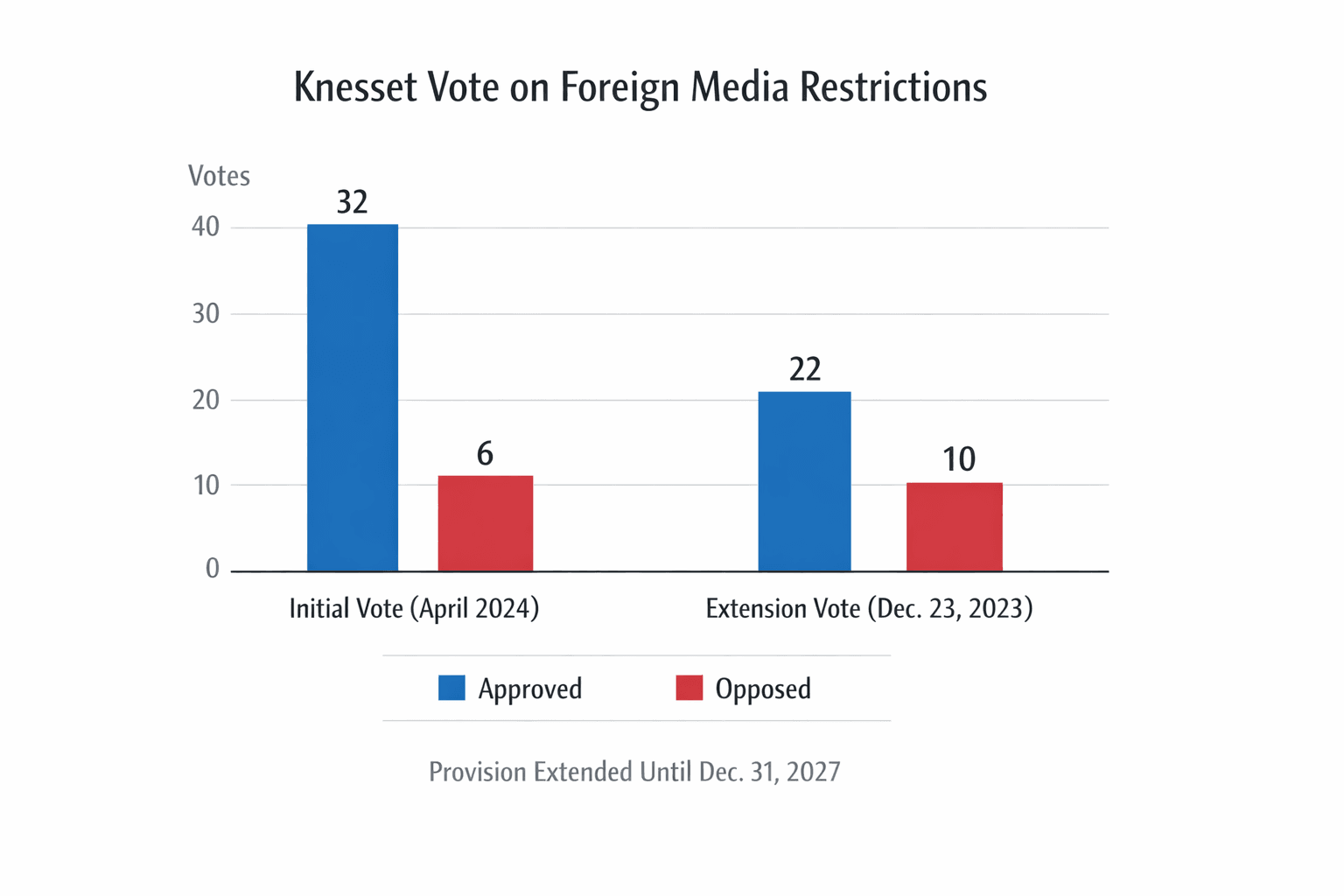
The Knesset late on Dec. 23 approved an extension of a temporary order that empowers the communications minister to restrict or ban foreign media outlets judged to cause “real harm to state security.” The measure, sponsored by Likud lawmaker Ariel Kalner, passed in second and third readings with a recorded vote of 22 in favor and 10 against, keeping the provision in force until Dec. 31, 2027.
The extension replaced wartime emergency legislation first adopted in April 2024 after the Hamas assault on Oct. 7, 2023. That original order was used in May 2024 to shut down the operations of the Qatar based broadcaster Al Jazeera in Israel. Authorities say the law is intended to protect national security, an argument the government has repeatedly framed in public statements. Prime Minister Benjamin Netanyahu wrote on X on April 1, 2024 that Al Jazeera “harmed Israel’s security, actively participated in the October 7 massacre, and incited against Israeli soldiers.”
Under the text reported by multiple outlets, the communications minister may impose restrictions only with the prime minister’s approval and with ratification by either the security cabinet or the full government. The statute also authorizes authorities to order the closure of foreign networks operating in Israel and to confiscate their equipment. The Knesset’s official X account described the amendment as allowing “the restriction of broadcasts by foreign media that harm state security” under a temporary provision valid until Dec. 31, 2027.
Critics have seized on several changes in the revised bill, saying they mark a clear expansion of executive power. Reporting said the amendment included language that reduced or eliminated judicial oversight and allowed restrictions to be applied even when Israel is not under a declared state of emergency. Press freedom groups and opposition outlets warned that such powers could be used broadly to target critical foreign media and to limit independent reporting from inside Israel and the occupied territories.
Legal and diplomatic implications are already drawing attention beyond Israel’s borders. The extension could complicate relations with countries whose broadcasters operate regionally, notably Qatar where Al Jazeera is based, and with states that regard press freedom as a core value. International human rights law requires that any curtailment of freedom of expression meet tests of legality, necessity and proportionality. Observers say measures that remove judicial review risk failing those tests and invite legal challenges at home and scrutiny abroad.
Parliamentary supporters argued the law is time limited and tailored to address a specific security threat as defined by the government. Opponents countered that the formal end of the state of emergency on Dec. 1, 2025 made retention of these powers unnecessary and disturbing. The extension is explicitly temporary, but its continuation through 2027 leaves room for further parliamentary debate or legal battles. For journalists, diplomats and regional audiences, the measure reshapes the operating environment for foreign media in Israel and raises broader questions about balancing security and free expression in a polarized and volatile region.
This article was produced by Prism’s automated news system from verified source data, official records, and press releases, then run through automated quality and moderation checks before publishing. The system is built and supervised by the people who set the standards it runs under. Read our full AI policy.
Did this article answer your question?