Italy Blocks U.S. Military Aircraft From Using Sigonella Base for Iran Operations
Italy's defence minister blocked U.S. bombers mid-flight from landing at Sigonella, Sicily, citing a failure to seek prior authorization for Iran-linked operations.
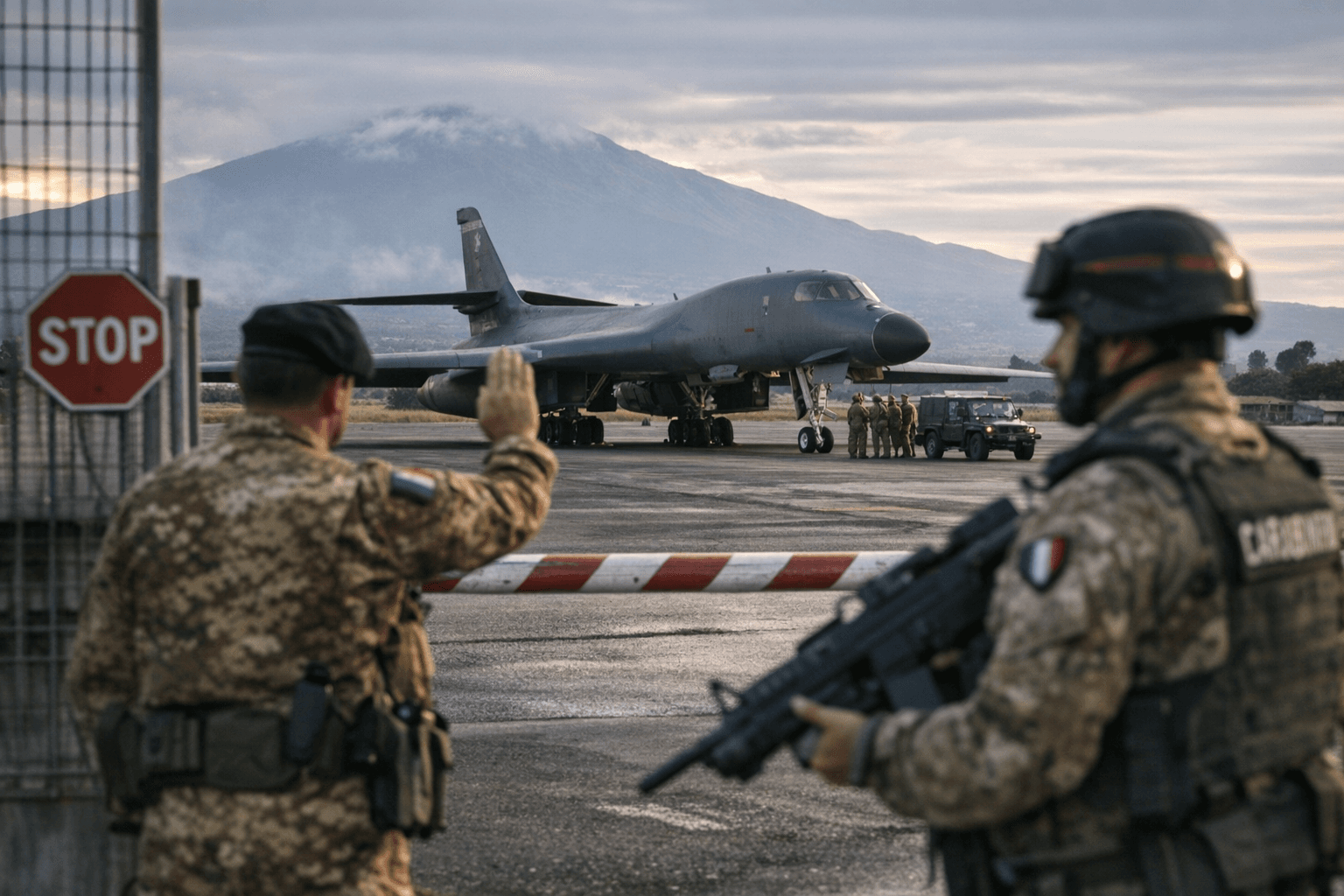
The aircraft were already airborne when Italy said no.
Several U.S. bombers had filed flight plans that included a stopover at Naval Air Station Sigonella in eastern Sicily, intending to refuel and continue toward the Middle East as part of the ongoing U.S.-Israel military campaign against Iran. The plans were submitted to Italian authorities while the aircraft were in the air, not before departure, and no prior consultation with Italian military command had taken place. Italy's chief of defence staff, General Luciano Portolano, learned of the inbound flight plans through the air force's general staff. He notified Defence Minister Guido Crosetto. Crosetto's directive was unambiguous: the aircraft would not be permitted to land.
The decision, first reported by Corriere della Sera and confirmed by ANSA on March 31, removed from U.S. operational planners one of the most consequential logistics nodes in the entire Mediterranean theater. Sigonella, a dual-runway installation near Catania, serves as the premier refueling and staging hub for U.S. and NATO forces operating between Europe, Africa, and the Middle East, hosting roughly 7,000 personnel and capable of supporting aircraft of all classifications. For bombers flying toward the Persian Gulf corridor, a Sigonella stopover represents not just a fuel margin but a scheduling buffer that compresses transit time and reduces crew fatigue over long-haul sorties. Without it, routes extend, fuel loads increase, and operational windows tighten.
Crosetto grounded the denial in treaty obligations that Washington had bypassed. Under the bilateral agreements governing Italian military facilities, any use of those bases for operations that could draw Italy into armed hostilities requires advance consultation with Rome and, depending on the scope, approval from the Italian parliament. Italian government sources stressed that the authorization requests never flowed through the required channels: no formal consultation had been sought before the aircraft were already en route.
The refusal carries a sharp domestic dimension as well. Opposition Democratic Party leader Elly Schlein publicly backed the denial, describing it as a defense of Italian sovereignty, a striking convergence between a center-right government and its left-wing opposition. Some pro-government commentators echoed that framing. Palazzo Chigi, the prime minister's office, struck a more institutional tone, reiterating procedural requirements without directly endorsing Crosetto's posture as confrontational. That careful calibration reflects the political tightrope Rome is walking: asserting legal authority without triggering a diplomatic rupture with Washington at a moment of already significant transatlantic strain.
Italy's move did not occur in isolation. Spain confirmed it was blocking all U.S. military aircraft involved in the Iran conflict from its airspace, and President Donald Trump publicly accused France of refusing overflight clearance to aircraft carrying military supplies to Israel. Together, the three European decisions constitute an emerging pattern of allied resistance to being used as logistical infrastructure for a conflict they were not consulted on and do not wish to be seen endorsing.
For U.S. planners, the practical consequences are real and compounding. Without refueling stops in southern Europe, bombers operating out of bases in the continental United States or the United Kingdom face significantly longer routes to the Middle East, increasing both operational cost and the complexity of sustained sortie rates. Alternative stopover options, including Diego Garcia in the Indian Ocean or carrier-based refueling, exist but add transit time and reduce flexibility.
Crosetto's directive, relayed to aircraft already in the air over the Mediterranean, is the clearest signal yet that NATO's operational unity over the Iran conflict is fracturing along the fault line between American military momentum and European legal and political constraint.
This article was produced by Prism’s automated news system from verified source data, official records, and press releases, then run through automated quality and moderation checks before publishing. The system is built and supervised by the people who set the standards it runs under. Read our full AI policy.
Did this article answer your question?