Italy trims 2026 growth forecast as economy remains stuck in low gear
Italy cut its 2026 growth view to 0.7% as energy shocks and policy uncertainty drag on Europe’s third-largest economy.
Italy’s latest growth downgrade is another warning flare for Europe’s slow-growth trap. ISTAT now expects the economy to expand 0.7% in 2026, after 0.5% growth in 2025, while the government of Prime Minister Giorgia Meloni has already trimmed its own target to 0.6% for 2026 and 2027 amid surging energy prices and Middle East tensions.
The numbers show an economy that is still moving, but barely. ISTAT said growth in both 2026 and 2027 would be driven entirely by domestic demand net of inventories, with household and business spending adding 0.9 percentage points to growth in 2026 and 0.5 points in 2027. Even after a stronger-than-expected first quarter, when GDP rose 0.3% from the previous three months, the outlook points to a country stuck well below the pace needed to lift living standards in a meaningful way.

Italy’s revised forecast is only slightly more optimistic than the European Commission’s, which on May 21 projected 0.5% growth in 2026, the same as in 2025, supported by Recovery and Resilience Plan investment. The International Monetary Fund, the OECD and the Bank of Italy are clustered in the same low range, around 0.5% to 0.6%. That convergence matters because it suggests Italy’s weakness is not a one-off misfire, but part of a wider euro area pattern of subdued demand, high uncertainty and limited room for policy to deliver a faster rebound.
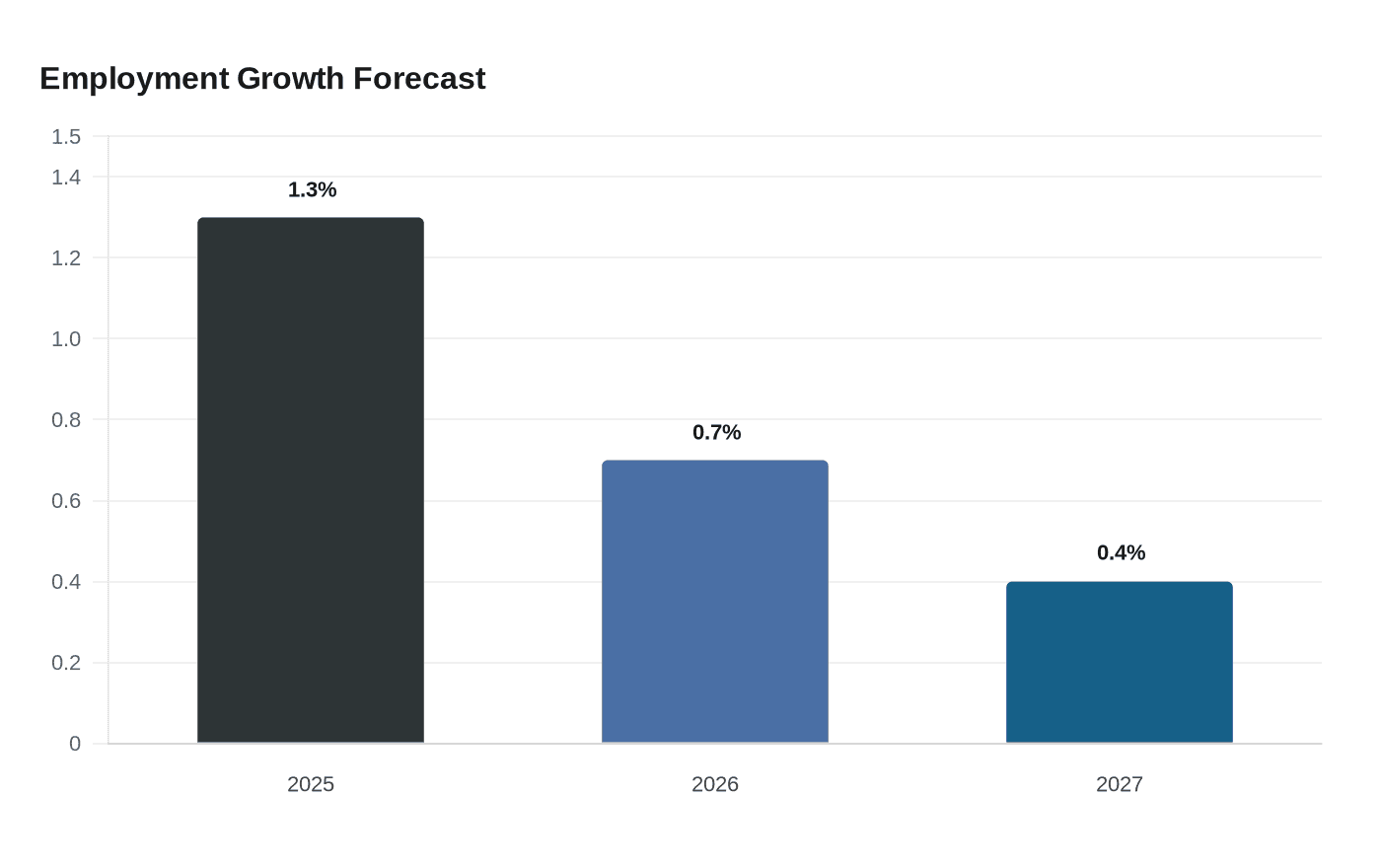
The labor market offers some cushion, but not a breakout. ISTAT expects employment, measured in labor units, to slow to 0.7% growth in 2026 from 1.3% in 2025, then ease further to 0.4% in 2027. Unemployment is projected to average 5.5% in both 2026 and 2027, an improvement from ISTAT’s December estimate of 6.1%, but still consistent with an economy that is adding jobs more slowly than it needs to.
For Rome, the problem is fiscal as much as statistical. Italy’s debt burden leaves little margin for disappointment, and growth near 0.5% to 0.7% does not generate much extra revenue or relieve pressure on public finances. For Europe, the message is broader: renewed energy shocks and geopolitical uncertainty are still enough to cap demand in one of the bloc’s biggest economies. For U.S. companies with exposure to the region, that means a weaker sales backdrop, more cautious customers and a market where stability is not the same as momentum.
This article was produced by Prism’s automated news system from verified source data, official records, and press releases, then run through automated quality and moderation checks before publishing. The system is built and supervised by the people who set the standards it runs under. Read our full AI policy.
Did this article answer your question?

%3Amax_bytes(150000)%3Astrip_icc()%2FCertificate-of-deposit-2301f2164ceb4e91b100cb92aa6f868a.jpg&w=1920&q=75)
