James Webb finds salty clouds on the Pink Planet GJ504b
Webb’s first spectrum of GJ504b revealed salty clouds in one of the coldest directly imaged worlds ever studied, a major step for faint exoplanet atmospheres.
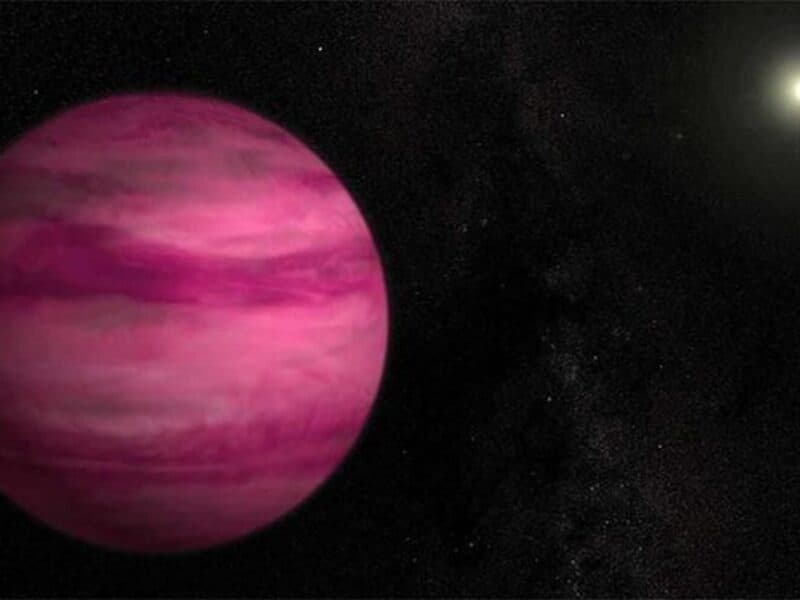
James Webb Space Telescope observations have revealed salty clouds in the atmosphere of GJ504b, the so-called Pink Planet, a faint object 57 light-years from Earth that sits near the boundary between giant planets and brown dwarfs. The finding gives astronomers their first successful spectrum of the cold world and opens a sharper view of an object long known to be too dim for detailed study from the ground.
GJ504b was discovered in 2013 and is technically classified as a planetary-mass companion rather than a planet. It orbits a sun-like star and carries an estimated mass of roughly 25 times Jupiter’s mass, placing it in the gray area between massive planets and brown dwarfs. Scientists describe it as one of the coldest directly imaged planetary-mass companions ever studied, which is exactly why it had resisted earlier attempts at spectroscopy.

The new work changed that. Using JWST’s NIRSpec instrument, researchers obtained the first successful spectrum of GJ504b, a major advance for examining cold, dim worlds that remain beyond the reach of most ground-based telescopes. When the team added clouds to its atmospheric model, unusual spectral features disappeared, pointing to salt clouds that likely obscure deeper layers of the atmosphere.
That result matters because salt clouds had been theorized more than 15 years ago, but direct evidence had been elusive. The observations now provide some of the first direct support for that idea in a cold object’s atmosphere, strengthening the case that cloud chemistry on distant worlds can be more complex than simple models predict.
The study brings together scientists including Amanda Morris, Marshall Perrin, Aneesh Baburaj, and Jean-Baptiste Ruffio, with ties to Northwestern University, the University of California, San Diego, NASA, and the Space Telescope Science Institute. Their work underscores how Webb is extending planetary science into territory that was previously out of reach, especially for objects that are faint, cold, and difficult to isolate from their host stars.
GJ504b remains an unusual target, but its new spectrum gives astronomers a clearer look at how atmospheres behave on the fuzzy frontier between planets and brown dwarfs. In that frontier, the Pink Planet is now offering one of the clearest signs yet that salt clouds can dominate the view.
This article was produced by Prism’s automated news system from verified source data, official records, and press releases, then run through automated quality and moderation checks before publishing. The system is built and supervised by the people who set the standards it runs under. Read our full AI policy.
Know something we missed? Have a correction or additional information?
Submit a Tip