OpenAI says AI chemist improved a difficult medicinal chemistry reaction
An AI chemist ran 10,080 tests on a stubborn Chan-Lam reaction, lifting mean yield from 16.6% to 25.2%. Human chemists then confirmed the gain at bench scale.
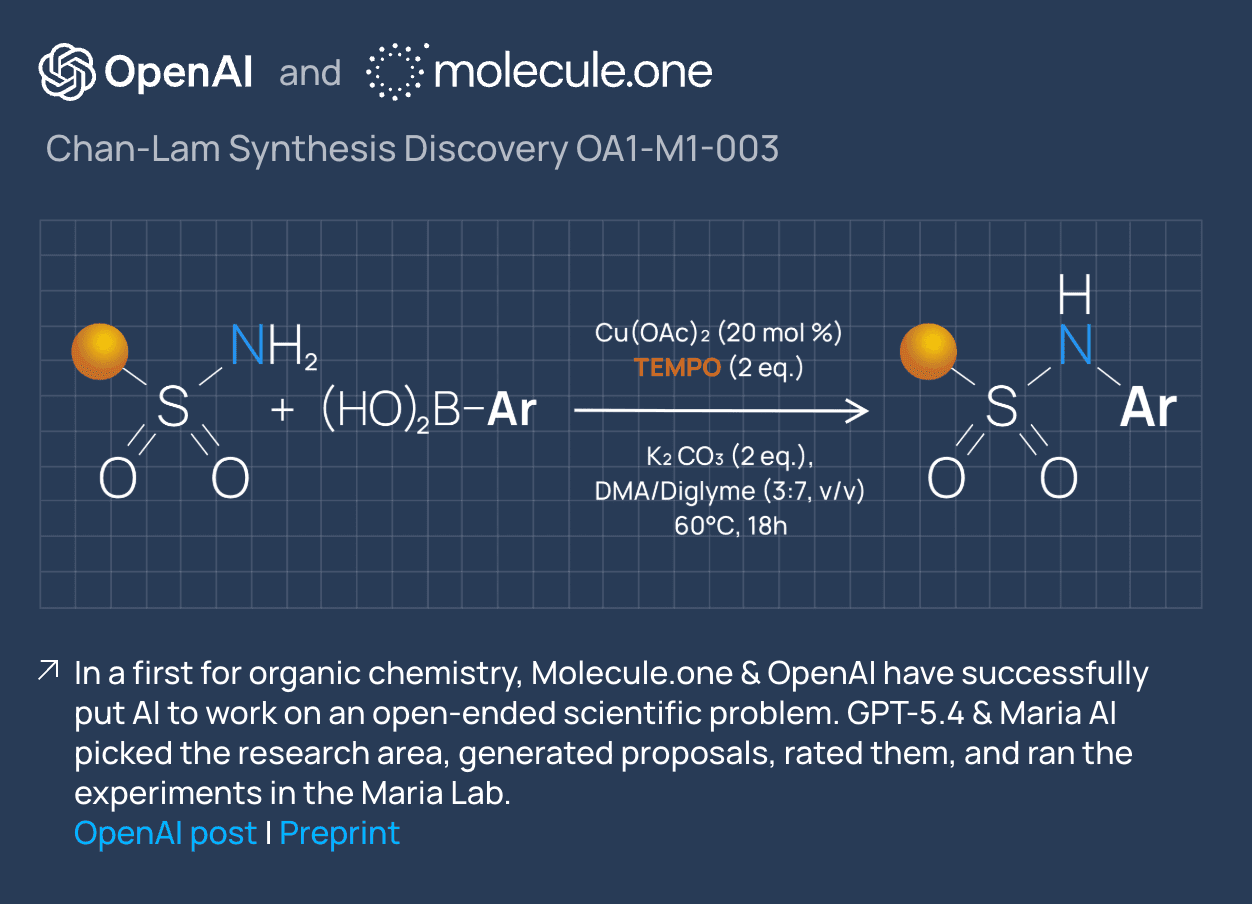
OpenAI said an AI chemist improved a difficult medicinal chemistry reaction by pushing a stubborn Chan-Lam coupling past a long-standing yield barrier, then holding up under human validation. Across two microscale screening campaigns totaling 10,080 reactions, the system raised mean estimated product yield from 16.6% to 25.2% and increased the share of reactions above 30% yield from 15.6% to 37.5%.
The work paired GPT-5.4 with Maria, Molecule.one’s agentic chemistry system connected to a high-throughput laboratory in Maria Lab. OpenAI said the system did more than suggest ideas: it generated research proposals, designed and ran experiments, analyzed the data and proposed follow-up tests. Human chemists remained in the loop, steering the project, choosing among proposals and validating the final result at the bench.
The reaction chosen for the demo was a challenging version of Chan-Lam coupling, a carbon-heteroatom bond-forming method that is useful in medicinal chemistry but notoriously sensitive to substrate choice. The specific target was direct N-arylation of primary sulfonamides, which the paper described as a difficult disconnection because these compounds are low in nucleophilicity and the reaction can be prone to over-arylation and boronic-acid degradation. OpenAI said the system identified primary sulfonamides as a high-value but difficult substrate class and suggested mild oxidants such as TEMPO as a path to better performance.
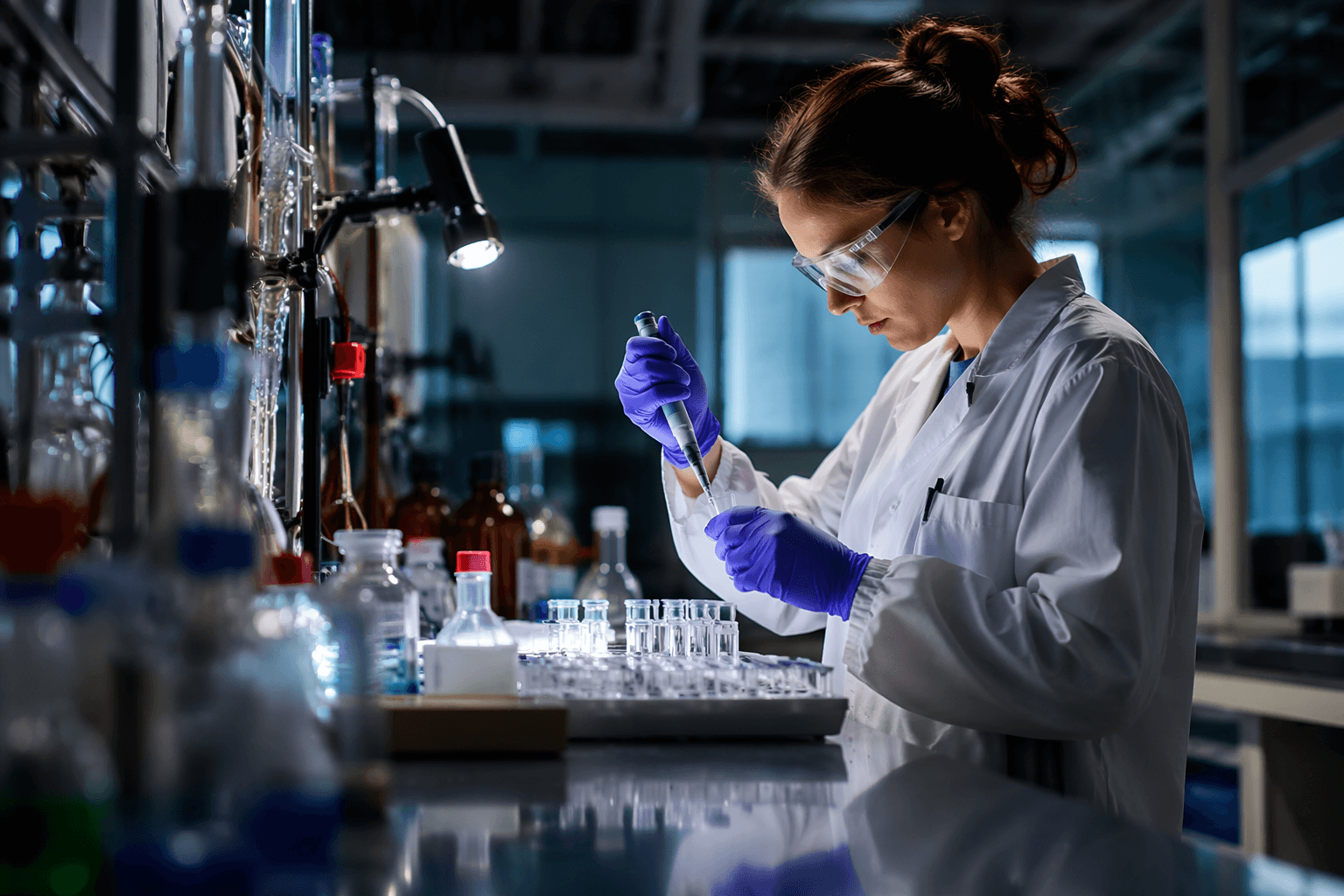
That hunch paid off in the screen. The optimized condition used 2 equivalents of TEMPO and 20 mol% Cu(OAc)2, while 4-hydroxy-TEMPO performed similarly and may offer a lower-cost, easier-to-remove alternative. The paper said yields improved for 88% of the boronic acids and 83% of the sulfonamides tested. When human chemists repeated representative reactions at bench scale, they confirmed higher yields for 11 of 14 substrate pairs, with most showing more than a twofold increase.
The result matters because medicinal chemistry still depends on reactions that work reliably across many substrates, not just in carefully chosen examples. OpenAI has argued in earlier science-focused writing that even when the right idea exists, moving from concept to tested result can take years. This collaboration was aimed at that bottleneck: turning model-generated hypotheses into actual chemistry, then checking whether the chemistry survived outside the screening plate.
The joint paper listed a long author team spanning OpenAI and Molecule.one, including Jan Rzymkowski, Shuyuan Zhang, Artur Chołuj, Aleksander Szkółka, Mateja Dud, Mateusz Bruno-Kamiński, Jan Busz and Michał Sadowski. For OpenAI and Molecule.one, the claim was not that AI replaced chemists, but that it narrowed the gap between proposing a reaction and proving one in the lab.
This article was produced by Prism’s automated news system from verified source data, official records, and press releases, then run through automated quality and moderation checks before publishing. The system is built and supervised by the people who set the standards it runs under. Read our full AI policy.
Know something we missed? Have a correction or additional information?
Submit a Tip