Japan Airlines tests humanoid robots for baggage and aircraft cleaning
Japan Airlines is testing humanoid robots at Haneda to load baggage containers and clean aircraft, a sign airports are trying to offset a shrinking labor pool.
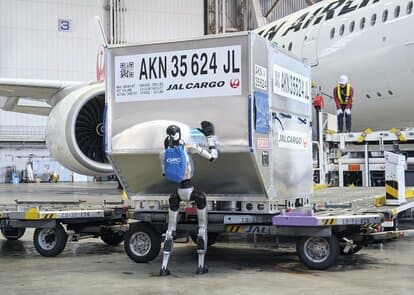
Japan Airlines has launched a two-year trial to see whether humanoid robots can take on some of the hardest work on the airport ramp, starting with loading and unloading baggage containers at Tokyo Haneda Airport. The experiment, announced on April 27, 2026, is set to begin in May and will run in phases through 2028 under JAL Ground Service Co., Ltd. and GMO AI & Robotics Trading Co., Ltd.
The airline says the first focus is cargo handling, but the longer-term plan reaches deeper into the jobs that keep flights moving on time. Future uses could include aircraft cabin cleaning and operating ground support equipment around planes. JAL says the goal is to reduce labor and workload in ground handling without major changes to airport facilities or aircraft structures, a crucial test in an industry where physical work still depends on people working in tight spaces around aircraft.
That constraint is exactly why JAL is betting on humanoids rather than fixed automation. Fixed systems and single-purpose robots have struggled to adapt to the narrow gaps, shifting equipment and varied tasks that define ramp operations. JAL Ground Service says its staff work in limited spaces around aircraft and rely heavily on manual labor, making the ground side of aviation far less automated than passengers might assume when they move through polished terminals and self-service kiosks.
The pressure to find a new model is rising across Japan’s aviation sector. Inbound tourism is climbing while the working-age population is shrinking, leaving airlines and airports with fewer people to do physically demanding work. JAL employs about 4,000 ground handling workers, and the company is treating this trial as a test of whether robotics can ease that burden while preserving safety oversight in human hands, as JAL Ground Service president Yoshiteru Suzuki has indicated.
A media demonstration showed a 130-centimeter-tall humanoid robot made by Unitree Robotics, the Hangzhou-based company, pushing cargo onto a conveyor belt and waving. The choice of a human-shaped machine is not cosmetic. JAL and GMO AI & Robotics said the form factor could let robots work inside existing airport layouts with minimal modification, which matters in an industry where infrastructure is expensive, space is constrained and aircraft turnaround time is unforgiving.
Haneda, one of Tokyo’s busiest airports, handles more than 60 million passengers a year, so even modest gains in baggage flow or ramp efficiency could ripple through the system. The project is the first demonstration experiment of its kind at airports in Japan, and it signals a wider question facing aging-workforce economies: whether the next wave of automation will be built not to replace airports, but to keep them running when labor can no longer stretch as far as demand does.
This article was produced by Prism’s automated news system from verified source data, official records, and press releases, then run through automated quality and moderation checks before publishing. The system is built and supervised by the people who set the standards it runs under. Read our full AI policy.
Did this article answer your question?


