Jeep's Newest Trail Concepts Tackle Moab's Toughest Rocks With Impressive Poise
Six Jeep concepts tackled Moab's ledges and slickrock with a mechanical-plus-digital formula that looks closer to production reality than any Easter Safari lineup in recent memory.
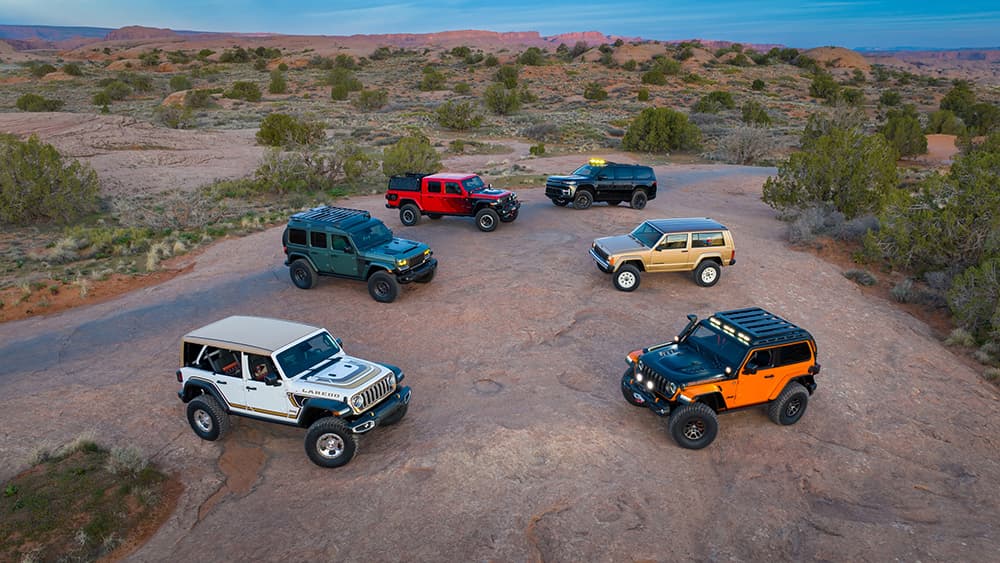
Six concepts, one desert proving ground, and a clear signal about where Jeep is taking its most capable vehicles. At the 60th anniversary Easter Jeep Safari in Moab, Utah, running March 28 through April 5, 2026, Jeep rolled out its most ambitious concept lineup in years: three Wranglers, a Grand Wagoneer, a Gladiator, and a 1984 Cherokee restomod. Together they covered virtually every corner of the brand's market, from stripped-down manual-transmission crawlers to luxury-trimmed SUVs. The common thread running through all of them was a commitment to real, quantifiable capability tested against Moab's least forgiving terrain.
Six Concepts, Six Distinct Missions
The headliner is the Wrangler Anvil 715, an overland-focused build on a 2026 Wrangler Unlimited Rubicon 392. Its 6.4-liter V8 produces 470 horsepower and 470 pound-feet of torque, and the exterior ditches the standard grille for a throwback design inspired by the SJ Kaiser M715 military pickup, complete with square headlights and branch deflectors running from hood to windshield. A fixed roof with integrated safari windows and roof rack, 37-inch tires, steel bumpers front and rear, and an onboard air system for rapid tire pressure changes round out a build described as "capable, intentional and thoughtfully engineered without unnecessary bulk."
The Wrangler Buzzcut takes the opposite aesthetic approach, painting a two-door shell in Hemi Orange and lowering the roofline by two inches compared to a stock Wrangler. A 2-inch suspension lift, 37-inch tires on 17-inch beadlock wheels, a front-bumper winch, snorkel, and a full rear-seat delete signal a vehicle built for technical rock work rather than multi-day touring. The Wrangler Laredo, meanwhile, returns to mechanical basics: a Willys-based four-door running the 3.6-liter V6 with 285 horsepower, a six-speed manual transmission, a 2-inch JPP suspension lift, and 37-inch BFGoodrich KM3s on 17-inch vintage-inspired wheels, paired with a quick-disconnect sway bar. It is a deliberate tribute to the first Jeep to carry the Laredo nameplate.
On the truck side, the Red Rock Gladiator was purpose-built as a special project for the Red Rock 4-Wheelers Club, the volunteer organization that maintains and cleans Moab-area trails. It runs a 3-inch lift kit, 17-inch beadlock wheels, 37-inch tires, and a Warn winch, with the bed fitted out with a Bedslide cargo tray, Leitner Designs cargo rack, and GearPod storage. The Grand Wagoneer Commander concept reimagines Jeep's flagship full-sizer as a capable trail-support platform: Rock Krawler reworked the suspension and tuned it for off-pavement use, 35-inch tires wrap 20-inch wheels, and custom skid plates protect the undercarriage, while the interior retains its premium materials and finish in full. Rounding out the lineup, the XJ Pioneer restomod breathes new life into a 1984 Cherokee with a 2-inch suspension lift, 33-inch BFGoodrich tires on 17-inch vintage mag-inspired wheels, redesigned wheel arches, and the original 2.8-liter V6 under the hood.
What the Rock Proved
On Moab's ledges and slickrock, the concepts delivered what the research describes as impressive poise. Long-travel suspension geometry kept tires planted over extreme obstacles, a prerequisite on terrain where even brief wheel lift can strand a vehicle sideways on a ledge. Aggressive low-range gearing allowed precise throttle modulation at near-walking speeds, reducing the need for repeated brake interventions that can overheat rotors and fade pad performance on sustained descents. Underbody skid plates, prominent on both the Anvil 715 and the Commander concept, prevented damage on the sharp granite edges that punish under-protected vehicles.
The integration of drive-by-wire throttle mapping with hill-descent control drew particular notice from reviewers. Rather than relying on a driver to feather a pedal manually, the system delivers repeatable, low-speed crawling that largely removes brake-fade risk on stepped descents. The mix of analog hardware, solid axles and locking differentials carried over from Jeep's proven production lineup, combined with digital overlays including torque vectoring and terrain response programming, proved complementary rather than redundant. Electronic aids stepped in where mechanical traction alone would reach its limits, and retreated when momentum and geometry were sufficient.
Where the Limits Showed
Not everything was without friction. Reviewers flagged potential curb weight and packaging tradeoffs as consequential concerns. Heavier builds compress approach and departure angles; a vehicle that gains protection from steel bumpers and a fixed roof simultaneously sacrifices the geometry that lets it crest steep ledges cleanly. In loose terrain such as deep sand or mud, that extra mass compounds recovery difficulty, since a stuck vehicle with complex underbody hardware resists simple high-lift jack positioning. These are not hypothetical concerns: they are the practical cost of adding electronics, structural reinforcement, and comfort features to trail-focused designs, and they will require tradeoffs before any of these concepts reach a dealer lot.
The Analog-Digital Balance and What It Means for Production
The broader design argument Jeep is making with this lineup is that hardcore capability and accessible electronics are not mutually exclusive. The Laredo's manual transmission and quick-disconnect sway bar represent the purist end of that argument; the Commander concept's Rock Krawler suspension tune inside a $90,000-plus luxury SUV represents the other. What sits in between, and what will actually reach production, is the critical question. Notably, none of the 2026 lineup included electric or experimental powertrains, a deliberate departure from recent years. Jeep's own press language described these concepts as vehicles that "preview" the models the brand intends to build, language that carries more specificity than the typical concept-car disclaimer.
Concept vehicles routinely shed features in translation from Moab to the factory. Unique fabrications, one-off supplier parts, and prototype electronics often prove too expensive or complex to certify for consumer sale. The Anvil 715's fixed custom roof, for instance, removes a core Wrangler identity feature. The Buzzcut's lowered roofline may have structural implications that complicate pedestrian safety certification. What is more likely to survive is the software architecture: drive-by-wire calibration, hill-descent tuning, and terrain response programming are the kind of scalable investments that transfer across model lines without adding meaningful per-unit cost.
The Stakes for Buyers Watching the Pipeline
For anyone actively shopping trail-focused SUVs, the 2026 Easter Safari concepts represent the clearest evidence yet that Jeep intends to hold its position at the top of the factory off-road hierarchy. If the brand can carry the suspension geometry, skid-plate protection, and electronic drive management from these concepts into production without a significant price premium over current Rubicon and 392 models, the gap between what Jeep sells at retail and what requires aftermarket modification to compete will narrow further. The XJ Pioneer's existence in the lineup also suggests Jeep is paying close attention to the restomod and heritage market, a segment with real spending power.
What Moab confirmed is that the mechanical foundation is sound, the software integration is mature, and the appetite within Jeep's engineering teams for genuine difficulty is intact. The 60th Easter Safari marks not just an anniversary but a credible preview of where the brand's most serious production hardware is heading.
This article was produced by Prism’s automated news system from verified source data, official records, and press releases, then run through automated quality and moderation checks before publishing. The system is built and supervised by the people who set the standards it runs under. Read our full AI policy.
Did this article answer your question?

