Jensen Huang's Nvidia Keynote Dazzled Crowds but Left Wall Street Cold
Nvidia's GTC showcase unveiled sweeping AI ambitions, but investors shrugged as uncertainty over AI's near-term returns kept markets unmoved.

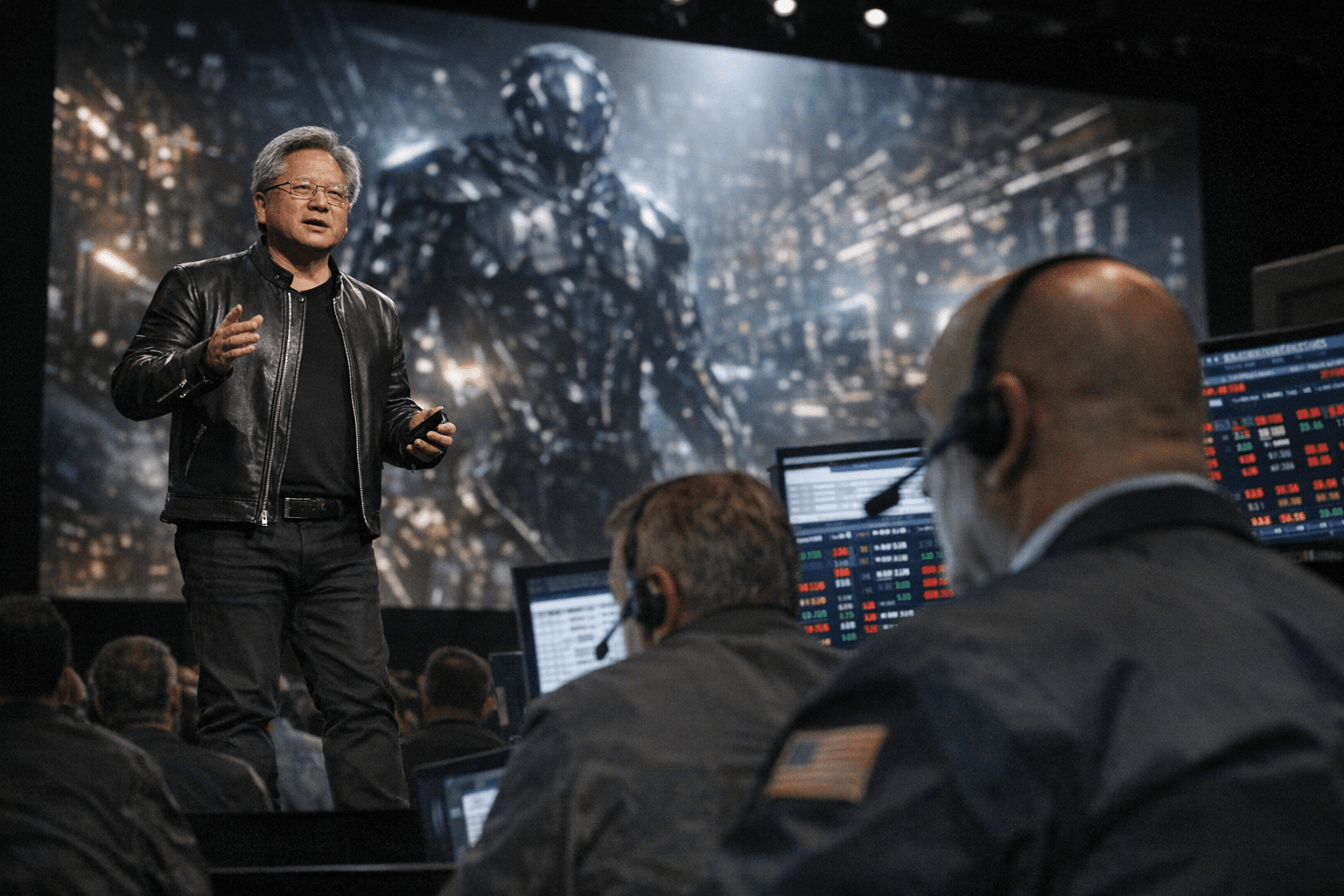
Jensen Huang spent hours on stage in San Jose promising a new era of artificial intelligence, unveiling next-generation chips, the Vera Rubin platform, and agent runtimes designed to push computing further into the AI age. Wall Street responded with a yawn.
Nvidia's GTC conference, the company's annual showcase and one of the most-watched events in the technology calendar, failed to generate the market enthusiasm that executives had anticipated. Despite the breadth of announcements and the scale of Huang's vision, shares moved without conviction, a striking disconnect between the spectacle inside the convention center and the sentiment among investors watching from afar.
The muted reaction reflects a growing tension at the heart of the AI investment story. Nvidia has been the defining stock of the AI boom, riding a wave of demand for its chips that powered some of the most dramatic gains in market history. But investors are increasingly asking a harder question: when does the infrastructure spending translate into measurable economic returns?
That skepticism colored the reception to GTC's announcements. The Vera Rubin platform, positioned as a significant leap in Nvidia's data center architecture, and the company's expanded push into agent runtimes, software systems that allow AI models to carry out multi-step tasks autonomously, represent genuine technical ambition. The problem is that ambition has been priced into Nvidia's valuation for some time, leaving little room for new announcements to deliver upside surprise.
Analysts have pointed to a broader recalibration across the AI sector. The initial phase of the boom was driven by a consensus that whoever built the infrastructure would capture extraordinary value. That consensus is now being tested. Hyperscalers are spending at record levels on data centers, but questions linger about whether the AI applications running on that infrastructure will generate returns commensurate with the investment.
Nvidia's forecasts at GTC were sweeping, as they have consistently been, projecting AI's expansion into every layer of the economy. The company's execution has, by most measures, been exceptional, and its technological lead in AI accelerators remains formidable. But execution and lead do not automatically translate into a higher share price when the market is already pricing in sustained dominance.
The cautionary mood among investors also reflects macro pressures that extend beyond any single company. Interest rate uncertainty, geopolitical risk in semiconductor supply chains, and growing competition from custom chips developed by Amazon, Google, and Microsoft have collectively introduced a more complex calculus for anyone holding or considering Nvidia stock.
What GTC demonstrated clearly is that Nvidia continues to set the pace in AI hardware and is expanding aggressively into the software and systems layers that could deepen its moat. What it could not do was dissolve the fundamental uncertainty investors now attach to AI's commercial timeline, a problem no keynote, however long or technically impressive, is equipped to solve.
Know something we missed? Have a correction or additional information?
Submit a Tip