Job seekers share the changes that finally got them hired
A tight labor market and automated screening are burying qualified applicants. The people who got hired stopped spraying resumes and started targeting the funnel.

Why good candidates keep disappearing
A resume can still be strong and still go nowhere. That is the defining frustration in today’s hiring process: qualified applicants are getting filtered out by software, lost in application volume, or left waiting in a feedback loop that never closes.

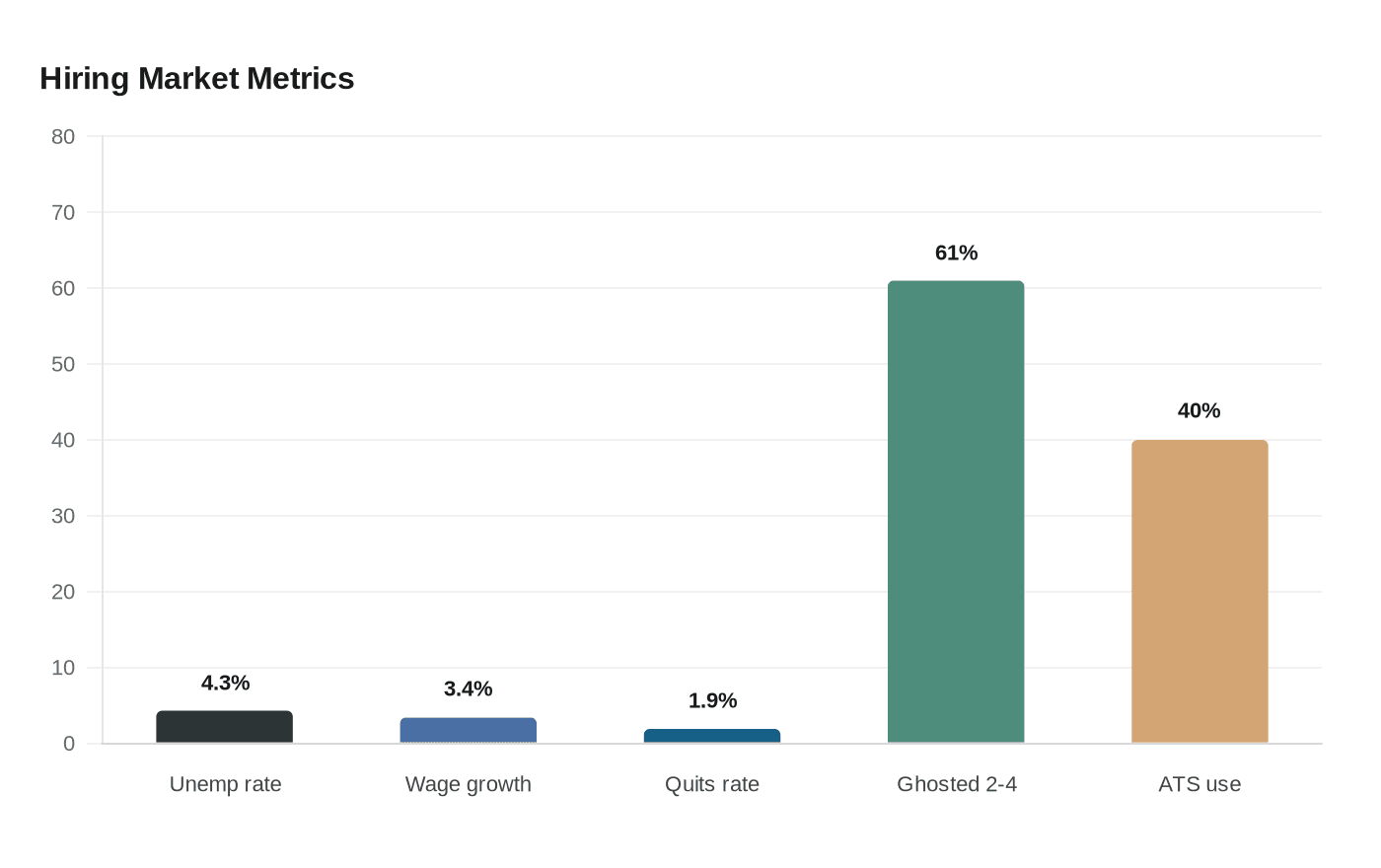
The problem is not just anecdotal. The U.S. Bureau of Labor Statistics said payroll employment rose by 172,000 in May 2026, while the unemployment rate held at 4.3 percent. But even with that steady headline, the search can drag on for months: BLS data show 1,696,000 people were unemployed for 27 weeks or longer in 2025, a reminder that joblessness often becomes a long-duration problem rather than a short gap.
The labor market is still tight, just in a different way
The modern hiring squeeze looks less like mass layoffs and more like a slow, selective bottleneck. The St. Louis Fed said nominal wage growth for private industry workers slowed to about 3.4 percent in the last quarter of 2025, while the quits rate fell to 1.9 percent in August and October 2025. That combination points to a low-fire, low-hire economy, where workers are staying put and openings are harder to pry loose.
For job seekers, that matters because fewer people moving means fewer openings created by churn. A stable labor market can still feel blocked if employers are not expanding aggressively and internal mobility is muted. In that environment, sending out more applications is often less effective than learning how the funnel actually works.
The silent middle of hiring is growing wider
Indeed’s research helps explain why so many candidates never get a response. The company surveyed 4,516 job seekers and 4,517 employers across the United States, the U.K. and Canada, and found that ghosting has become routine on both sides of the market. Indeed reported that just over 3 in 5 U.S. job seekers, or 61 percent, said they had ghosted two to four employers in the previous 12 months.
That silence reflects a breakdown in the feedback loop. Job seekers often fire off dozens of applications and hear nothing back; employers, faced with large applicant pools, sometimes do the same. The result is a hiring process where both sides behave as if nonresponse is normal, which only deepens the sense that qualified applicants are vanishing into the system.
Why resumes get lost before a human reads them
A major choke point sits in applicant tracking systems, or ATS, which employers use to screen candidates before a recruiter ever opens a file. Indeed says nearly 40 percent of employers use ATS screening, which means the first audience for many resumes is software, not a person.
That changes the logic of the application. Jobscan advises applicants to tailor keywords to each posting because ATS tools often look for direct matches in titles, skills and phrasing. A resume that reads well to a person can still underperform if it does not echo the language of the posting closely enough. In practical terms, the best-qualified applicant can lose to the better-matched document.
What finally moved the needle
The stories of Megan Nicole O’Neal, Angelo Mendoza, Russ Garcia and Marianne Matarese point to the same structural lesson: the people who finally got hired changed how they entered the funnel. Their experiences fit a broader pattern in which networking, resume customization, recruiter outreach and ATS optimization do more to break a deadlock than sheer application volume.
That does not mean every candidate needs the same tactic. It does mean the old strategy of mass applying is poorly suited to a market where employers are filtering harder, responding less and hiring more cautiously. The applicants who break through usually do some version of the following:
- They tailor each resume to the posting, especially the headline skills and title language.
- They use networking to create a human touchpoint before the application disappears into software.
- They reach out to recruiters or hiring managers instead of waiting for a response that may never come.
- They optimize for ATS by matching keywords, formatting cleanly and avoiding elements that software can misread.
These are not gimmicks. They are responses to a system that has become increasingly procedural. When nearly 40 percent of employers are using ATS tools and 61 percent of U.S. job seekers admit to ghosting multiple employers themselves, the hiring market rewards precision, persistence and timing far more than volume alone.
What the data say about the new job search
The economics behind the process matter. Slower wage growth, fewer quits and a sizable pool of long-term unemployed workers all suggest that competition is still intense even when the economy is adding jobs. In a market like that, employers can be picky, candidates can be invisible, and small mismatches can decide whether a résumé gets a callback or disappears.
That is why the most effective job-search changes are often structural rather than motivational. The applicants who found traction did not just “try harder.” They adjusted to how hiring now works: software screens first, humans often arrive later, and silence is part of the system. The people who understand that reality are the ones most likely to move from the pile of ignored applications into an actual offer.
This article was produced by Prism’s automated news system from verified source data, official records, and press releases, then run through automated quality and moderation checks before publishing. The system is built and supervised by the people who set the standards it runs under. Read our full AI policy.
Did this article answer your question?