Justice Department Probes $7 Billion Oil Trades Before Iran Policy Moves
Federal investigators are chasing oil bets that hit minutes before Iran policy moves, with nearly $7 billion in suspicious trading now under review.
The Justice Department is looking at whether traders used advance knowledge of Iran-related policy moves to profit from a series of oil bets that landed with unnerving precision around Donald Trump’s announcements. What began as scrutiny of more than $2.6 billion in tied trades has widened into a broader market-integrity question, with Reuters saying the total value of well-timed wagers on falling oil prices may have reached as much as $7 billion across March and April.
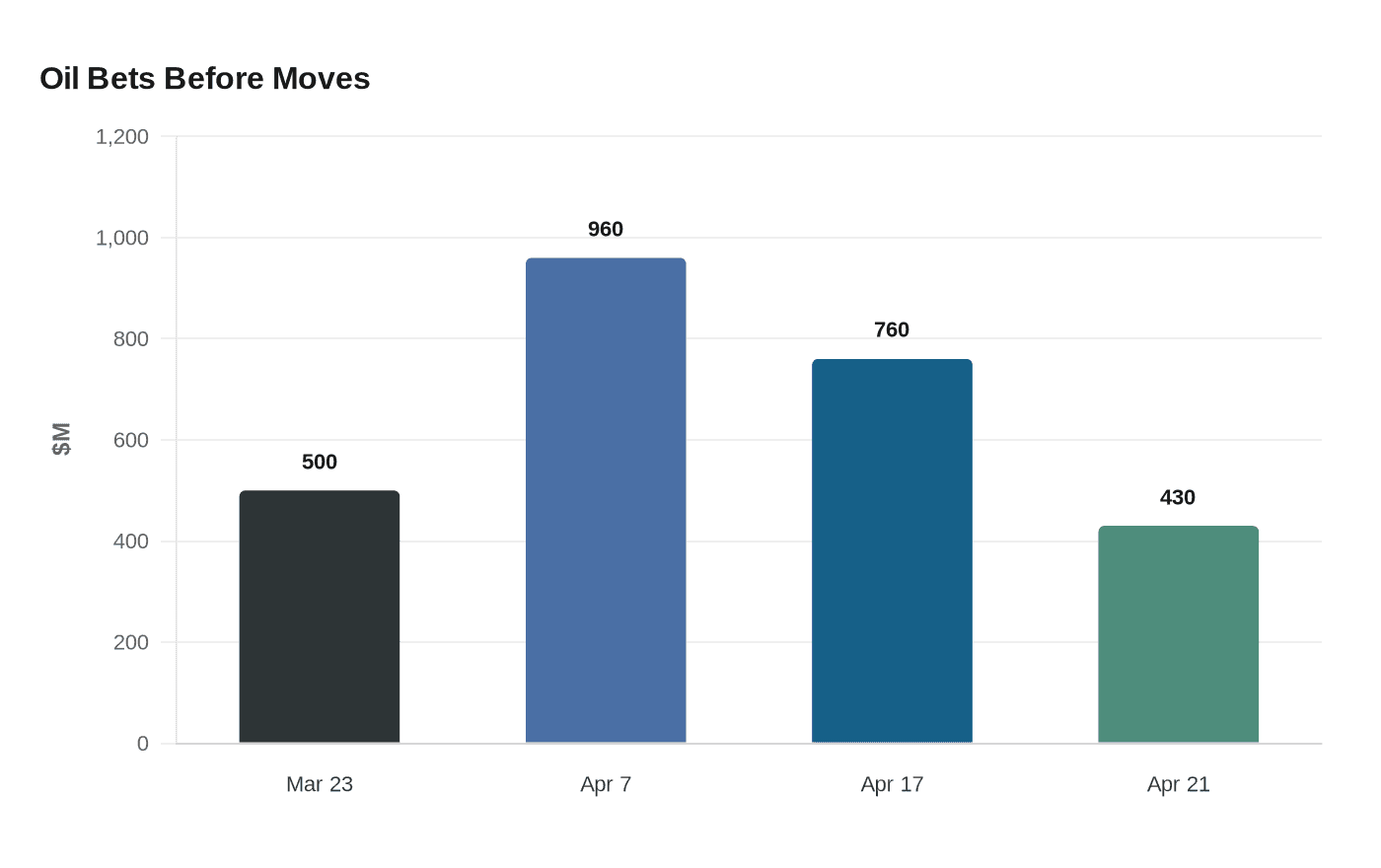
The clearest pattern centers on four trades. More than $500 million was placed about 15 minutes before Trump delayed threatened attacks on Iran’s power grid on March 23. Another $960 million bet came hours before a temporary ceasefire announcement on April 7. A $760 million trade landed 20 minutes before Iranian Foreign Minister Abbas Araghchi posted that the Strait of Hormuz was open on April 17. On April 21, $430 million was wagered 15 minutes before Trump said he would extend the ceasefire. ABC News said those trades were part of at least four specific transactions under review, but the LSEG data it obtained did not identify the traders and did not prove insider trading.
The trades were concentrated in benchmark oil markets on Intercontinental Exchange and CME Group venues, including Brent, WTI, diesel and gasoline futures and derivatives. Reuters said the unusual activity first drew attention on March 23 and then repeated on April 7, April 17 and April 21. Bloomberg reported on April 15 that the Commodity Futures Trading Commission had already opened its own investigation and was seeking data from CME Group and Intercontinental Exchange before the broader Justice Department probe became public.
NBC News reported that the Justice Department inquiry is being led by the U.S. Attorney’s Office for the Southern District of New York. NBC also reported a separate investigation into suspicious activity on prediction market platforms tied to the same Iran war developments, widening the scope beyond traditional energy futures into newer betting venues that can also move fast when geopolitics turns.
The key question for investigators is whether the timing reflects skillful trading on public information or misuse of nonpublic government knowledge. To prove insider trading or a similar abuse, authorities would need to connect the trades to specific leaks, identify the traders and their information sources, and show that the positions were built on material nonpublic details before the announcements. Both ICE and CME declined to comment, and federal authorities did not immediately comment. A White House spokesperson said federal employees are subject to ethics rules that prohibit using nonpublic information for financial benefit.
This article was produced by Prism’s automated news system from verified source data, official records, and press releases, then run through automated quality and moderation checks before publishing. The system is built and supervised by the people who set the standards it runs under. Read our full AI policy.
Did this article answer your question?

