Kenya's Flower Industry Loses Up to $1.4 Million Weekly Amid Iran War Chaos
Kenya's flower industry has lost over $4.2 million in three weeks as Iran war chaos sends freight costs to a 10-year high of $5.80 per kilo.
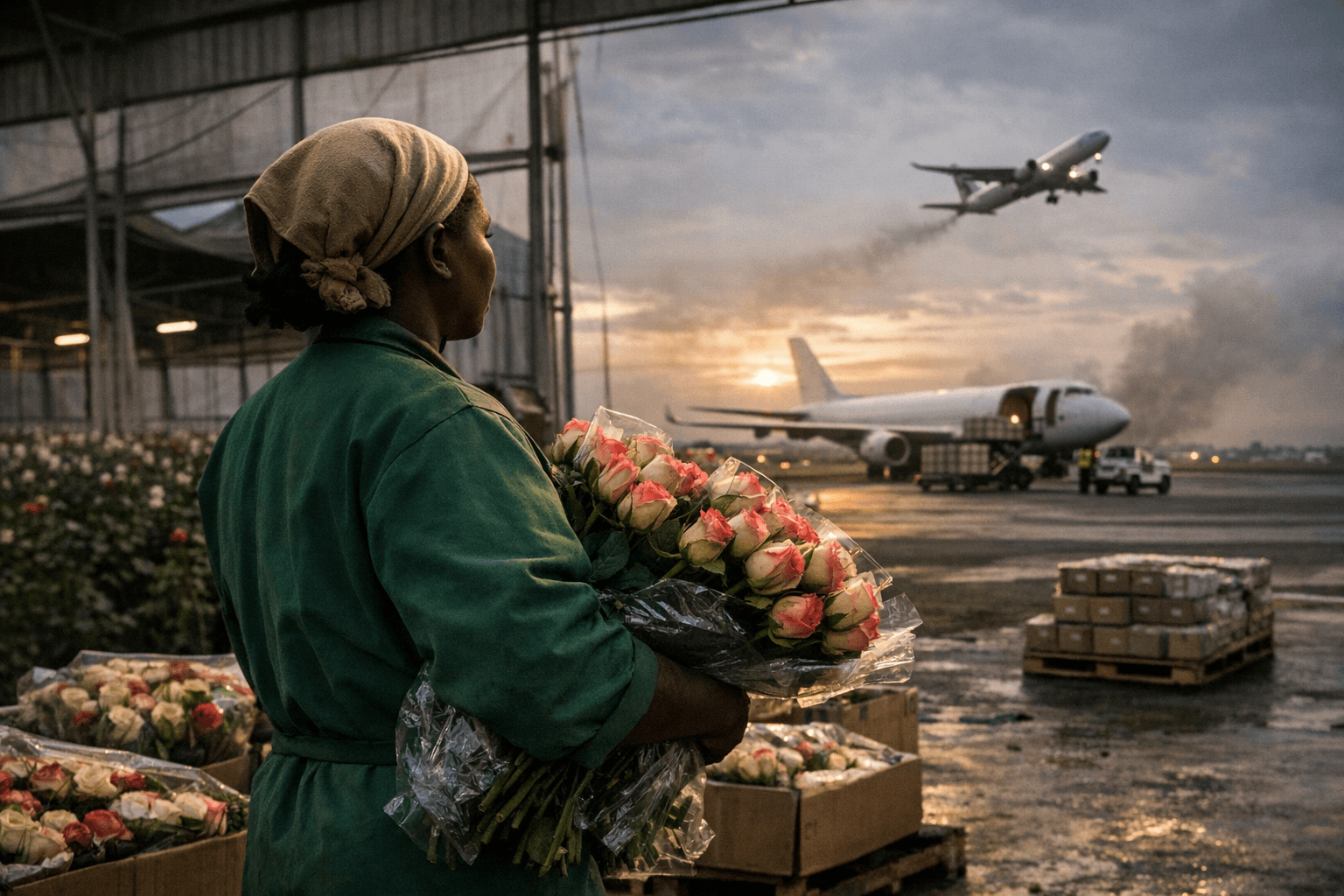
Kenya's flower industry has reported weekly losses of up to $1.4 million since the Iran war began, a bleeding that has compounded week after week at Isinya Roses farm in Kajiado County, where workers like Belinda Wanjala, 23, were still harvesting roses for export on Tuesday even as the economics of getting those flowers to market deteriorated sharply.
The Kenya Flower Council said Tuesday the ongoing conflict has resulted in over $4.2 million in losses over the last three weeks. The industry group, which represents growers and exporters of cut flowers and ornamentals across the country, said the damage spans both reduced demand in key markets and a freight system under acute stress.
"We are seeing a reduction in movement, delays in movement of produce, and longer routes, while pricing is extremely high. Last week, we were at $5.80 per kilo, which is the highest we've had in the last 10 years," Kenya Flower Council chief executive Clement Tulezi said.
The freight squeeze is hitting Kenya on two fronts simultaneously. While the Middle East is not Kenya's main export market for flowers, cargo freight to Europe has been disrupted by the conflict in the Middle East, resulting in reduced exports as well as higher costs. "With the current freight rates, customers are not able to buy. And while the freight rates are high, it is also difficult to get the freight. Only a few freights are operating, as mainly the Middle Eastern carriers have stopped, and the European carriers are charging about $5 per kilo, which is two times the normal rate," according to industry figures. The Middle East itself accounts for approximately 10 to 15 percent of Kenya's total flower exports, with the United Arab Emirates and Saudi Arabia among the primary buyers in the region, Tulezi told Xinhua in an earlier dispatch.
Kenya's horticulture sector, one of its most important industries, is worth over $800 million annually, according to the Central Bank of Kenya. Experts warn the disruption will likely result in job losses in a sector that employs up to half a million Kenyans directly.
The industry relies almost entirely on air freight to move a highly perishable product to global buyers, which means every disruption to flight routes translates almost immediately into spoiled inventory or cancelled orders. Exporters have been diverting shipments to alternative markets, but that comes at a cost: lower realized prices and additional logistical overhead on already thin margins.
Growers like Isinya Flower Farms now warn that, should the conflict drag on, the sector will continue to deteriorate, with scenarios similar to the COVID-19 period looming. During that crisis, Kenyan growers destroyed millions of stems as global air capacity collapsed overnight.
The Kenya Flower Council is now lobbying the Kenyan government to introduce direct cargo flights to Europe in a bid to maintain the European market and cushion growers. The council is also working with airlines, freight operators and government agencies to identify new cargo routes and explore temporary relief measures for affected shipments.
At Isinya Roses in Kajiado, the daily routines continue: Festus Mwirotsi, 34, scouts for pests in roses meant for export, Norah Vutukha, 33, grades cut flowers at the sorting line, and Benson Misikhu, 40, moves stock from cold storage. The flowers are ready. The question is whether they can be moved profitably to a world that, for now, is in the middle of a war.
Know something we missed? Have a correction or additional information?
Submit a Tip