Keyboard Energies Concert Pairs Historical Keyboards with Minimoogs and Electric Pianos
Nine instruments, including vintage Minimoog Model D synthesizers and a clavichord, met in a compact concert at Cornell Tech, which paired five centuries of keyboard design and gave attendees hands-on time.

Keyboard Energies took place at Cornell Tech’s Tata Innovation Center, Room 141, presenting a short concert and instrument demonstration that paired historical keyboards with electric pianos and vintage synthesizers. The event ran in the afternoon and followed the compact format described on the event listing, combining newly imagined arrangements with a hands-on opportunity for attendees to play the instruments themselves.
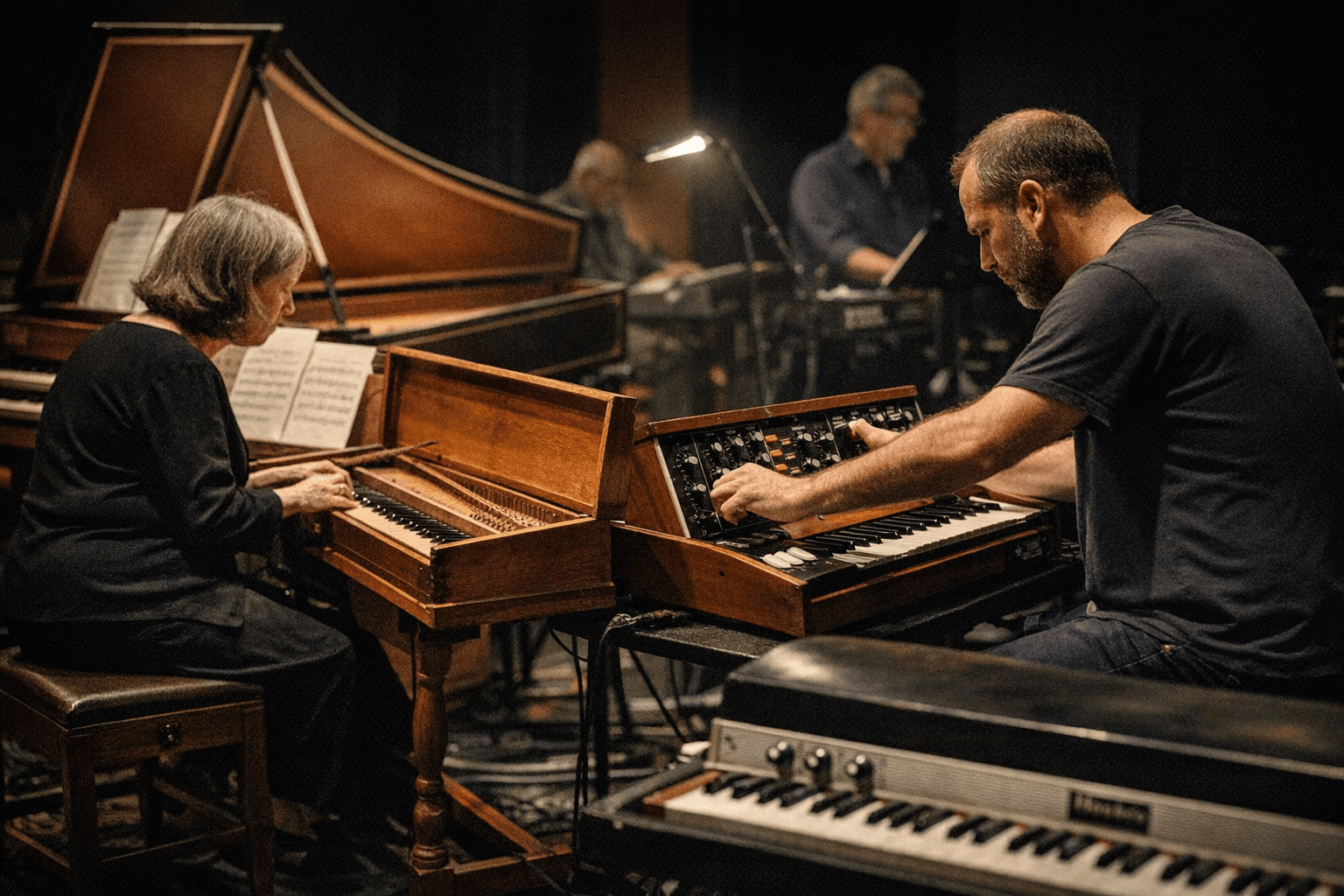
The program showcased nine instruments drawn from the Cornell Center for Historical Keyboards collection, explicitly listing vintage Minimoog Model D synthesizers designed by Cornell alumnus Robert Moog, two electric pianos, and a clavinet. The clavichord, harpsichord, and fortepiano were generously provided by Yi‑heng Yang. Event materials framed the gathering with the sentence, “From clavichord to synthesizer, Keyboard Energies brings together keyboard instruments designed over the last half‑millennium to explore sonic possibilities that are at once old and new.”
Musical content was presented as a compact program of newly imagined arrangements spanning composers from Palestrina and J. S. Bach to Brillon de Jouy, Mozart, Alkan, Wagner, and Debussy. The Eventbrite summary spelled out the conceit succinctly: “Keyboard Energies brings together historical keyboards and synthesizers to explore new and unexpected sonic relationships.” Program order, individual arrangement credits, and movement-level details were not listed in the event materials.
Conceived, arranged, and performed by Roger Moseley, Patricia García Gil, and Federico Ercoli, the concert placed named CCHK personnel at the center of the evening. Roger Moseley is identified as Director of the Cornell Center for Historical Keyboards and Cornell’s Milstein Program in Technology and Humanity. Patricia García Gil is listed as a Postdoctoral Associate and Artist in Residence at CCHK, and Federico Ercoli is identified as a Graduate Fellow at the Center.
Audience-facing logistics followed the pattern in the promotional posts: the short concert and instrument demonstration was followed by hands-on time for attendees, and reservation was handled via Eventbrite with Roosevelt Islander pointing readers to “Reserve Your Spot.” The event materials did not specify an admission price for this concert; the sequel event at Cornell later was explicitly described as free and open to the public, but the March program’s fee status was not stated.
The Cornell Center for Historical Keyboards provided institutional context for the project. The CCHK is described as “dedicated to the music and culture of keyboard instruments across their long history” and as an organization that “fosters original and imaginative approaches to the performance and study of keyboard instruments, their technological underpinnings, their intersections with other arts, and their participation in the global currents of cultural and social history.” The Center’s stated collection holdings and support for Cornell’s DMA program help explain why a program juxtaposing clavichord and Minimoog is both a performance event and a piece of scholarly programming.
Keyboard Energies also sits within a continuing series at Cornell. A related presentation, Keyboard Energies II: The Keyboards Strike Back, was listed for Oct. 9 at Barnes Hall with a 7:30 p.m. start, a roster of 17 keyboard instruments including a Roland Juno‑60, and a program that was described as free and open to the public with no tickets required. The March concert’s pairing of five centuries of keyboard design and its hands-on component reflect CCHK’s mission to integrate historical, technological, and performative approaches to the keyboard.
Know something we missed? Have a correction or additional information?
Submit a Tip