Khamenei’s death sparks nationwide jubilation and mourning, raising succession questions
State TV announced Ayatollah Ali Khamenei’s death and images and verified footage show both thousands mourning and others celebrating, while constitutional succession and regional strikes add uncertainty.
Around 5:00 am on Sunday state television announced the death of Ayatollah Ali Khamenei, saying he had “fulfilled his lifelong dream” of martyrdom. Within hours the country displayed starkly contrasting scenes: thousands gathered to mourn in Tehran’s Enghelab Square while videos circulating on social media and verified by news teams showed people dancing, honking and setting off fireworks in districts from Tehran’s Pardis neighborhood to the northern coastal city of Shahsavar, and a monument to Ayatollah Ruhollah Khomeini was toppled in parts of southern Iran.
The dual public reaction underscores deep fractures in Iranian society after nearly four decades of Khamenei’s rule. “The street was full! I had tears rolling down my eyes. No one outside can understand what Iranians who were victims of this murderer feel right now,” Nazanin, 24, a media professional in Tehran, told The Guardian. At the same time students at the University of Tehran commemorated protest victim Raha Bahloulipour and chanted, “For every one person killed, a thousand stand behind them,” reflecting persistent grief for those lost during recent unrest.
Medical and security accounts recall the cost of the crackdown that followed nationwide protests earlier this year. A doctor based in Rasht who treated “hundreds of protesters with gunshot wounds to the head, chest and genitals” described a private, cautious relief: “I smoked a cigarette for the first time last night. It was the best Saturday night ever,” and added, “We as a nation have been waiting for this news for decades. I feel like I am dreaming but we are cautiously celebrating. For now we celebrate – despite the security forces armed with AK47s,” as reported by The Guardian.
The announcement intensifies immediate institutional and geopolitical questions. Article 111 of Iran’s constitution vests the position of supreme leader in the Assembly of Experts, an 88-member body of clerics, and until it convenes the duties of the office fall to a three-member council composed of the president, the head of the judiciary and a jurist from the Guardian Council selected by the Expediency Discernment Council, according to NBC News citing the Council on Foreign Relations. No authoritative list of interim officeholders or timing for the Assembly’s deliberations was provided in initial reports.
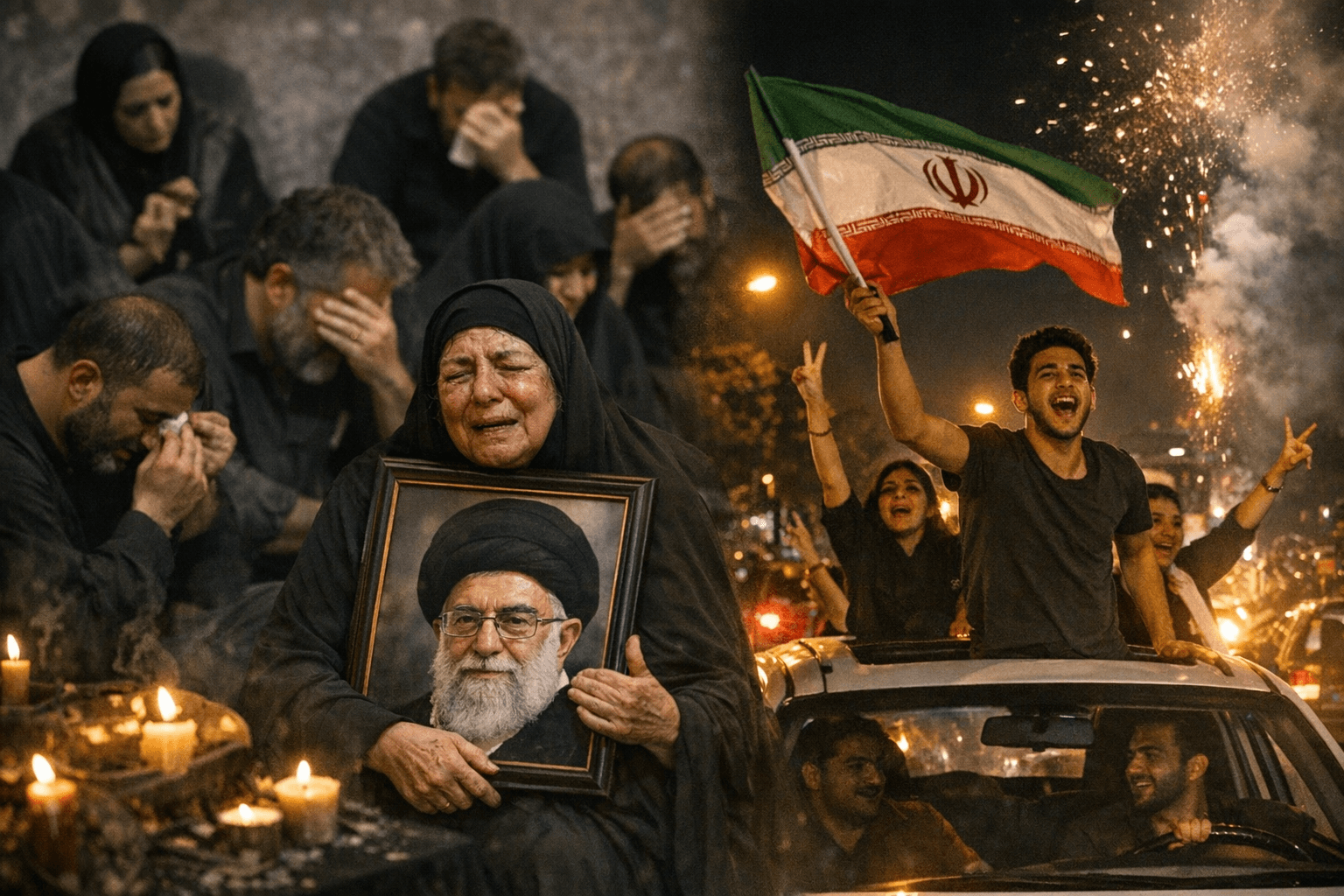
Public apprehension is widespread. An anonymous Iranian cargo driver told AFP, “The situation right now in our country is not good at all… I don’t know what will happen in the future, but it’s not a good future for us Iranians.” Social media posts collected by Iran International conveyed mixed emotions: “What a strange morning... War was not our choice or decision. Most of us feel a mix of worry, a sense of vindication, anger, hope, scattered thoughts, and many other contradictory emotions,” and another user wrote, “Khamenei’s death feels so surreal to me that I won’t believe it until I see his body.”
The reporting package also included headlines and verified footage referencing an expanded military backdrop: U.S. and Israeli strikes reportedly extending into a second day and explosions across the Persian Gulf, though publicly available reports cited in the coverage did not provide casualty or operational figures. At the northern Islam Qala border crossing an AFP journalist observed the Iranian flag lowered and a black flag raised while trucks continued to cross.
For Iranians on the ground the immediate impacts are logistical and psychological: long lines at gas stations, crowded supermarkets and shuttered schools and businesses were reported as people processed the news. With contested streets, a potent security presence and a constitutional succession process that requires clerical deliberation, the country is entering a period of acute institutional uncertainty that will shape both domestic politics and regional stability in the coming days.
This article was produced by Prism’s automated news system from verified source data, official records, and press releases, then run through automated quality and moderation checks before publishing. The system is built and supervised by the people who set the standards it runs under. Read our full AI policy.
Did this article answer your question?

