Kharg Island Controls 90% of Iran's Oil, Making It a Critical War Target
A tiny Persian Gulf island handles 90% of Iran's oil exports — and U.S. strikes have already hit its military sites while deliberately sparing the pipelines.
He who controls Kharg Island, controls the destiny of this war," Senator Lindsey Graham, one of Trump's close Republican allies, posted on social media. That statement, blunt as a military briefing, cuts to the core of why a coral island barely visible on most maps has become the most consequential piece of real estate in the U.S.-Iran conflict.
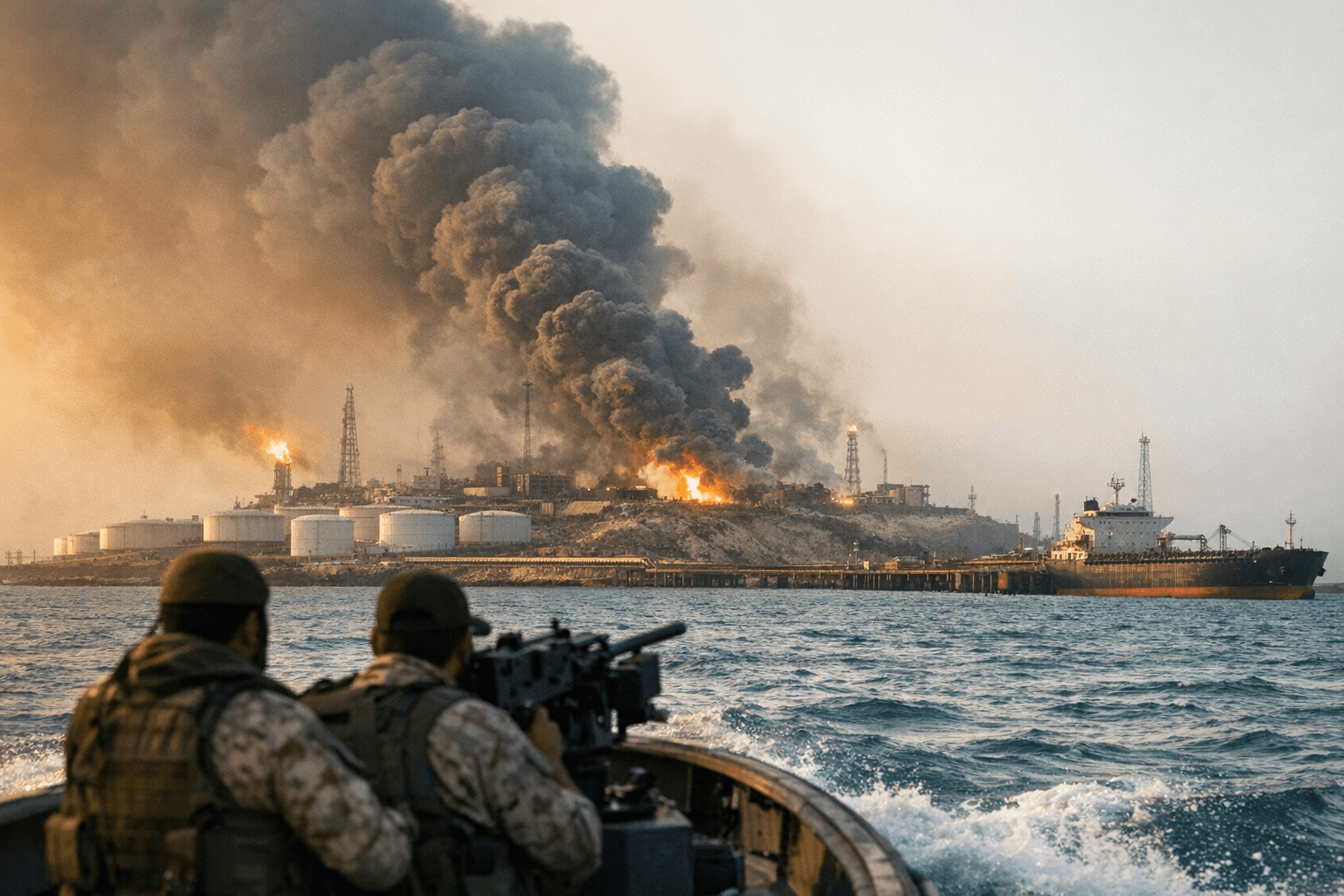
President Trump said the U.S. military "totally obliterated" every military target on Kharg Island during large-scale precision strikes on March 13, thrusting the strategic small isle into the global spotlight as the Iran war continues. Yet the oil terminals, the loading docks, the storage tanks holding the financial lifeblood of the Islamic Republic — those remain standing. That gap between what was hit and what was spared is not an oversight. It is a policy choice, and understanding it requires understanding what Kharg Island actually is.
What Makes Kharg Island Irreplaceable
Just 20 miles off Iran's northern Gulf coast, Kharg Island is Iran's hub for oil exports and a key bargaining chip Mr. Trump plans to use to keep the Strait of Hormuz open and safe. For decades, it has served as Iran's main oil export terminal, historically handling 85-95% of the country's crude exports. Most reporting shortens that range to a single, stark figure: roughly 90% of all Iranian crude passes through this one island.
The small coral island sits about 21 miles (33 kilometers) off Iran's coast and is the primary terminal through which nearly all of Iran's oil exports pass. Tankers load up on the island before heading through the Persian Gulf and the Strait of Hormuz. If the island's loading facilities were knocked out, Iran's ability to export oil would collapse almost immediately. Oil revenue, earned mainly by selling crude to China, remains one of the Islamic Republic's most important sources of funding.
The scale of ongoing exports, even amid active conflict, is striking. Iran recently has been exporting roughly 1.1 million to 1.5 million barrels of oil per day, mostly to China. Iran has exported 13.7 million barrels since the war started, and multiple tankers were seen on satellite imagery loading at Kharg, according to TankerTrackers.com, a maritime intelligence company.
Infrastructure on the Ground
The physical layout of Kharg reflects decades of investment in a single strategic bet. The island has storage tanks and housing for thousands of workers. Gazelles roam freely near the refineries and depots that make Kharg one of Iran's most valuable and sensitive assets. The storage tanks are concentrated in the island's south, clustered alongside loading facilities that service the tankers China depends on for a significant portion of its oil supply.
The island is also home to a medieval Portuguese fortress and the ruins of one of the oldest Christian monasteries in the Persian Gulf. That juxtaposition — ancient stone ruins alongside 21st-century oil infrastructure, wild gazelles grazing beside industrial depots — underscores how Kharg defies easy categorization as purely a military or economic target. It is both, and neither fully, which complicates every option being weighed in Washington.
Why Washington Has Held Back
Recent U.S. strikes on Kharg targeted military installations while leaving key oil facilities intact, a sign that Washington is trying to preserve a major pressure point without immediately detonating global oil markets. Kharg Island, Iran's main oil export hub, is emerging as a potential pivot point in the U.S.-Israeli war on Iran. The oil and shipping infrastructure on the tiny island, at the northern end of the Persian Gulf, is an appealing target for the United States and Israeli military raids. But an attack would carry significant risks.
Those risks are not abstract. Iran has been threatening the world's energy markets by keeping the Strait of Hormuz closed to most traffic. National security analyst Aaron MacLean told CBS Saturday Morning that Mr. Trump has shown he has leverage if Iran keeps the Strait closed. About 20% of the world's oil supplies pass through the waterway. MacLean put the linkage plainly: "The president has linked the vulnerability of Kharg Island to Iran's continued closure of the Strait of Hormuz."
Strikes on the oil infrastructure would be a massive escalation in the war that could send global oil markets into a panic, and threats to the island would pressure Tehran's energy system.
The Expert Case for Control Over Destruction
Petras Katinas, an energy researcher at the Royal United Services Institute, frames the strategic calculus in terms that go beyond the current Iranian government. Katinas said Kharg Island was critical to funding Iran's government and military. If Iran were to lose control of Kharg, it would be difficult for the country to function, even though the island isn't a military or nuclear target.
"It doesn't matter which regime is in power – new or old," Katinas said. A takeover would give the U.S. leverage over negotiations with Iran because the island is "the main node" of its economy.
That last point carries an uncomfortable implication flagged by multiple outlets: expanded strikes on Kharg would not only further damage Iran's current government but could also undermine the viability of whatever might eventually replace it. Destroying the economic engine of Iran does not simply punish the current regime — it potentially hollows out whatever comes after.
Abdullah Aljunaid, a Bahraini analyst, told Fox News Digital that after Iran's military capabilities were weakened, the U.S. focus could shift to economic pressure on Iran. The distinction matters: economic pressure through the threat of destroying Kharg is a different instrument than actually destroying it.
The Spectrum of Options
As the U.S.-Iran war enters a new phase, the range of options now being discussed stretches from hitting Iran's economic and oil lifeline at Kharg Island to the far more dangerous prospect of a ground invasion, or a narrower operation focused on Iran's nuclear material. The urgency comes as recent U.S. strikes have degraded parts of Iran's military infrastructure without collapsing the regime, raising pressure on the Trump administration to decide what comes next.
Each option carries significant risks: disrupting Kharg Island could shock global oil markets, a ground invasion could draw the U.S. into a prolonged regional war, and operations targeting nuclear material could trigger escalation while still failing to eliminate the threat.
The current posture — military sites struck, oil facilities intact — threads a narrow needle. It signals capability without triggering the market shock that full infrastructure destruction would cause. What happens next could determine not only the trajectory of the conflict with Iran, but also the stability of global energy supply and the future of Tehran's nuclear program.
A Small Island Bearing an Outsized Weight
No single piece of infrastructure in the region concentrates this much economic and geopolitical leverage in so compact a geography. Shut down the loading facilities on that coral island 20 miles off the Iranian coast, and Iran cannot export. If Iran cannot export, it cannot fund its military, its proxies, or its nuclear program at anything close to current levels. The gazelles grazing near the depots are indifferent to all of this. The tanker operators, the commodity traders watching Brent prices, and the negotiators in Washington are not.
This article was produced by Prism’s automated news system from verified source data, official records, and press releases, then run through automated quality and moderation checks before publishing. The system is built and supervised by the people who set the standards it runs under. Read our full AI policy.
Did this article answer your question?


