King Arthur’s Fresh Pasta Recipe and Tips acce Guide for Beginners
King Arthur’s fresh‑pasta primer lays out hands‑on technique (well method, machine settings, semolina finishing) while Emilie Raffa’s flour and egg tips sharpen your home results.

1. Lede and production hook
Between fast-moving restaurant openings and retail launches, hobby pasta makers still need durable how‑to resources. King Arthur Baking’s Fresh Pasta Recipe is a long-standing, practical primer that distills technique, ingredient ratios, and troubleshooting in a way that’s acce
This guide pulls the King Arthur Baking excerpts by Hetal Vasavada together with practical, tested advice from Emilie Raffa of TheCleverCarrot so you can get from eggs-and-flour to plated pasta with predictable results.
2. Attribution and sourcing
The core method below follows King Arthur Baking’s step-by-step excerpts credited “By Hetal Vasavada,” which provide the procedural backbone: the well-and-egg dough, dough division, machine rolling sequence, cutting, semolina finishing, and resting. Emilie Raffa’s commentary from TheCleverCarrot supplies tested flour, egg-size, and workspace recommendations and a few comparative test results; quoted comments from readers (Annie, Delphine, Anthony Sheff) are included where supplied.
3. Make the dough by hand (King Arthur method)
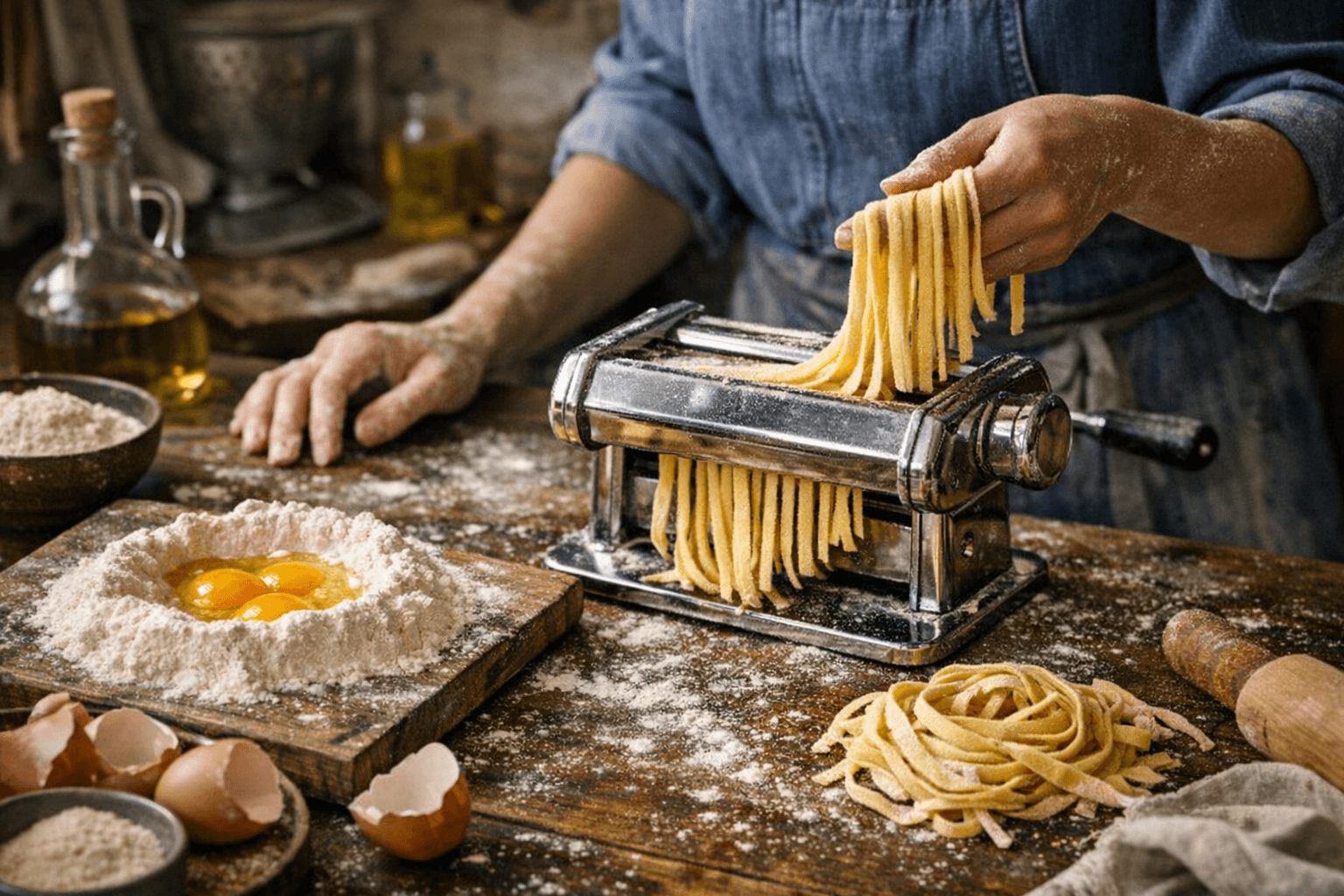
“To make the dough by hand: In a medium bowl, combine the flour and salt. Transfer the flour mixture to a clean work surface.” Create a large well in the flour, crack the eggs directly into the well, and “scramble them with your fingers or a fork.” Draw flour evenly from all sides of the well into the center until “a soft, loose dough forms.” Switch to a flexible bowl scraper and use a cutting motion to further incorporate moisture; the dough “will seem dry at first but continue to fold and press it over on itself until it comes together, then knead on an unfloured surface until the dough is smooth and firm, 1 to 2 minutes.” These are the tactile cues you’ll repeat every time you make pasta by hand.
4. Divide and feed the pasta machine (weights and rolling sequence)
After the dough is cohesive, “Divide the dough into two pieces (about 220g each).” Work with one piece at a time, keeping the other covered, and “dust both sides of the dough with flour to prevent it from sticking.” Roll the dough through the pasta machine once on the largest setting, then “Fold the dough in thirds like a letter (this helps it become a rectangular shape) before rolling it a second time on the largest setting.” Progress one notch at a time, dusting as needed, and “Continue adjusting the setting and rolling the dough through the machine until you’ve reached your desired thickness (we like between setting seven and nine on the Atlas 150 Pasta Machine).” These exact steps and the Atlas 150 reference give you a clear mechanical roadmap.
5. Cut, dust, and form, two options (machine cutter or by hand)
When your sheet is ready, handle and portion it as King Arthur instructs: “Cut the sheets of pasta into 12"-long pieces.” For machine-cut noodles, “Dust a sheet lightly with flour, then pass it through the noodle cutter on your pasta machine.” For a hand-cut approach: “To cut the sheets by hand, lightly coat the top of one sheet with semolina flour, then loosely roll up both short ends toward the center so they meet in the middle. Cut the rolled-up dough into strips of your desired thickness, and unroll.” After cutting, “Place noodles onto a semolina-dusted baking sheet and toss to coat lightly,” then “Once the noodles are cut and coated with semolina flour, coil the pasta into loose mounds (‘nests’) and set them aside on a parchment-lined baking sheet, covered, until you’re ready to boil them.” Repeat the process for every piece: “Repeat with the remaining pieces of dough.”
6. Flour and egg recommendations (TheCleverCarrot testing)
King Arthur’s recipe language references “flour and salt” and eggs; Emilie Raffa adds tested specificity. “Italian Tipo 00 flour: this fine milled, soft wheat Italian flour creates light, tender pasta. The texture feels like baby powder. I like Molino Grassi or Caputo.” She reports comparative testing: “For comparison, I tested this recipe with Bob’s Red Mill 00 flour and King Arthur’s Pasta Flour Blend and it wasn’t the same at all (too chewy).” If 00 is unavailable Emilie advises: “If you can’t find Italian 00 flour, substitute with King Arthur all purpose flour instead.” On egg sizing she is explicit: “Large eggs + yolk: Size matters! I use large eggs (~55-58g each) to ensure the dough contains the correct amount of moisture. Too little egg = dry, crumbly dough.” Use these specifics to tune hydration without changing the handling steps King Arthur prescribes.
7. Workspace, sheet length, and handling tips
Emilie’s practical setup advice keeps the process from turning into a battle with your counter: “Make space. You’ll need a long, clutter-free surface to roll the dough. Pasta sheets can measure up to 3 ft long! The kitchen table is ideal.” Combine that with King Arthur’s semolina and parchment approach, semolina-dusted baking sheet, parchment-lined trays, and covered nests, to keep strands separate and ready to boil. Knead only 1 to 2 minutes after the dough comes together, per King Arthur, and keep dough portions covered while you work to prevent skinning.
8. Troubleshooting and substitution notes
If your dough feels too dry, Emilie’s egg-size guidance is the first adjustment: verify you used large eggs (~55–58g each). If texture comes out “too chewy,” her test indicates certain flours (Bob’s Red Mill 00 and King Arthur’s Pasta Flour Blend in her trials) produced that result. For gluten-free attempts Annie asked about replacements; Emilie replied: “Hi Annie! Great question. Gluten free flour can be tricky to work with. Although I haven’t tested it, I’d start with a 1:1 all purpose GF flour. I’ve had great results with King Arthur’s Measure for Measure.” Treat that as an experienced but untested suggestion from Emilie rather than a proven substitution.
- Serving size confirmation: “Emilie Raffa says Yes, absolutely! I think I answered your question above re: 6 servings. But it can be doubled as well.”
- Gluten-free suggestion (Annie → Emilie): “Hi Annie! Great question. Gluten free flour can be tricky to work with. Although I haven’t tested it, I’d start with a 1:1 all purpose GF flour. I’ve had great results with King Arthur’s Measure for Measure. Let us know if you experiment!”
- All-purpose substitution (Delphine → Emilie): “Hi Delphine! Great question. Yes you can use all purpose flour. I recommend King Arthur brand if you can find it.”
- Manicotti question (Anthony Sheff → Emilie): “Yes it can!” (Emilie confirmed the recipe can be used for manicotti; Emilie’s further reply about whether to add water for pliability is not included in the supplied material.)
9. Reader Q&A excerpts (verbatim)
10. Reconciliation, limits, and missing facts to source
Procedural steps and exact machine settings come from King Arthur’s Hetal Vasavada excerpts; flour brand preferences, egg-size specifics, substitution experiments, and community Q&A come from Emilie Raffa’s TheCleverCarrot thread. Missing from the supplied excerpts are full ingredient weights for the complete King Arthur recipe, publication dates, and the truncated original report word ending “acce.” Also, several replies and conversion details are omitted in the supplied material (e.g., Emilie’s follow-up about water for manicotti and the conversion of 300g to cups), so if you need exact ingredient totals or those specific clarifications you should consult the full posts.
11. Final takeaway
Follow King Arthur’s tactile sequencing, well method, folding, rolling through progressively thinner settings (we like between setting seven and nine on the Atlas 150 Pasta Machine), 12" sheet cuts, semolina finishing, and 1–2 minutes of final knead, and use Emilie Raffa’s tested flour and egg recommendations (Tipo 00 if you can source Molino Grassi or Caputo; otherwise King Arthur all‑purpose; large eggs ~55–58g). Together, those concrete steps and brand-tested choices give you a repeatable path from raw ingredients to “nests” ready to boil, making fresh pasta a reliable weekend project rather than a one-off experiment.
Know something we missed? Have a correction or additional information?
Submit a Tip