King's Cross redevelopment makes London a leading AI hub
King's Cross went from red-light district to AI magnet through a 67-acre rebuild that restored 20 historic buildings and added 50 new ones. The test now is whether London’s gains reach beyond global tech tenants.
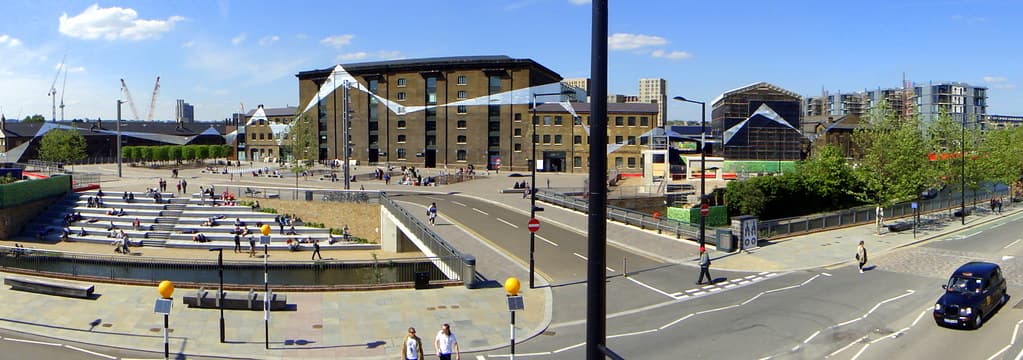
King's Cross is one of London’s sharpest urban reversals: a district once known for prostitution, drug dealing and neglect now sits at the centre of the city’s AI economy. The change did not happen by accident. It grew out of a 67-acre redevelopment on old railway land that turned an undesirable address into a mixed-use quarter, then gave frontier tech companies a place to cluster.
From railway land to urban repair
The King's Cross Central project was designed as a long-term "urban repair" scheme on former railway land in central London. It restored 20 historic buildings and added 50 new ones, while delivering offices, shops, restaurants, galleries, bars and leisure uses across the site. ULI has described the approved scheme as a high-density, mixed-use development, which helps explain why the area could absorb both heritage buildings and the kind of commercial space that AI firms now want.
That transformation matters because the district’s reputation was once the opposite of what it is today. More than 20 years ago, King's Cross was described as one of London’s seediest areas, and in the 1980s and early 1990s it was widely known as a red-light district. Allies and Morrison has summed up the shift plainly: the area was once cut off from the city and long an undesirable address, but has since undergone a dramatic transformation.
The policy decisions that changed the map
The redevelopment was not only a property story. The Greater London Authority identifies King's Cross as an Opportunity Area in the Mayor’s London Plan, with potential for 1,000 new homes and 25,000 new jobs by 2041. That planning status gives the district a civic role beyond private development: it is meant to help absorb growth in housing and employment at a time when central London land is scarce and expensive.
The public sector also helped shape the outcome by stepping back from ownership. A government sale of its King's Cross development stake, undertaken to reduce the deficit, underlined how the site moved from state-held land to a more market-driven regeneration model. That shift helped unlock investment, but it also means the public payoff now depends on whether the planned homes, jobs and public realm are widely shared, or mainly captured by landlords and premium tenants.
Why AI firms chose King's Cross
The area's appeal to AI companies is tied to both image and infrastructure. Google DeepMind is based in King's Cross, and in July 2022 Google said it was creating a local innovation hub there. More recently, Google unveiled Platform 37 and The AI Exchange as new spaces for AI innovation and discovery in King's Cross, with Google describing Platform 37 as a new building and a "world-class workspace" intended to support the community.
That corporate gravity has pulled in a dense cluster of frontier-tech names. The district is linked with Wayve, Synthesia, Isomorphic Labs and Meta’s AI teams, while later industry commentary has also placed OpenAI and Anthropic opening or planning European offices in or near the area. As London’s tech geography has shifted away from Shoreditch, King's Cross has become the address that signals access to capital, talent and transport in one place.
What the AI cluster says about London's economy
King's Cross is now being described as London's leading AI hub outside the US, and that designation carries market consequences. High-value firms tend to reinforce high-value districts: they attract specialist workers, support premium office demand and lift the status of the surrounding neighbourhood. In a location that once struggled to shed its old reputation, the new economy is visibly tied to urban design, rail connectivity and the patience to redevelop a large central site over many years.
The broader economic question is whether this is a civic success or a polished enclave economy. The case for success is concrete: 67 acres of central land were reused, 20 historic buildings were saved, 50 new ones were added, and the London Plan now counts the area as a place that can deliver 1,000 homes and 25,000 jobs by 2041. The caution is just as concrete: the companies moving in are among the most valuable in the world, which raises the stakes for affordability, access and who gets the benefit of the district's new status.
The real test of reinvention
King's Cross shows how regeneration can change not just one site but an entire urban quarter. It moved from stigma to scale, from dereliction to a mix of heritage buildings, offices and leisure uses, and from a transport-adjacent backwater to a magnet for AI firms. The next measure of success will be whether the same machinery that attracted Google DeepMind and its peers also delivers homes, jobs and public space that work for London beyond the balance sheets of its biggest occupiers.
This article was produced by Prism’s automated news system from verified source data, official records, and press releases, then run through automated quality and moderation checks before publishing. The system is built and supervised by the people who set the standards it runs under. Read our full AI policy.
Did this article answer your question?