LaGuardia Runway Collision Between Air Canada Jet and Fire Truck Raises Safety Concerns
An air traffic controller can be heard saying "I messed up" after Air Canada Flight 8646 slammed into a Port Authority fire truck at LaGuardia, killing both pilots.
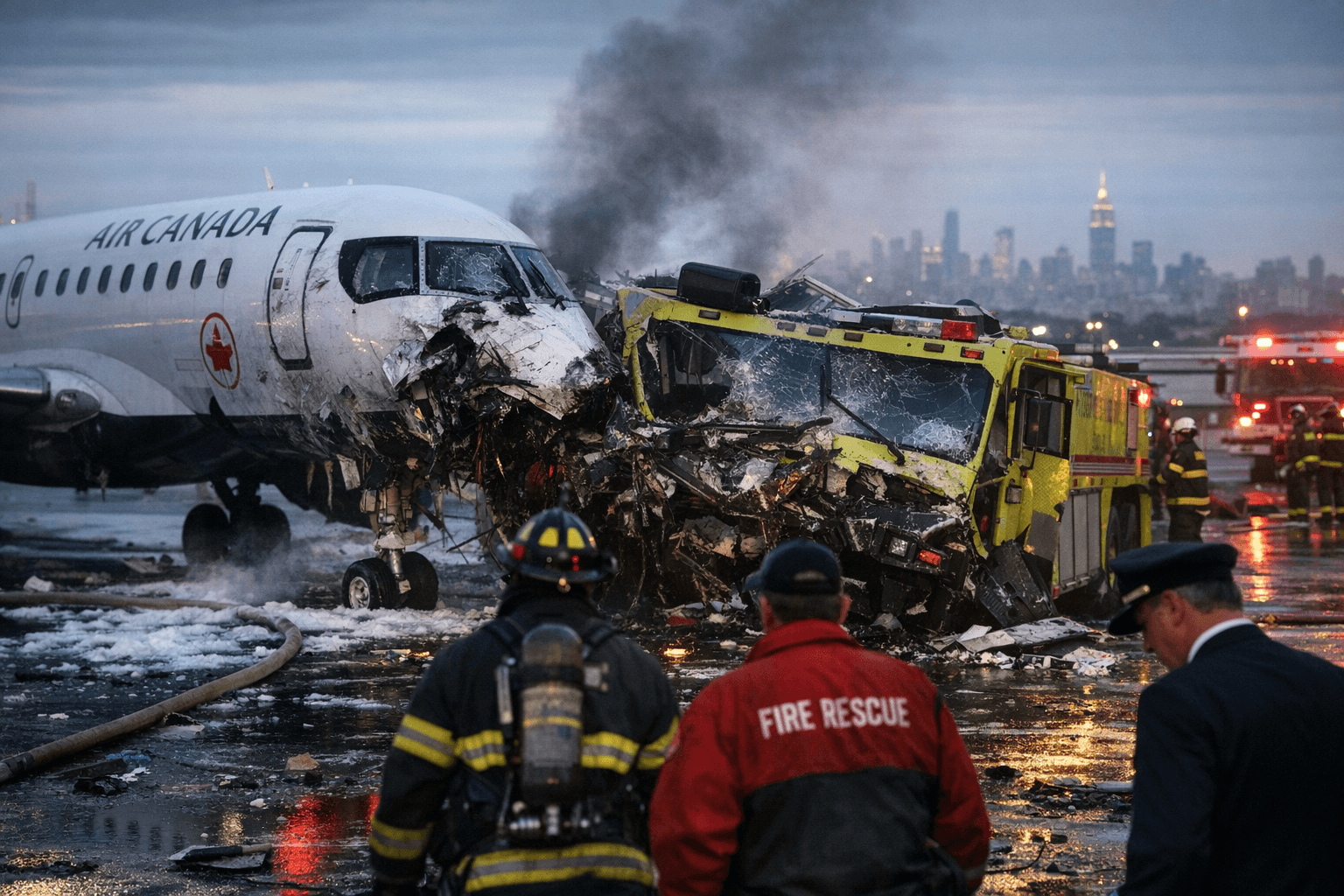
Air Canada Express Flight 8646 struck a Port Authority Aircraft Rescue and Firefighting vehicle after landing on Runway 4 at LaGuardia Airport at approximately 11:45 p.m. Sunday, March 22. The CRJ-900 had arrived from Montreal. Radio-Canada sources identified the two pilots killed as Antoine Forest, from Coteau-du-Lac, Quebec, and MacKenzie Gunther. The Federal Aviation Administration described them as "two young men at the start of their careers."
The Port Authority confirmed Air Canada Flight 8646, operated by Jazz Aviation, had 72 passengers and four crew members on board, and that 41 people were taken to hospitals, including 39 from the aircraft and two Port Authority Aircraft Rescue and Firefighting officers from the truck. Port Authority Executive Director Kathryn Garcia said early Monday that initial indications were that 32 people had been released from hospitals, but that "there are also serious injuries." Most of the injuries were broken bones and bruises, but one person suffered a brain bleed, according to law enforcement sources.
The impact severed the cockpit and hurled a flight attendant, still secured to her seat, far from the crash site. She survived. Flight attendant Solange Tremblay suffered multiple fractures to one leg and will need surgery after being thrown from the plane, her daughter Sarah Lépine told Canadian news station TVA Nouvelles. Her survival is "a total miracle," Lépine said.
The sequence of events leading to the collision was defined by a cascade of simultaneous emergencies. The collision happened as air traffic control was responding to a separate incident in which pilots of United Airlines Flight 2384 aborted their takeoff after an anti-ice warning light came on. They reported an odor in the cabin and requested assistance from firefighters; the pilots said flight attendants were feeling ill and declared an emergency when no gates were immediately available. That is what put the Port Authority fire truck on the runway. The truck was crossing the tarmac just before midnight after being given permission to check on the other plane that had aborted its takeoff.
Air traffic control recordings indicate the fire-rescue vehicle was cleared to cross the runway before a controller then told it to stop. The audio that followed has become central to the investigation. Air traffic audio indicates the fire truck was cleared to cross the runway before the collision. "I messed up," a controller can be heard saying afterward. The Daily Beast reported the controller's fuller admission: "I tried to reach out to stop them. We were dealing with an emergency earlier and I messed up," with a colleague responding, "You did the best you could," and the pilot of the Air Canada flight saying, "That wasn't good to watch."
A preliminary review by emergency responders shows the plane had received clearance to land, and the truck also had clearance to cross the runway, a scenario that placed investigators squarely on the question of sequencing and whether a single controller was managing both. Investigators will be looking into what the communication breakdown was that allowed the vehicle to be on the runway as the plane was landing, and will also want to understand if the air traffic controller was working alone in the tower.
Transportation Secretary Sean Duffy said LaGuardia's air traffic control is relatively well staffed, with a goal of 37 controllers; it currently has 33, with seven more in training. Duffy did not say how many controllers were working Sunday night. There was mist and fog at LaGuardia at the time of the crash.
The deadly collision is the first fatal crash at LaGuardia Airport in over three decades. The plane was traveling at about 100 mph when the collision occurred. Former FAA safety inspector David Soucie told CNN the point of impact likely prevented a far more catastrophic outcome: "Because that aircraft hit directly in the middle of the fire truck, the fire truck was moved forward, and the aircraft was damaged in the nose." A different point of impact could have involved the aircraft's fuel system.
The NTSB deployed 25 specialists to the site, along with five members of its Transportation Disaster Assistance Team, and additional employees supporting the investigation from its Washington headquarters. NTSB Chair Jennifer Homendy said the cockpit voice recorder and the flight data recorder have been retrieved from the plane and driven to the agency's labs in Washington. Homendy disclosed that the NTSB had to "beg" to get an air traffic control specialist through backed-up TSA security lines, with the specialist waiting in a Houston security line for three hours before the agency intervened.
Former NTSB chair Robert Sumwalt estimated the investigation will take between 12 and 18 months to complete. Transportation Secretary Duffy used the crash to urge Congress to approve more funding to upgrade air traffic control equipment. Whether staffing configurations at the LaGuardia tower on a late Sunday night contributed to the deadliest runway collision the airport has seen in a generation will be the investigation's defining question.
This article was produced by Prism’s automated news system from verified source data, official records, and press releases, then run through automated quality and moderation checks before publishing. The system is built and supervised by the people who set the standards it runs under. Read our full AI policy.
Did this article answer your question?