Lake Turkana faces growing threats as upstream changes hit fisheries
Lake Turkana’s rising waters are turning a vital fishery into a moving target, displacing shoreline communities and sharpening conflict with wildlife.

A lake built on one river, and exposed to one river’s changes
Lake Turkana sits in northwestern Kenya and southwestern Ethiopia as Africa’s fourth largest lake and the world’s largest permanent desert lake. That geography makes it unusually vulnerable: more than 90% of its inflow comes from the Omo River, so shifts upstream quickly ripple through water levels, shoreline stability, fisheries, and the lives of the people who depend on them.
The lake has long been a climate adaptation system in its own right. Seasonal flooding and natural variability have helped sustain fishing grounds, grazing areas, and settlements around Turkana County, but that same variability now carries more risk as the basin absorbs the effects of dam regulation, irrigation pressure, and changing rainfall patterns. In a closed basin with limited long-term monitoring, even small hydrological changes can become major economic shocks.
An ecosystem with regional importance and fragile data
Lake Turkana is not just a body of water. Researchers say it supports at least 79 fish species, including 12 endemic species, and it remains home to the world’s largest remaining population of Nile crocodile, along with hundreds of resident and migratory birds. Those numbers matter because they point to a system with both ecological depth and commercial value: when fish stocks shift, entire shoreline economies shift with them.
That ecosystem is also the least studied of Africa’s Great Lakes, leaving major data gaps in long-term hydrology, fisheries trends, and shoreline change. In practical terms, that means communities, scientists, and policymakers are often responding after the damage is visible, rather than with the benefit of reliable early warning. For a lake that anchors food supply, transport, and local livelihoods, limited monitoring becomes a policy problem as much as a scientific one.
Upstream development changed the water balance
The strongest pressure on the lake has come from the Omo River basin. Hydrology researchers note that before Gibe III, the Omo flooded annually between July and October, feeding the lake’s seasonal rhythm. The filling of the Gibe III reservoir then caused Lake Turkana’s water level to decline by 1.5 meters between January 2015 and January 2017 before downstream flows became regulated.
That shift matters far beyond a single measurement. The Omo-Turkana Research Network says further reductions could come from irrigation abstractions tied to plantations, which would compound the pressure already created by upstream regulation. A shrinking lake changes the shoreline, concentrates fish in fewer areas, and raises the cost and risk of fishing trips. It also pushes the lake away from the natural cycles that communities have used for generations to plan their livelihoods.
One of the clearest signs of this pressure is Ferguson’s Gulf. The gulf is an important fishing and breeding area and the only sheltered western shoreline, yet it has receded significantly and its mouth has narrowed to less than 1 kilometer. That narrowing threatens breeding habitat, reduces safe access for boats, and weakens a natural buffer that communities have relied on in rough weather.
Rising waters are creating a different kind of danger
The story is no longer only about a lake that can shrink. UNESCO says recent empirical observations have not matched earlier expectations that the dam would simply lower the lake; instead, water levels across the Great Rift Valley lakes, including Lake Turkana, have risen continuously. That is a reminder that climate adaptation in this basin is not linear. Regulation upstream and climate variability can combine to produce both depletion and flooding risk, sometimes in the same decade.
UNEP warns that over the next 20 years climate change could bring heavier rains over Lake Turkana’s river inflows, raising lake levels and increasing the likelihood of severe flooding. The floods of 2019 and 2020 are already being treated as warnings of what could become more common. In other words, the same basin that has faced water stress can also produce destructive excess, and communities must prepare for both.
A 2021 UNESCO/UNEP-DHI study added another layer of uncertainty by finding that Lake Turkana’s future hydrology may be wetter and more variable than previously thought, with climate change potentially increasing rainfall and river inflows over coming decades. That makes the basin a textbook case of climate risk compounding existing development pressure: more rainfall can mean more fish habitat in some periods, but also more shoreline damage, more displacement, and more danger.
The human cost is already visible along the shore
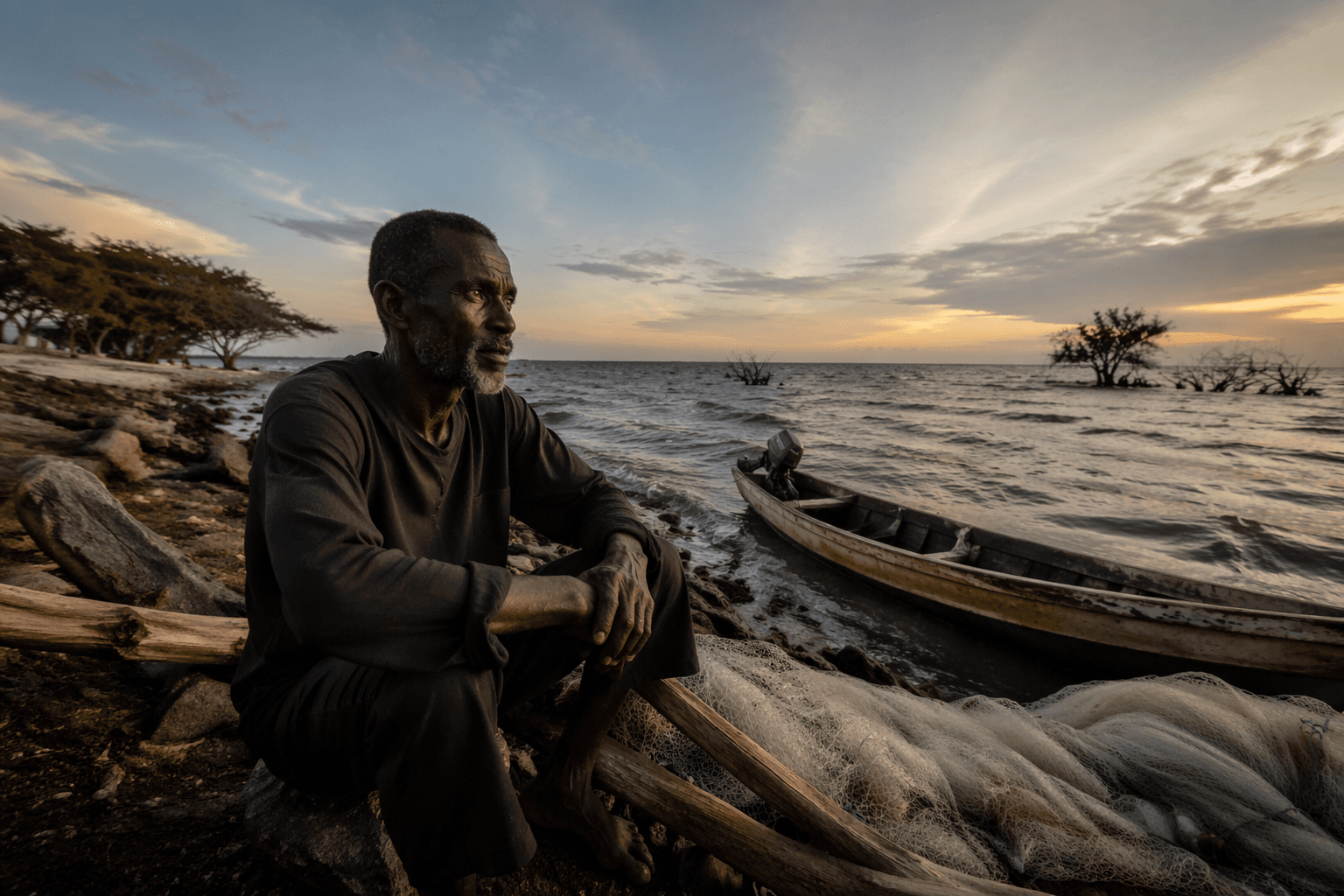
For fishermen and shoreline residents, the changes are not abstract. Rising waters have submerged former offices, homes, fishing grounds, and community infrastructure, forcing repeated displacement and making it difficult to know which parts of the lake are safe. When the shoreline moves, so does the map of daily life: landing sites disappear, paths flood, and places once considered stable become uncertain.
The human-wildlife interface is shifting too. One account from Lake Turkana fisherfolk says crocodiles have moved closer to human settlements as waters rise and habitats shift, with attacks surging. That creates a layered security problem: families lose access to traditional fishing areas, fear increases around the water’s edge, and the lake that once fed communities can become a zone of greater danger. This is how environmental change turns into economic loss, then social stress, and finally a daily safety crisis.
Heritage protection is now tied to survival
Lake Turkana National Parks was inscribed on the UNESCO World Heritage List in 1997 and placed on the World Heritage in Danger list in June 2018 because of upstream development concerns, including Ethiopia’s Gibe III dam. The site’s heritage status reflects more than landscape value. It recognizes that the lake’s biodiversity, fisheries, and shoreline cultures are inseparable, and that upstream intervention can destabilize all three at once.
UNESCO says a 2024 consultative meeting between Kenya and Ethiopia agreed on joint actions to report on impacts in the Omo River basin. The World Heritage Committee has also asked both countries to advance a Strategic Environmental Assessment for the Omo-Turkana Basin, a process that has been pending since 2014. Kenya has been asked to develop an operational plan, a monitoring system, and co-management arrangements with local communities, all of which point to a broader need for basin-wide governance rather than isolated emergency response.
In 2024, Kenya also participated in a UNESCO and ICESCO workshop in Rabat focused on the plan to remove the site from the danger list. That effort will matter only if it produces durable coordination on water levels, irrigation, flooding, fisheries, and community protection. Without that, Lake Turkana risks remaining what it has become in recent years: a place where climate adaptation, food security, wildlife conflict, and heritage conservation collide in real time.
The lake’s future will be decided not by water alone, but by how Kenya and Ethiopia manage the basin that feeds it. For the communities along its shores, that makes every change upstream a local economic event, a conservation event, and a security event all at once.
This article was produced by Prism’s automated news system from verified source data, official records, and press releases, then run through automated quality and moderation checks before publishing. The system is built and supervised by the people who set the standards it runs under. Read our full AI policy.
Know something we missed? Have a correction or additional information?
Submit a Tip