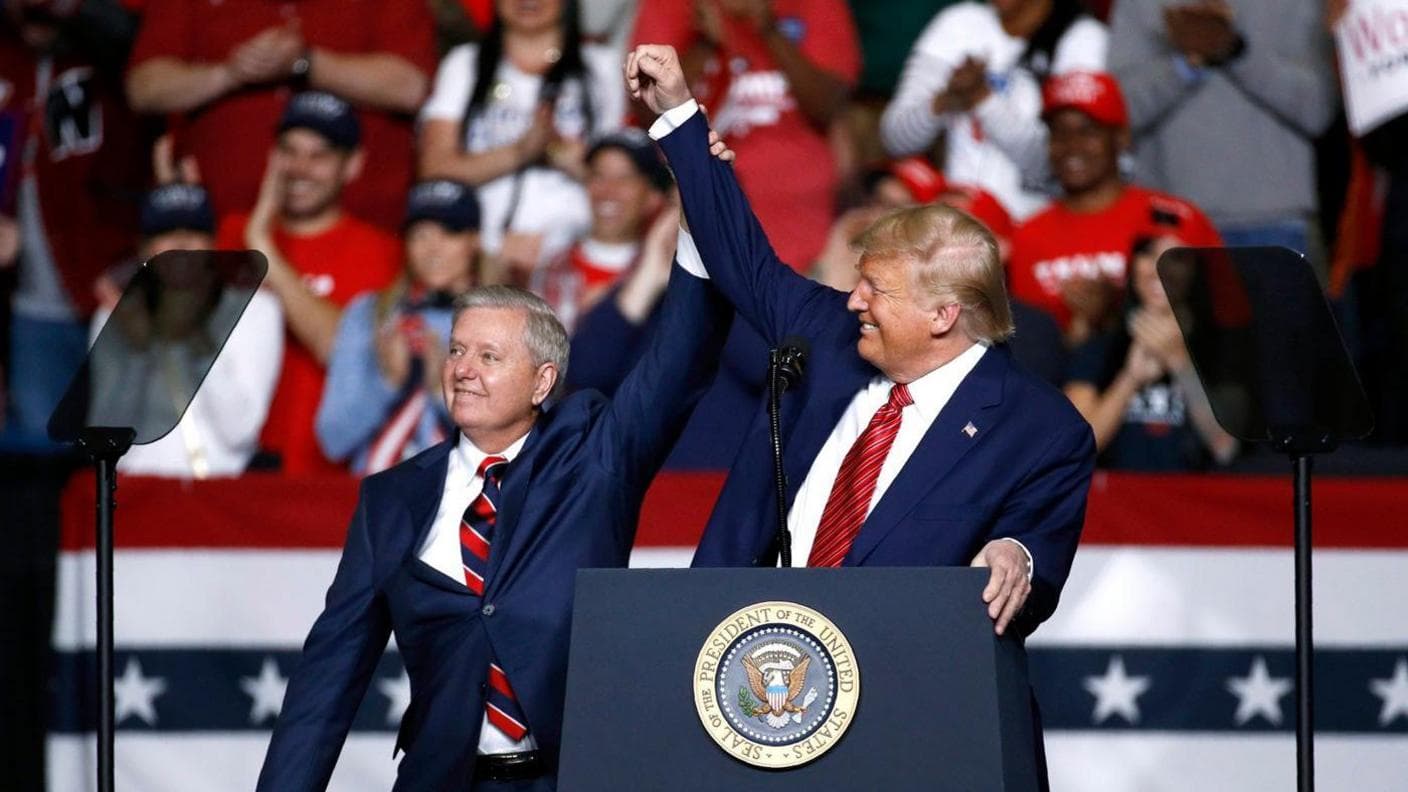
Lindsey Graham dies after sudden illness, Trump calls him like family
Trump said his last call with Lindsey Graham came hours before the South Carolina senator died at 71, setting off a fast succession fight.

Lindsey Graham died Saturday at 71 after a "brief and sudden illness," ending the career of a South Carolina Republican who had become one of Donald Trump’s closest Senate allies and one of the party’s most visible foreign-policy voices. Graham died hours after returning from a trip to Ukraine, and Trump said he spoke with him Saturday evening and that it "could've been his last call."
Graham had been running for reelection in 2026 and was seeking his fifth term in the U.S. Senate. He won the June 9 Republican primary with 56.8 percent of the vote, defeating Mark Lynch, while Annie Andrews won the Democratic nomination for the general election. His death removes the GOP’s nominee from a race that was already underway and forces South Carolina into a new round of campaigning.

South Carolina law allows the governor to make an interim appointment when a Senate vacancy occurs while the Senate is not in session, giving the state immediate authority to keep the seat filled. A special primary is set for August, putting the replacement process on a compressed timetable as Republicans and Democrats adjust their November strategies around a now-open Senate contest.

Graham’s career stretched from the House, where he was first elected in 1994, to the Senate, where he took office in 2002 and built one of the chamber’s most durable brands on defense and foreign affairs. He became a staunch Trump ally without surrendering his role as a key GOP voice on national security, a balancing act that gave him outsized influence inside the party and in the Senate. His absence leaves South Carolina Republicans to decide who inherits that position, and leaves the Senate without a veteran negotiator at a moment when legislative business and the November election are already tightly linked.
This article was produced by Prism’s automated news system from verified source data, official records, and press releases, then run through automated quality and moderation checks before publishing. The system is built and supervised by the people who set the standards it runs under. Read our full AI policy.
Did this article answer your question?