Los Alamos team uses geometry to resolve Schrödinger's century-old color perception
Los Alamos researchers led by Roxana Bujack used geometric methods to resolve a century-old question about color perception, a result that could boost local science work and tech applications.
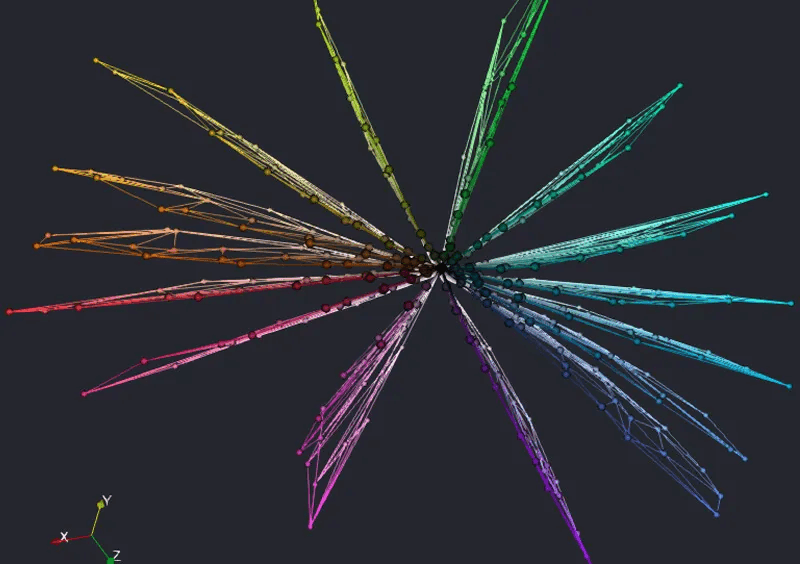
A Los Alamos National Laboratory team led by Roxana Bujack has applied geometry to mathematically define how people perceive differences in color, resolving a century-old issue first posed by physicist Erwin Schrödinger. The work, announced in a LANL release on January 29, 2026, reframes an abstract question about color into a rigorous geometric framework that clarifies when two colors look the same or different.
The research tackles long-standing ambiguity in the foundations of color science. Schrödinger and other early 20th century physicists proposed ideas about color perception that were qualitative; Roxana Bujack and her colleagues translated those ideas into precise mathematical language. By using geometric tools to define perceptual difference, the team moved from descriptive statements about color to testable, quantitative definitions.
The immediate scientific implication is clearer metrics for comparing colors. That clarity matters beyond theory: imaging systems, sensor calibration, remote sensing, display technology, and computer vision all rely on robust models of how humans or algorithms distinguish color. For Los Alamos County, the result strengthens the laboratory’s local research portfolio and underpins applied work on optics and sensing conducted on the Pajarito Plateau.
Local residents are likely to see indirect benefits. Advances that make color measurement more reliable can improve environmental monitoring, laboratory instrumentation, and visual diagnostics used in research and industry. Increased clarity in color perception may also help LANL collaborate with regional startups and university partners on applied projects, potentially supporting local hiring and contracting opportunities. Roxana Bujack’s leadership highlights the continuing role of Los Alamos scientists in turning fundamental math into tools with practical use.

From a policy perspective, the finding reinforces the value of funding basic research that feeds applied innovation. Mathematical breakthroughs of this kind often seed improvements in instrumentation and data analysis that later translate into commercial products or mission-critical capabilities. For Los Alamos County officials and community leaders, maintaining support for laboratory-led research and workforce development will be central to capturing any economic upside.
What comes next is further translation of the geometric definitions into software, calibration standards, and experimental tests that validate perceptual predictions. For readers in Los Alamos County, the milestone is a reminder that work happening at the lab on the Pajarito Plateau can shape technical standards and spur downstream opportunities in local science and technology sectors.
Sources:
Know something we missed? Have a correction or additional information?
Submit a Tip