Los Angeles arrests target cartel-linked family accused of fentanyl, guns trafficking
A Lancaster family, prosecutors said, moved fentanyl, pound quantities of meth and ghost guns while one co-defendant remained at large.
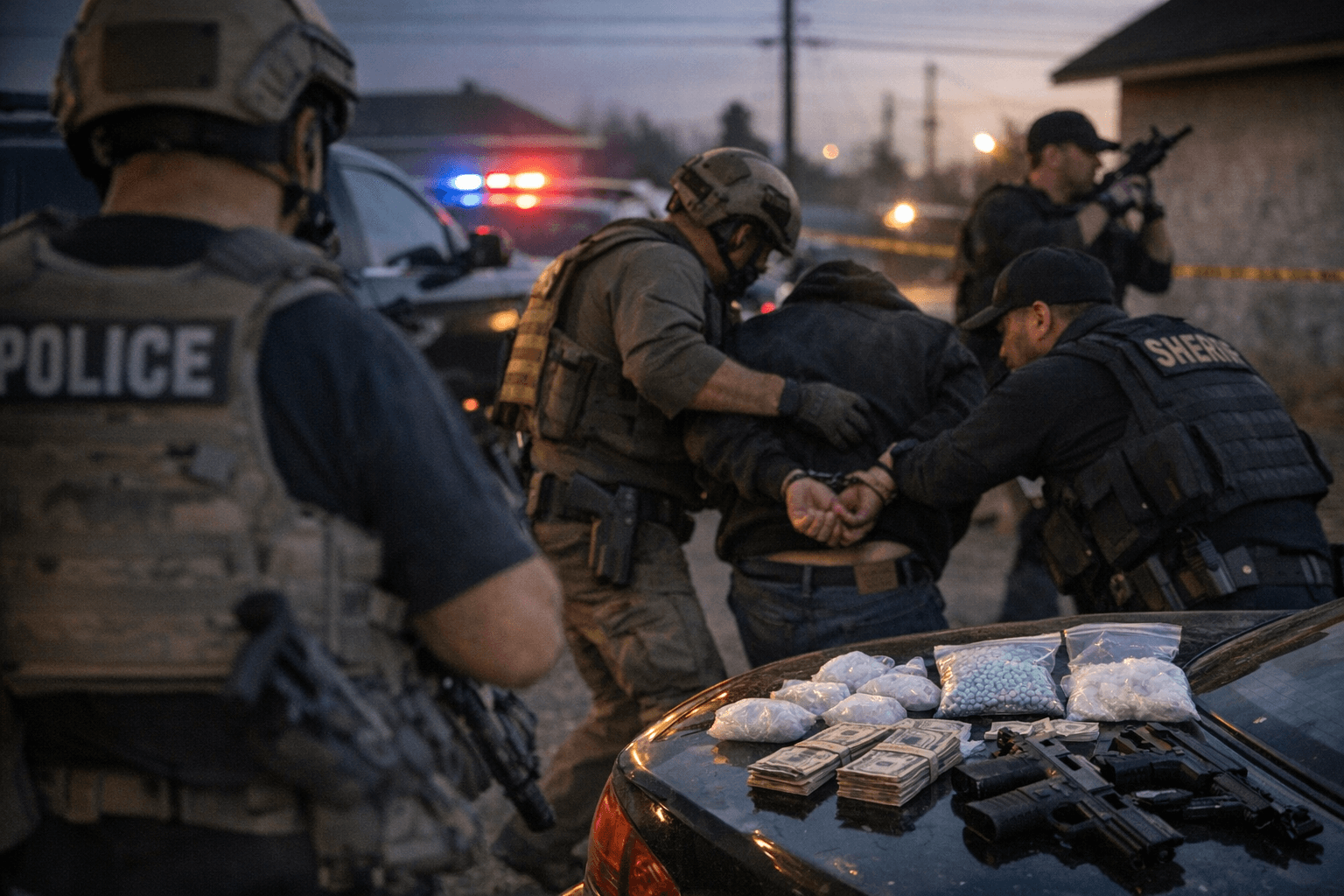
Federal authorities in Los Angeles moved against what prosecutors described as a family-run trafficking ring tied to the Sinaloa Cartel, arresting four defendants on a 29-count indictment that folded fentanyl, methamphetamine and firearms into one case. The structure of the allegations, officials said, showed more than street-level dealing. It pointed to a coordinated network built on kinship, repeated sales and weapons access.
The U.S. Department of Justice identified the arrested defendants as José Luis Salazar-Cruz, 44, Alfonso Salazar, 46, José Manuel Salazar, 22, and Jorge Humberto Salazar, 43. Prosecutors said José Luis Salazar-Cruz, Alfonso Salazar and Jorge Humberto Salazar were brothers, while José Manuel Salazar was José Luis Salazar-Cruz’s son. A fifth co-defendant, José Ángel López Paniagua, 23, of Littlerock, remained sought. The alleged conduct ran from February 2024 to December 2025.
Salazar-Cruz faced the heaviest slate of charges, including seven counts of alien in possession of firearms, seven counts of methamphetamine distribution, four counts of fentanyl distribution, one count of firearms trafficking, one count of possession of a destructive device and one count of possession of an unregistered short-barreled rifle. The indictment also charged the defendants with conspiracy to distribute controlled substances and conspiracy to engage in the business of dealing in firearms without a license.
Prosecutors said the family linked suppliers and buyers and met directly with customers, with multiple drug sales involving about one pound of methamphetamine. That scale matters. It places the case in the lane federal authorities increasingly treat as a public-safety and border-security threat, where narcotics trafficking and gun crime reinforce one another. The alleged use of firearms without serial numbers added another layer of difficulty for investigators trying to trace weapons recovered in later crimes.
The firearms side of the case is especially significant because the Bureau of Alcohol, Tobacco, Firearms and Explosives says its National Tracing Center is the nation’s only crime-gun tracing facility. ATF also says the vast majority of privately made firearms lack serial numbers or other markings traceable to a federal firearms licensee, which makes ghost guns harder to investigate once they move into criminal hands. In a case like this, that can complicate everything from trafficking probes to violence-linked homicides.
The arrests came amid sustained federal pressure on the Sinaloa Cartel. In May 2025, the Justice Department separately charged alleged cartel leaders with narco-terrorism and material support of terrorism, signaling how aggressively prosecutors now frame cartel-linked operations. The public-health backdrop is just as stark: CDC provisional data show overdose deaths fell in 2024, but fentanyl remains a major driver of mortality. Against that backdrop, a family case in Lancaster and Hesperia becomes more than a local indictment. It is another look at how cartel logistics can be embedded in ordinary neighborhoods, then carried through guns, drugs and blood ties.
This article was produced by Prism’s automated news system from verified source data, official records, and press releases, then run through automated quality and moderation checks before publishing. The system is built and supervised by the people who set the standards it runs under. Read our full AI policy.
Did this article answer your question?


