Machine learning maps Earth's underground carbon network through fungi
Machine learning is exposing fungi as a hidden climate system. The new maps show why underground networks matter for carbon storage, farm soils, and land policy.
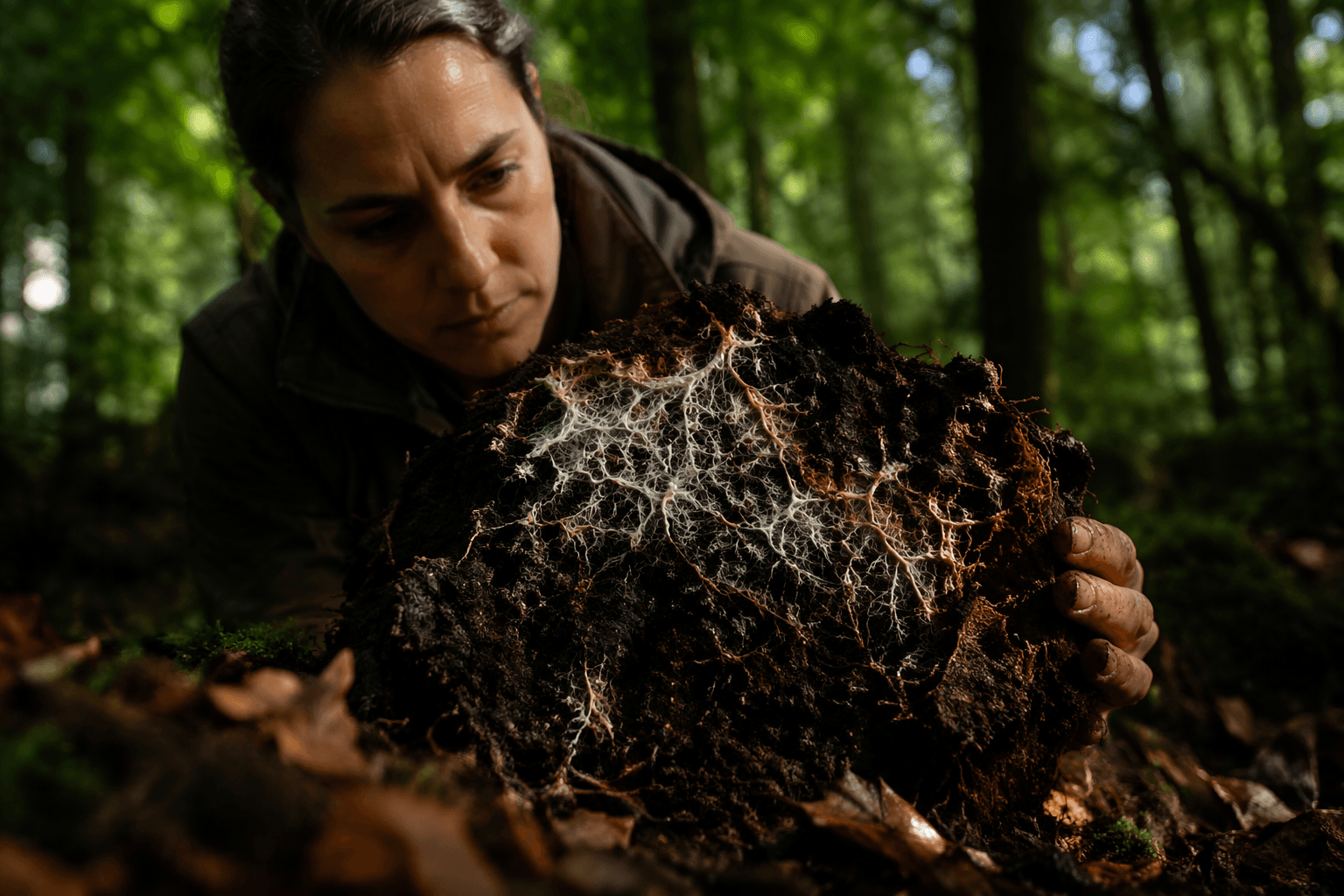
Plants are not just growing above ground and rooting below it. They are feeding a vast underground exchange system, sending a share of their photosynthetic carbon to roots and onward to mycorrhizal fungi, where some of it can end up in soil organic matter. That hidden pathway is now being measured with machine learning and a custom imaging robot that can track more than 500,000 fungal nodes at once, making fungi harder to ignore in climate and agriculture debates.
Why the underground network matters
Mycorrhizal fungi sit at the center of an economy that moves carbon, nutrients, and water through soils. Plants pull carbon dioxide from the air during photosynthesis, then direct a portion of that carbon belowground to roots, where it is transferred to fungi. Some of that carbon is incorporated into hyphae, and when those hyphae die and decompose, it can become part of soil organic material.
That process is not a small side effect of plant growth. Earlier Science reporting said plants can send as much as 20 percent of their photosynthetic production through mycorrhizae, a figure that helps explain why scientists treat fungal networks as a major pathway in Earth’s carbon cycle. In practical terms, that means soil is not just a place where carbon sits passively; it is an active, living system that can move, store, and recycle it.
What the new tools change
The latest advance is not just a new conclusion, but a new way of seeing. A Nature study used a custom-designed robot for high-throughput time-lapse imaging that could track over 500,000 fungal nodes simultaneously, offering a far more detailed view of how these networks form and expand. That kind of scale matters because fungal trade networks are dynamic, branching, and hard to measure with older techniques.
For decades, ecologists have relied on field measurements, stable isotope analyses, and fungal sequencing to show that root-associated fungi help regulate ecosystem carbon dynamics. The new machine-learning and robotic approach does not replace those methods; it expands them, allowing scientists to watch fungal systems in motion rather than infer their behavior from smaller snapshots. That opens the door to better estimates of how much carbon these networks hold, how quickly they move, and how their structure changes across different landscapes.
From decomposition to ecosystem infrastructure
The scientific picture of fungi has widened well beyond the idea of mushrooms and decay. Mycorrhizal fungi help plants acquire phosphorus and nitrogen, two nutrients that often limit growth, and they can improve soil structure by hindering water loss and erosion. They also help protect plants against pathogens and toxic wastes, which makes them part of a broader support system for ecosystems under pressure.
That is why fungal networks matter to more than climate science. In agriculture, they shape nutrient efficiency and soil resilience. In restoration projects, they can influence whether replanted landscapes recover or struggle. In climate research, they affect whether carbon stays in soils or returns to the atmosphere.
A long scientific history now getting a sharper map
The underground partnership between plants and fungi has been on the scientific record since the late 1880s, when the German forester A. B. Frank investigated how truffles and related fungi propagate and described a mutual support network beneath the surface. More than a century later, the basic insight remains the same, but the tools are much more powerful. Researchers can now watch the exchange network at a granularity that early naturalists could only imagine.
A major 2012 Science paper by Christensen, William Reeburgh, Camill, and T. E. M. Treseder added another layer to that story by concluding that roots and associated fungi drive long-term carbon sequestration in boreal forest soils. That finding linked fungal partnerships directly to climate-relevant carbon storage in boreal forests, one of the world’s most important terrestrial carbon reservoirs. The new imaging work strengthens that line of inquiry by showing how those networks can be observed and measured at scale.
Why land-use and soil policy should care
The policy implications are straightforward: if fungal networks help lock carbon into soils, move nutrients to crops, and stabilize land against erosion, then soil management becomes a climate tool, not just an agricultural practice. That shifts the debate from yield alone to the health of the underground infrastructure that supports yield, storage, and resilience. It also suggests that land-use decisions that damage fungal communities can carry costs that do not show up in harvest totals immediately.
This matters in forests, grasslands, and farms alike. In boreal forests and the circumpolar north, where soils are a major carbon store, disruption to root-fungal partnerships could weaken long-term sequestration. In working lands, policies that encourage practices protecting soil structure and microbial life could improve water retention, reduce erosion, and support nutrient uptake without relying so heavily on external inputs.
A broader mapping effort is already underway
The robot study fits into a larger push to map the underground world more precisely. A 2025 Nature study used machine learning trained on 25,000 geolocated soil samples to make high-resolution global maps of mycorrhizal fungal richness, and those maps showed that fungal biodiversity is vast but still poorly protected. That is a crucial point for conservation, because it suggests that fungal diversity deserves the same geographic attention that is already given to forests, wetlands, and coral reefs.
Together, these efforts change the framing of soil from background medium to contested ecological infrastructure. The work also reinforces a simple but consequential idea: climate and agriculture policy cannot be fully effective if it ignores the underground networks that regulate carbon, nutrients, and plant survival. The more precisely those networks can be mapped, the easier it becomes to design land management that protects them rather than erasing them.
This article was produced by Prism’s automated news system from verified source data, official records, and press releases, then run through automated quality and moderation checks before publishing. The system is built and supervised by the people who set the standards it runs under. Read our full AI policy.
Did this article answer your question?