Magnitude 5.4 Earthquake Rattles Northern Cebu, Prompts Evacuation Fears
A magnitude 5.4 quake struck 17 km southeast of Bogo City at 3:22 p.m. Monday, sending students fleeing classrooms as PHIVOLCS warned of aftershocks.
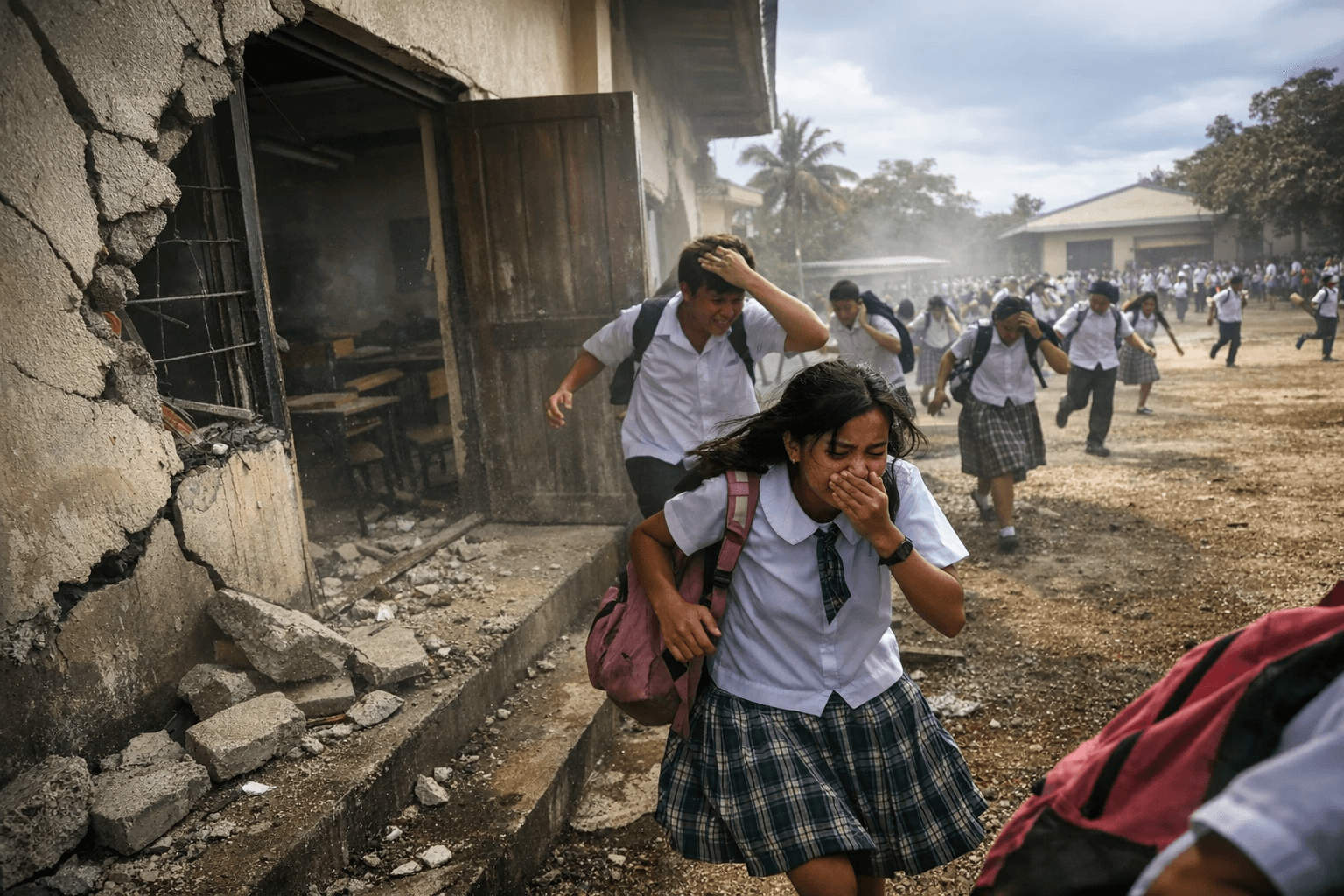
A magnitude 5.4 earthquake struck off northern Cebu province Monday afternoon, shaking communities across Cebu and Leyte and sending students scrambling for safety as authorities raced to assess the damage.
The Philippine Institute of Volcanology and Seismology recorded the tremor at approximately 3:22 p.m., with its epicenter located about 17 kilometers southeast of Bogo City at a shallow depth of around 10 kilometers. PHIVOLCS classified the event as a moderate quake and immediately warned of possible aftershocks, noting that the shallow depth increased the likelihood of pronounced ground shaking across nearby population centers.
The shaking was felt broadly across the Eastern Visayas region. At Palompon Institute of Technology in Leyte, students "rushed out of their classrooms" when the tremor hit. Schools and businesses throughout northern Cebu reported similar scenes, with people streaming outdoors as the ground moved beneath them.
Local municipal authorities in northern Cebu launched damage assessments shortly after the quake and advised residents to follow established earthquake safety protocols. Early reports indicated minor structural incidents and scattered power interruptions in isolated areas, but as of initial assessments, no widespread major damage or mass casualties were confirmed.
Civil-defense officials urged residents to inspect buildings for cracks, avoid structures showing signs of damage, and monitor official advisory channels for updates. Regional rescue and response teams remained on standby as authorities worked through their evaluations.
The April 6 event carries particular weight for communities still recovering from a magnitude 6.9 earthquake that struck northern Cebu in late 2025. Seismological analysts suggested the new tremor may represent part of an aftershock sequence connected to that larger event, which caused significant damage across the same general area and left residents acutely attuned to any new ground movement.
For national disaster authorities and seismologists, the pattern of activity will determine whether the region faces a short burst of aftershocks or a more protracted sequence requiring extended response planning. Officials reiterated drop-cover-hold guidance and instructed residents to secure heavy objects indoors, remaining prepared to evacuate any building where structural compromise is suspected.
With engineering inspections of bridges, schools, and health facilities underway, authorities were prioritizing the structures most essential to the region's daily function and emergency response capacity, a calculus the 2025 earthquake made painfully familiar.
This article was produced by Prism’s automated news system from verified source data, official records, and press releases, then run through automated quality and moderation checks before publishing. The system is built and supervised by the people who set the standards it runs under. Read our full AI policy.
Did this article answer your question?


