Ukraine Targets Russian Oil Infrastructure to Cut War Funding at Its Source
Ukraine's drone campaign cut Russia's oil exports by 43% in one week, costing Moscow an estimated $1 billion as the Persian Gulf conflict drove prices above $100 a barrel.
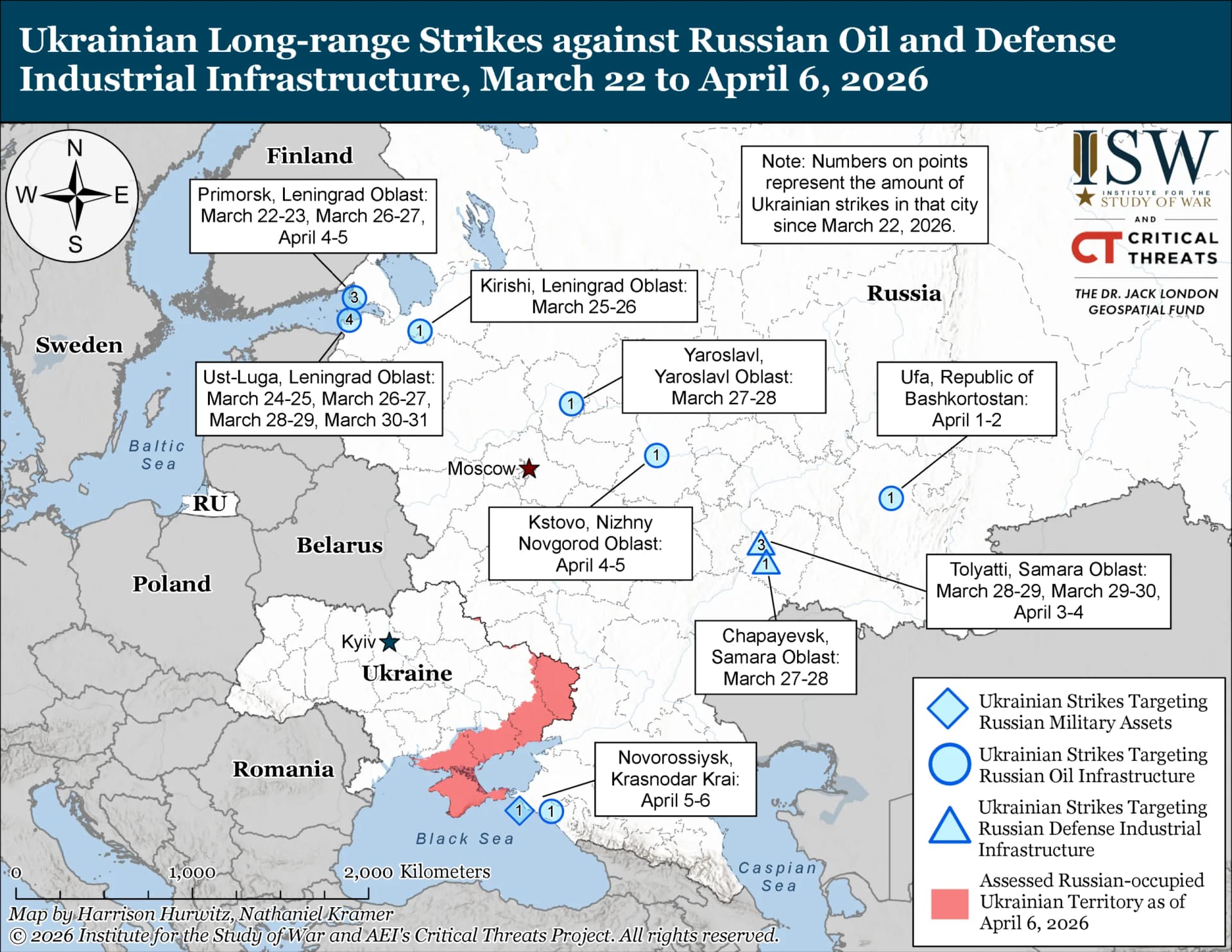
Russia's energy windfall from the Persian Gulf conflict arrived just as Ukraine began dismantling the infrastructure needed to collect it. Over two weeks of intensifying drone strikes, Kyiv's forces hit refineries from the Baltic coast to the Volga basin, disrupted two of Russia's three major oil export corridors, and slashed the country's total seaborne crude shipments nearly in half.
The campaign tracks a specific financial logic. Moscow's Urals crude blend, which had languished near $40 per barrel as recently as late February, surged once US-Israeli strikes ignited the war against Iran, pushing global oil prices above $100 for the first time since 2022. For a Russian federal budget already reeling from oil and gas revenues of 8.5 trillion rubles ($107.5 billion) in 2025, their weakest reading in years, the timing looked like a rescue. Moscow's fossil fuel earnings reached €7.7 billion in just the first two weeks of the Iran war, roughly €372 million per day and about 14% above February's average.
Ukraine moved to intercept that revenue at its source. On March 22-23, drones struck the Baltic port of Primorsk, igniting a fuel depot, setting fire to most of the terminal's berths, and engulfing two tankers. Planet Labs satellite imagery confirmed the fires. The Ust-Luga terminal, Russia's other primary Baltic export hub, was struck three times in five days. Together, Primorsk and Ust-Luga handle more than 40% of Russia's seaborne oil exports and move roughly 2 million barrels of crude per day.
On March 25-26, drones hit the KINEF Kirishi refinery in Russia's Leningrad region, owned by Surgutneftegas, with an annual processing capacity of approximately 20 million tonnes. The plant was forced to cease operations entirely, leaving all three of Russia's major Baltic oil logistics hubs simultaneously offline.
The economic damage was measurable. Russia's total oil exports fell 43% in the week of March 22-29, dropping from 4.072 million barrels per day to 2.318 million. Only 22 tankers departed, 15 fewer than the prior week; Primorsk loaded four tankers instead of the usual 10. Bloomberg estimated the disruption cost Moscow approximately $1 billion in lost revenues that week alone, with strikes at Primorsk destroying roughly $200 million worth of oil at that single port. President Volodymyr Zelensky acknowledged that "40 percent of their capabilities remained at that facility" after the Ust-Luga strikes.

The campaign then reached deeper into Russian territory. On April 5, Robert "Madyar" Brovdi, commander of Ukraine's Unmanned Systems Forces, confirmed a strike on the Lukoil-owned NORSI refinery in Kstovo, roughly 800 kilometers inside Russia in Nizhny Novgorod Oblast. The plant processes 17 million tonnes of crude annually, produces more than 50 types of petroleum products including aviation and diesel fuel, and provides nearly 30% of the gasoline consumed by the Moscow region while directly supplying fuel to Russian forces. The facility's combined heat and power plant was also struck. The following day, Ukraine hit the Black Sea energy hub of Novorossiysk, which handles roughly 1.5% of global oil supplies and carries a loading capacity of 700,000 barrels per day, reporting damage to mooring, loading, and storage infrastructure.
Across the full campaign, Ukraine struck 13 sites and seriously damaged at least eight refineries. Combined with the effective halt of Druzhba pipeline exports to Hungary and Slovakia since January, roughly 40% of Russia's total oil export capacity has been disrupted.
The strikes carry a complicating diplomatic dimension: by targeting Russia's export terminals, Ukraine contributes to the same price spike that partially rewards Moscow. Several Western allies reportedly pressed Kyiv to pause the attacks. Ukraine refused. For Kyiv, the arithmetic is straightforward: even at $100 per barrel, a barrel Russia cannot ship produces no revenue at all.
This article was produced by Prism’s automated news system from verified source data, official records, and press releases, then run through automated quality and moderation checks before publishing. The system is built and supervised by the people who set the standards it runs under. Read our full AI policy.
Did this article answer your question?


