Magyar Poised to Become Prime Minister After Orbán Defeat in Hungary
Péter Magyar was set to take power after a record-turnout election ended Viktor Orbán's 16-year rule, but the real test is whether Tisza can break old networks.
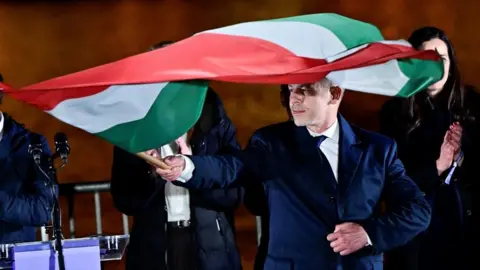
Péter Magyar was set to be formally elected prime minister as Hungary’s new parliament convened in Budapest, with thousands expected outside the neo-Gothic parliament building for what Magyar called a “regime-change celebration.” The scene marked more than a transfer of office. It was a test of whether the man who ended Viktor Orbán’s 16-year grip on power could turn a landslide vote into lasting institutional change.
Hungary’s parliamentary election on April 12 delivered Tisza a two-thirds supermajority in the 199-seat National Assembly, a margin that gives Magyar the numbers to rewrite laws and, if he chooses, press constitutional changes. Tisza won 52.1% of the party-list vote and 136 seats, according to verified results, after turnout climbed to about 79%, one of the highest levels in post-Communist Hungary. Orbán conceded defeat on election day, closing the book on 16 consecutive years of Fidesz-led government.

The scale of the result made Magyar’s victory the biggest opposition breakthrough in Hungary’s post-Communist era. It also sharpened the central question now facing his incoming government: whether the promise of “regime change” can reach beyond electoral arithmetic and into the institutions that sustained Orbán’s system. That means media, courts and corruption oversight, the areas where power in Hungary has often proved harder to dislodge than any government.
Magyar has already pointed to those fault lines. He said he would establish an anti-corruption office to investigate alleged misuse of public money under Orbán, and he has said he wants to suspend state media news services until “objective” and “impartial” reporting can be ensured. Those pledges signal an early effort to confront the public broadcaster and the patronage networks that critics say became embedded across the state during Fidesz rule.

The battle is not only domestic. Before taking office, Magyar traveled to Brussels for talks with European Commission President Ursula von der Leyen, as Hungary and the European Union discussed the release of about 17 billion euros in frozen funds. Roughly 11 billion euros in recovery money must be drawn by mid-August or be lost, giving the new government an urgent financial incentive to show progress on rule-of-law reforms. The coming months will show whether Magyar’s mandate becomes a clean break with Orbán’s era or a harder fight against the structures that survived it.
This article was produced by Prism’s automated news system from verified source data, official records, and press releases, then run through automated quality and moderation checks before publishing. The system is built and supervised by the people who set the standards it runs under. Read our full AI policy.
Did this article answer your question?

