Mask debate becomes central obstacle in DHS funding showdown
Masks on federal agents are central to DHS funding talks as Democrats demand reforms and Republicans warn of officer safety risks ahead of a looming deadline.
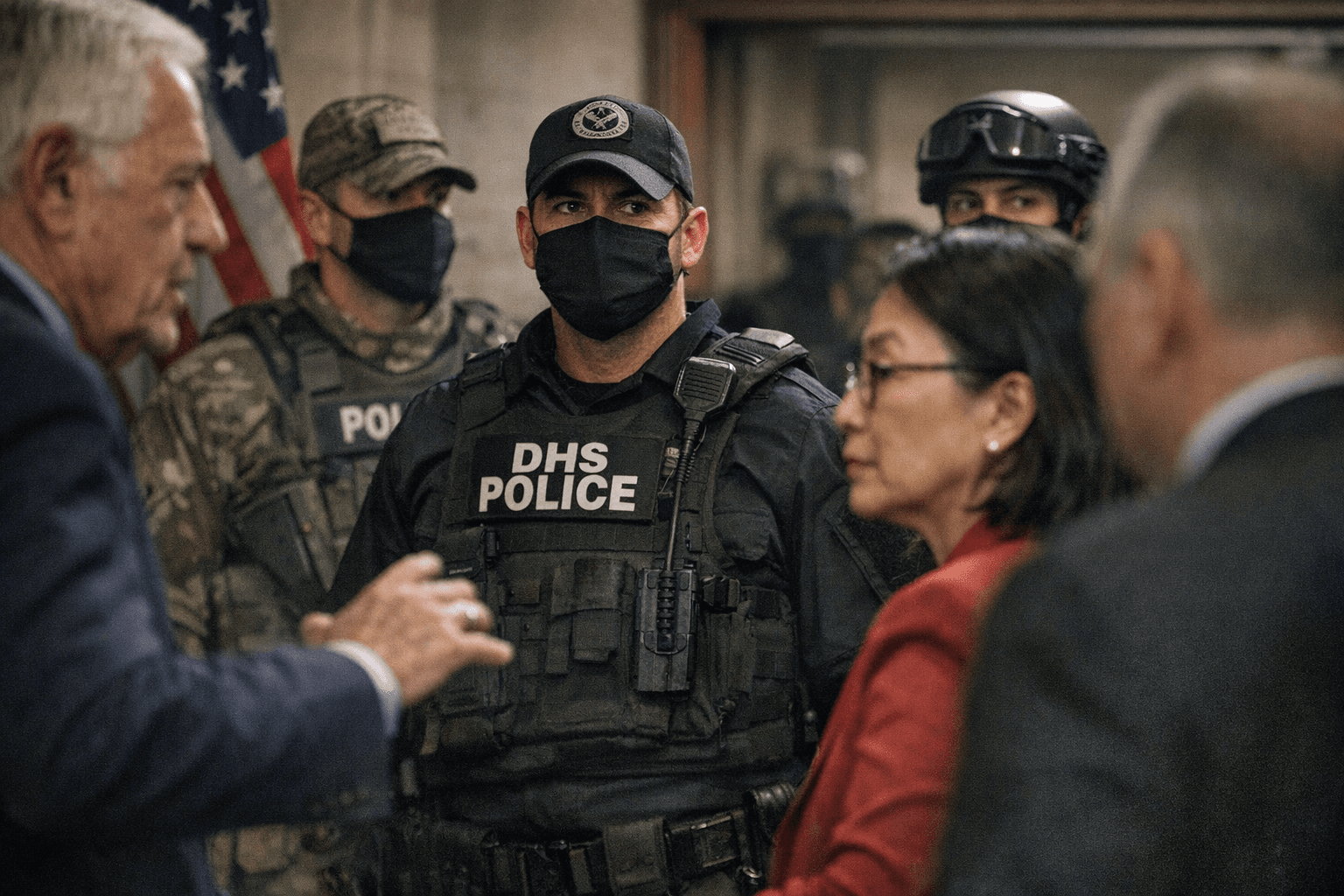
Images of masked ICE and other federal immigration officers have hardened into a political flashpoint as Congress races to finalize long-term funding for the Department of Homeland Security. Lawmakers and agency officials are clashing over a package of reforms that Democrats have tied to DHS funding, while DHS supporters and some Republicans argue that a ban on masks would endanger agents and complicate operations.
After a brief government shutdown ended Tuesday, Congress has funded the Department of Homeland Security only through the end of next week. Whether to ban the masks - or allow the masking to continue - has emerged as a central question in the debate in Congress over funding Homeland Security ahead of Friday’s midnight deadline, when it faces a partial agency shutdown. That short funding window has concentrated negotiations around reforms to immigration enforcement amid heightened public scrutiny of field operations.
Senate Democratic Leader Chuck Schumer and House Democratic Leader Hakeem Jeffries released a joint letter to House Speaker Mike Johnson and Senate Republican Leader John Thune outlining the conditions Democrats want for long-term DHS funding. The demands include targeted enforcement, no masks, require identification, protect sensitive locations such as schools, hospitals, churches and polling places, stop racial profiling, uphold use-of-force standards, ensure state and local coordination and oversight, build safeguards into the system, require body cameras, and no paramilitary-style police units. “These are common-sense solutions that protect constitutional rights and ensure responsible law enforcement,” the leaders wrote.
Republicans have pushed back, saying several measures would undermine officer safety. Rep. Tim Burchett (R-Tenn.) pushed back on the proposed ban on ICE agents wearing masks while on duty, reflecting a broader GOP concern that unmasking agents could expose them to doxxing, harassment and physical threats. Supporters at DHS say masks protect agents from doxxing and threats. Noting both security and transparency pressures, DHS Secretary Kristi Noem has suggested that ICE agents could be outfitted with body-worn cameras as soon as funding becomes available. She said officers in the Twin Cities region would be issued cameras as part of Operation Metro Surge.
Public opinion complicates the politics: a Quinnipiac poll cited in the coverage shows more than 90% of respondents want ICE agents to wear body cameras, about six in 10 think agents should be prohibited from wearing masks, and 51% of voters believe ICE funding should be cut. The poll also indicates a majority of Americans favor giving migrants in the U.S. illegally a path to citizenship. Those numbers give Democrats a public-opinion argument for accountability measures even as GOP leaders emphasize safety concerns.
Experts and observers warn the debate touches deeper issues of policing norms and community trust. “Humans read each others’ faces - that’s how we communicate,” Justin Smith, a former Colorado sheriff and executive director and CEO of the National Sheriffs' Association, said in ABC News reporting. “When you have a number of federal agents involved in these operations, and they can’t be identified, you can’t see their face, it just tends to make people uncomfortable. That’s bringing up some questions.” Meanwhile, analysts note that masking can shield officers from online harassment yet risks inciting fear and eroding accountability.
File images have crystallized the symbolism: federal immigration enforcement agents shattering a truck window and detaining two men outside a Home Depot in Evanston, Ill., Dec. 17, 2025 (Ashlee Rezin/Chicago Sun-Times via AP, File); federal agents conducting immigration enforcement operations Feb. 5, 2026, in Minneapolis (AP Photo/Ryan Murphy, File); police and federal officers throwing gas canisters to disperse protesters near an ICE facility in Portland, Ore., Oct. 5, 2025 (AP Photo/Ethan Swope, File).
With the funding clock ticking, lawmakers must weigh operational continuity for ICE, Customs and Border Protection, TSA, FEMA and the Secret Service against mounting public pressure for transparency and safeguards. The outcome will shape both immigration enforcement practices and a broader debate about police accountability in federal operations.
This article was produced by Prism’s automated news system from verified source data, official records, and press releases, then run through automated quality and moderation checks before publishing. The system is built and supervised by the people who set the standards it runs under. Read our full AI policy.
Did this article answer your question?