China Passes Sweeping Ethnic Unity Law Cementing Xi's Assimilation Push
China's legislature approved a landmark law formalizing assimilation of ethnic minorities, drawing sharp criticism from legal scholars and human rights groups.
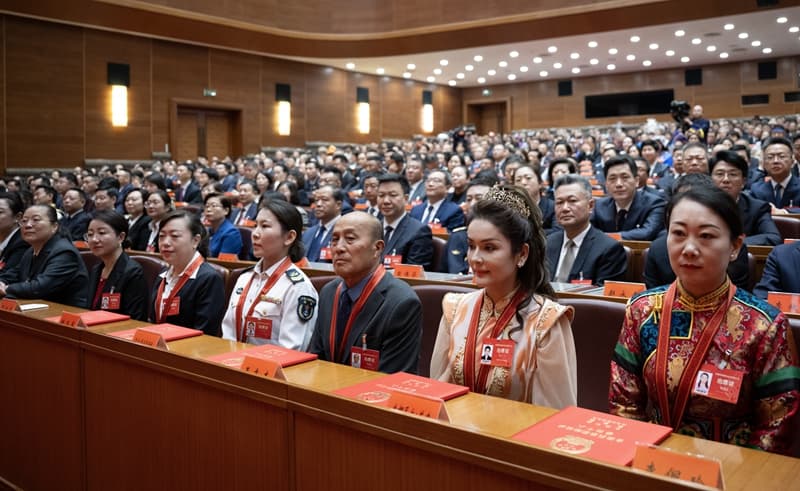
China's National People's Congress approved the Promoting Ethnic Unity and Progress law on Wednesday, formalizing President Xi Jinping's decade-long campaign to absorb the country's ethnic minorities into a Han-dominated national identity and cementing what critics call the most aggressive assimilationist policy framework since the founding of the People's Republic.
The law, designated a "basic statute" requiring approval by the full legislature rather than its standing committee, mobilizes government bodies, private enterprises, religious institutions, neighborhood committees, and the military to advance ethnic assimilation. The All-China Women's Federation is among the state-affiliated groups explicitly required to participate in promoting ethnic unity.
Lou Qinjian, the NPC delegate who introduced the proposal, said the law is designed to foster "a stronger sense of community among all ethnic groups in the Chinese nation." In a separate statement, NPC spokesperson Lou Qinjiang said it "aims to ensure the party's comprehensive leadership over ethnic affairs, improve institutional mechanisms for strengthening a sense of a shared community for the Chinese nation and to support ethnic minority regions in better integrating into the country's overall development."
The law's provisions reach deep into public and private life. It lowers the status of minority languages in favor of Mandarin, encourages intermarriage between Han Chinese and other ethnicities by prohibiting restrictions on such unions, and requires parents to "educate and guide minors to love the Chinese Communist Party." It also prohibits, in broad terms, any acts deemed damaging to "ethnic unity," a formulation critics warn could be applied to silence virtually any expression of minority identity.
Magnus Fiskesjö, an associate professor of anthropology at Cornell University, argues the law directly contradicts China's own constitution. Article 4 of the General Principles states: "All ethnic groups shall have the freedom to use and develop their own spoken and written languages." Fiskesjö was unsparing in his assessment: "The new law now to be enacted, 'Promoting Ethnic Unity and Progress,' openly contradicts the constitution. The law makes it clearer than ever that in President Xi Jinping's PRC non-Han peoples must do more to integrate themselves with the Han majority, and above all else be loyal to Beijing."

He warned the law could presage an even more radical step: "The next step may be the formal abolishment of 'ethnic minorities' as such, as long advocated by radical elements inside the Chinese regime."
The law's passage follows years of escalating regional enforcement. Similar regulations were introduced in the Tibet Autonomous Region in 2020 and in the Xinjiang Uyghur Autonomous Region and Inner Mongolia in 2021. The U.S. Congressional-Executive Commission on China has tied those earlier programs to severe abuses, including the "becoming family" initiative, under which ethnic minority families in Xinjiang were forced to house Communist Party cadres. The CECC reported that "women in these families have been subjected to rape and sexual abuse as a result of such programs."
The legislative push accelerated after the Communist Party called for the law's enactment in its 2024 Third Plenum Decision. The full Politburo reviewed a draft last August, the first such disclosure in nearly four decades, and the NPC Standing Committee referred it to the full legislature in December.
Beijing has defended the law as essential to "modernisation through greater unity." Xi Jinping has repeatedly called for the "Sinicisation of religion," requiring religious practice to conform with Communist Party values, and the new statute is widely seen as a legal capstone to that program. For China's roughly 55 recognized ethnic minority groups, the question is no longer whether assimilation is policy; it is now codified as law.
This article was produced by Prism’s automated news system from verified source data, official records, and press releases, then run through automated quality and moderation checks before publishing. The system is built and supervised by the people who set the standards it runs under. Read our full AI policy.
Know something we missed? Have a correction or additional information?
Submit a Tip