Mason Gordon's SlamBall: Trampoline Basketball Born in 1999, Relaunched 2023
Mason Gordon's SlamBall, conceived in 1999 and relaunched in 2023, fused trampoline acrobatics with contact sport and returned with safety-focused rules and a modern commercial push.
%3Afilters%3Aquality(100)%2Fimages%2Fstory%2F11711%2Fslamballedit_690w.jpg&w=1920&q=75)
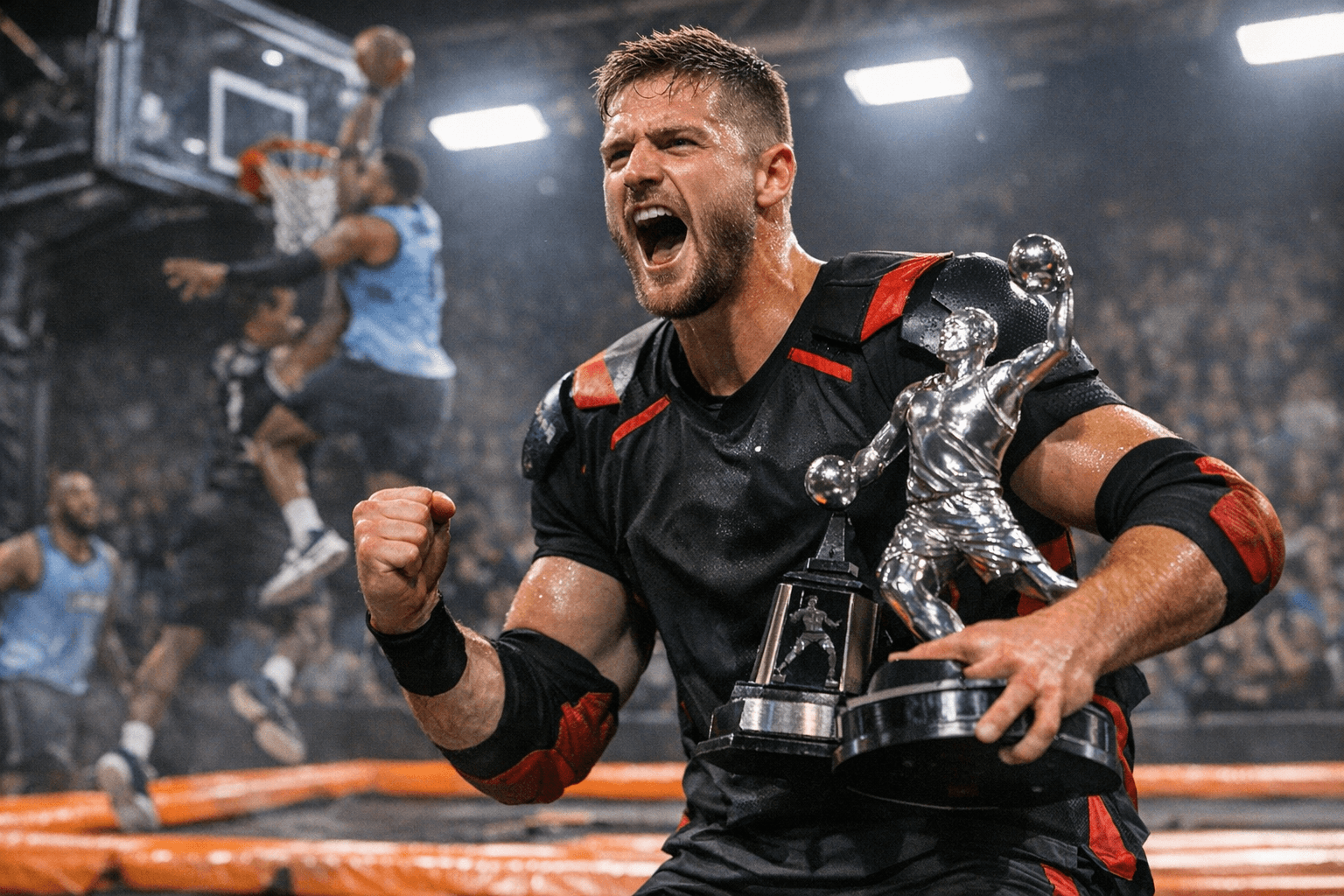
Mason Gordon invented SlamBall in 1999 and spent the early 2000s shaping a rule set and a player culture built for verticality and impact. Partnering with producer Mike Tollin, Gordon constructed a prototype court in an East Los Angeles warehouse and recruited the first players who trained to master a hybrid sport that blends basketball, football, hockey, and acrobatics. The game’s defining mechanics - four trampolines at each end, an acrylic dasher wall around the playing surface, and a scoring system that values slam dunks and long-range shots differently from traditional basketball - were set in those formative years.
SlamBall’s on-court product has always been spectacle-driven but also tactical. The trampolines change basic timing and spacing: offenses design plays around vertical rhythm and rebound angles while defenses must contend with contact-oriented collisions near the rim and off-the-wall plays that mimic puck-board ricochets in hockey. Early players were trained to adapt to high-flying, contact-oriented play, creating rosters that favored explosiveness and resilience over conventional backcourt skill sets. Teams typically organized around trampoline specialists and athletes who could exploit the scoring premium for dunks and long-range attempts, producing fast-paced, high-scoring affairs where momentum shifts happened on a single airborne sequence.
The 2023 relaunch kept SlamBall’s core theatrics but shifted the enterprise toward modern safety and commercial realities. Gordon remained a central figure guiding rule updates and court-safety protocols, including mandatory helmets and scrum caps. Those changes reflect a broader recalibration across action sports: preserve the spectacle while mitigating long-term injury risk. The relaunch also embraced a contemporary commercial strategy to position the sport for broadcast and streaming-friendly packaging and to attract athletes, sponsors, and event partners in a crowded entertainment landscape.

Culturally, SlamBall’s origin in an East Los Angeles warehouse and its synthesis of multiple sports speaks to a wider urban athletic vernacular. The sport tapped into street-level creativity and action-sport aesthetics long before legacy leagues chased similar crossover audiences. Its return offers an alternative pathway for players with nontraditional basketball skill sets and gives fans a condensed, highlight-ready competition that plays well on social platforms.
For fans, players, and promoters, the story is about more than flash. SlamBall’s evolution tests how far spectacle can be codified into sustainable sport - balancing athlete safety, competitive integrity, and commercial growth. As the league pursues its next seasons, the key questions will be talent development, health outcomes under new safety protocols, and whether the high-flying product can find a durable niche in the modern sports marketplace.
Sources:
Know something we missed? Have a correction or additional information?
Submit a Tip