Mayor’s Quarterly Data Shows San Francisco Encampments and RVs Hit New Lows
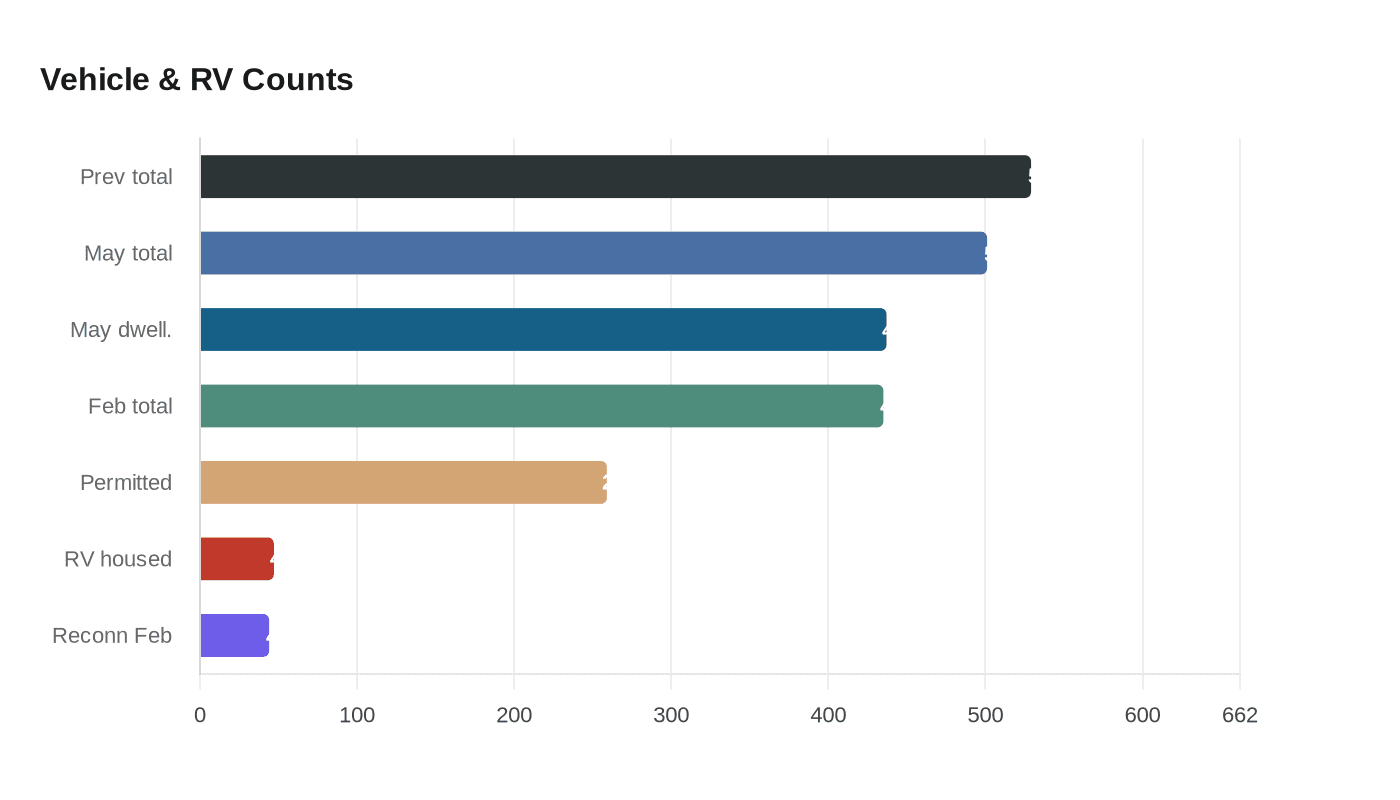
San Francisco reported 155 street encampments in February (61 tents, 94 structures) and 435 people living in vehicles, while city programs credit 47 households housed through an RV pilot.

San Francisco’s latest quarterly street-homelessness report shows 155 encampments as of February — 61 tents and 94 structures — and 435 people living in RVs or large vehicles, with 259 of those vehicles listed as permitted, city officials reported. The mayor’s office credited pilot programs and new policy measures for the declines and highlighted program outcomes including 47 households housed through an RV housing pilot enacted in 2025.
The February total of 155 encampments follows a prior-quarter count of 162 (61 tents, 101 structures), a drop the city says represents a new low under Mayor Daniel Lurie. Lurie released a recorded statement saying, “We have good news to report on our work to get people off the street and onto a path to stability,” and added, “We have much more work to do, there is no question about that. But we are on the right path and we will continue to drive forward on this plan.”
City officials pointed to two programmatic shifts as drivers of the change. The RV pilot launched last year has moved 47 households out of vehicular dwelling into housing placements, and the Journey Home program — expanded in January through a partnership with Glide nonprofit — reconnected 44 people in February, the highest monthly total since 2022, city materials state. The mayor’s Breaking the Cycle legislation, introduced to the Board of Supervisors, names District 7 Supervisor Myrna Melgar, Board President Rafael Mandelman, District 4 Supervisor Joel Engardio, District 6 Supervisor Matt Dorsey, and District 2 Supervisor Stephen Sherrill as partners in a plan that pairs outreach and offers of services with new enforcement and parking restrictions.

The administration is also pointing to prior data collection for context. “In May 2025, the Healthy Streets Operation Center conducted a large vehicle data collection effort that identified 501 large vehicles parked on city streets, of which 437 are being used for dwelling,” the mayor’s office reported as part of the Breaking the Cycle materials. KTVU noted the city releases these counts quarterly and reported that enforcement of a temporary six-month permit policy for people living in RVs began about three months before the station’s coverage; the current permitted-vehicle tally of 259 is part of the February snapshot.
Journalists and advocates flagged a discrepancy in how the vehicle decline is framed. The numeric change from 529 to 435 is reported across outlets, but sources differ on the comparison period: one account frames the drop as nearly 20 percent from the previous quarter, while another frames it as a year-over-year decline from February of last year to this February. Both accounts agree on the 529 and 435 figures but not on which baseline applies.
Advocates cautioned that lower counts of tents and RVs do not capture the full scale of homelessness. Jennifer Friedenbach of the Coalition on Homelessness said, “There is more of an attention on decreasing the visible homelessness. So the tents, the RVs, those are symbols of homelessness, and that is what this mayor has been going after. And that's very unfortunate.” ABC7 and Yahoo also carried a related notation that an advocate believes a change in the city’s counting method could be political and lead to an undercount, though those reports did not detail the alleged methodological change.
The mayor’s office and Board partners frame Breaking the Cycle as both assistance and enforcement; Board President Rafael Mandelman said the legislation “creates a humane pathway for current RV residents to find stable housing, while making it clear that new RV encampments will not be allowed and our streets will not continue to serve as shelter of last resort.” As the legislation moves through the Board, officials and providers will be watching whether the 47-household RV placements and the Journey Home reconnections convert to permanent housing outcomes and whether subsequent quarterly counts reflect durable reductions across San Francisco.
Know something we missed? Have a correction or additional information?
Submit a Tip