San Francisco Chinese Seniors Use AI Translation to Boost Civic Power
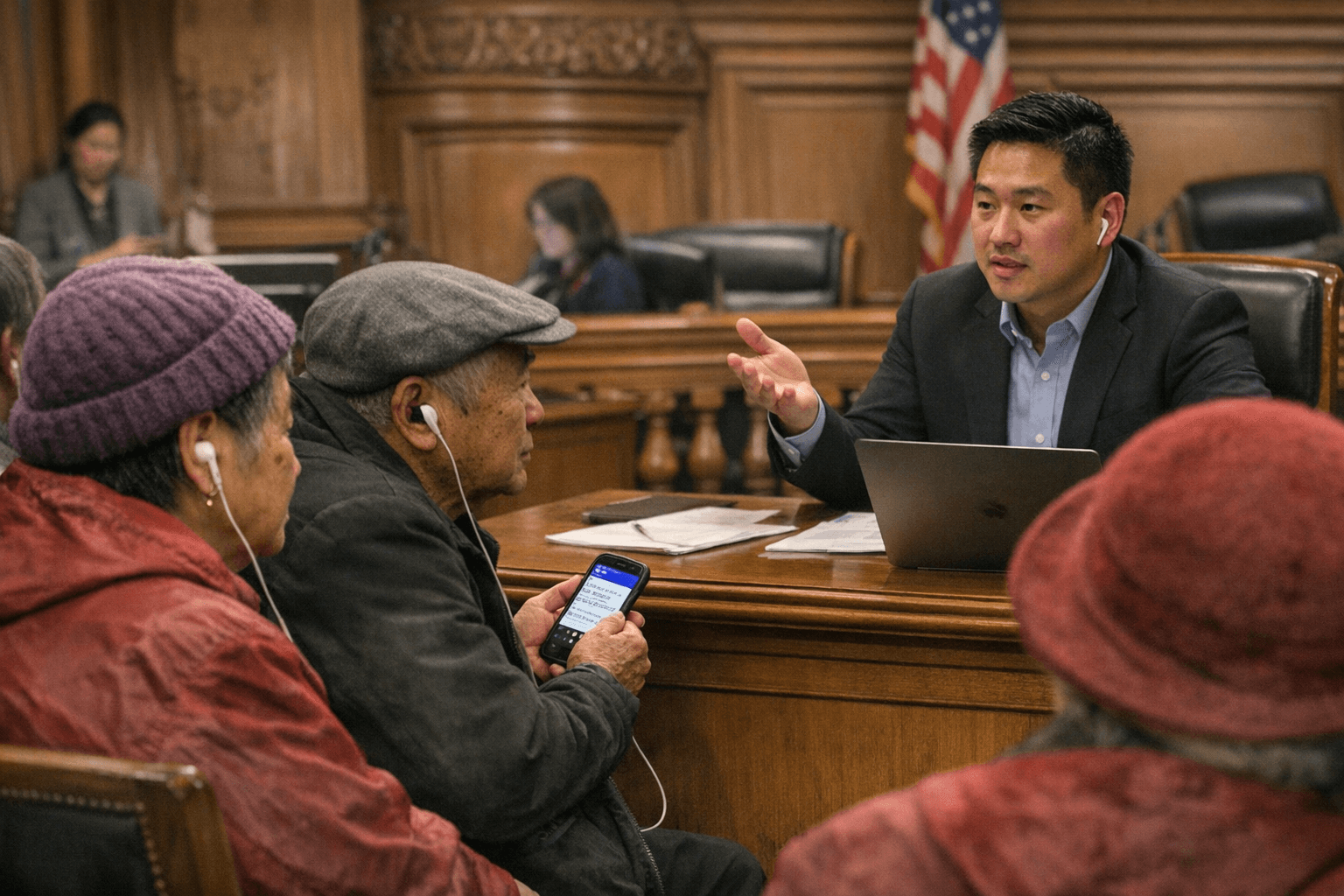
In a City Hall meeting, Chinese-speaking seniors used Google Translate and earbuds to lobby Sunset Supervisor Wong in Cantonese while he replied in English, pushing housing and transit changes.

In a City Hall office, a group of Chinese-speaking seniors spoke in Cantonese while Sunset Supervisor Wong replied in English, their conversation mediated in real time by Google Translate and earbuds; a handwritten Chinese note displayed next to an English translation on a screen said the seniors lived in a high-rise and supported zoning changes for more housing. The exchange shows how language technology is moving beyond one-off interpreter requests and into face-to-face lobbying at municipal offices.
That pattern has appeared across San Francisco public processes: seniors used automatic translation to advocate for more accessible public transportation at a Sept. 11 planning commission meeting, they complained at a July 25 San Francisco Democratic County Central Committee meeting that live translation at public hearings must be requested days in advance, and they voiced support for the Sunset Chinese Cultural District at an April 21 Land Use and Transportation Committee meeting. Those instances reflect an emerging practice of using AI-powered translation tools at hearings and committee rooms across the city.
Supervisor Wong, who speaks conversational Cantonese, described his on-the-ground experience using the tools and urged measured optimism: “It’s still in this developmental stage, but with how AI is exponentially getting better, soon it may even be more accurate than other forms of interpretation.” He previously wrote English sentences into Google Translate and showed the translated results to monolingual Russian- or Spanish-speaking constituents, but the earbuds method represents a new, real-time workflow.
Community organizer Chow is pushing for formal recognition of that workflow, calling for a city resolution that says, “‘Yes, we accept AI translation,’” and urging the policy to extend beyond Chinese to “not only City Hall, but also the state, not limited to Chinese, but all languages.” Chow’s demand frames a policy conflict: residents and volunteers are operationalizing AI now while municipal and state systems still rely on advance requests for human interpreters.
At the state level, the California Health and Human Services Agency requires since May 2023 that departments translate all “vital” documents into the top five languages for Californians with limited English proficiency - Spanish, Chinese, Tagalog, Vietnamese, and Korean - and agency officials are seeking IT bids to harness AI to translate a broad swath of health and social services documents and websites. Agency spokesperson Sami Gallegos declined to elaborate on which documents and languages would be involved, saying that information is “confidential,” and added that human editors supervising the project will oversee and edit the translations.
Translation accuracy and cultural nuance remain central concerns for implementation. Ching Wong, executive director of the Vietnamese Community Health Promotion Project at the University of California–San Francisco, who has translated health content for 30 years, warned that machine renderings can be misleading - “Breast cancer, for instance, is called ‘chest cancer’ in Chinese,” he said - and that in Vietnamese the pronoun “you” varies by social rank so “If a doctor uses ‘you’ incorrectly with a patient, it could be offensive.”
Technology training is helping diffusion. Jacob Shaul, who founded a nonprofit that has brought free coding courses to more than a thousand students across five continents, expanded his Mode to Code program to seniors in March of this year and now offers a free class to about 20 facilities, seven of which enrolled; classes meet once a week for four weeks with ongoing one-on-one assistance, and participating seniors already use AI for tasks from obituary drafts to translation assistance.
State officials and advocates are trading off access and accuracy as city and county deliberations see more seniors using AI in public meetings; with the Health and Human Services Agency seeking bids and community leaders like Chow pushing for formal acceptance, San Francisco faces a near-term policy choice on whether to integrate AI translation into official civic processes while supervisors and human editors work to guard linguistic nuance.
Know something we missed? Have a correction or additional information?
Submit a Tip