Memorial Day gas prices hit four-year high as travel surges
Gas hit $4.552 a gallon as 45 million Americans geared up for Memorial Day travel, the priciest holiday weekend in four years.
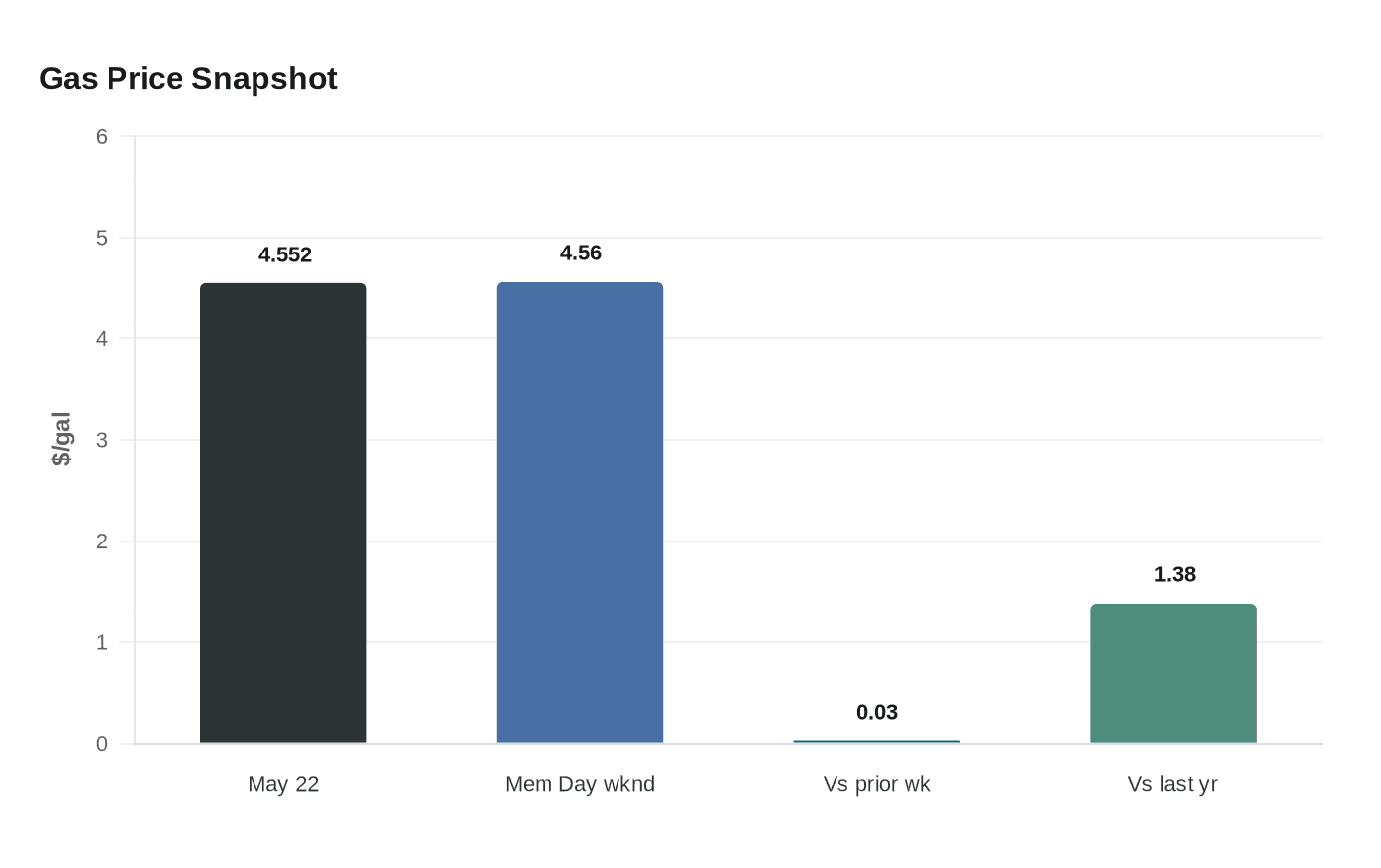
The quickest way to cut Memorial Day fuel costs is not a new vehicle. It is slower, smoother driving, because the holiday price shock is already here: AAA’s national average for regular gasoline stood at $4.552 a gallon on May 22, and Memorial Day weekend gasoline was at $4.56, the highest level in four years.
That price was 3 cents higher than the prior week and $1.38 above the same time last year, according to AAA’s latest fuel-price update, which is built from reports at 130,000 gas stations nationwide. The numbers land as a record 45 million Americans are expected to travel at least 50 miles from home for Memorial Day between May 21 and May 25, with 39.1 million projected to drive. That makes gas savings a real household expense, not a side note.

The biggest payoff comes from speed control. The Department of Energy says gas mileage usually falls rapidly above 50 mph, and every 5 mph driven over that threshold is like paying about $0.22 to $0.27 more per gallon of gasoline. Aggressive acceleration also burns more fuel than any other type of driving, which means the cheapest miles this weekend are the ones driven steadily, without hard starts or sudden braking.
Other tactics help by reducing the miles or drag you put on the tank. Combining errands and carpooling saves fuel by cutting trips outright, so the savings are proportional to the miles you avoid. Rooftop cargo is more expensive than many drivers realize: the Department of Energy says roof-mounted cargo can cut fuel economy by up to 8% in city driving and up to 25% at highway speeds, while FuelEconomy.gov says a large roof-top cargo box can trim gas mileage by around 2% to 8% in city driving, 6% to 17% on the highway and 10% to 25% on interstates. Even 100 extra pounds in a vehicle can increase gas costs by up to $0.03 a gallon.
Driver-feedback devices offer a modest but measurable gain, improving fuel economy by about 3% on average and by about 10% for drivers using them specifically to save fuel. Buying an EV, by contrast, is a long-term hedge against gasoline spikes, not a weekend fix. For travelers leaving Washington, DC, and other major metro areas, the math is plain: the biggest savings now come from slower speeds, lighter loads and fewer miles.
Know something we missed? Have a correction or additional information?
Submit a Tip