Michael Petch Reframes AMUG Conference as Reputation-Filter Rather Than Agenda-Setter
Michael Petch says AMUG’s influence is a quiet reputation-filter, reversing his 2018 view after his theory “completely fell apart” by 2025.
Michael Petch, editor-in-chief at 3D Printing Industry, published "Why I Was Wrong About the AMUG Conference" on February 27, 2026, and wrote plainly: "I was wrong to call it agenda-setting." Petch traces the shift to a change in how AMUG operates in practice since his first visit in 2018 and says that by 2025 "that theory completely fell apart," reframing the Additive Manufacturing Users Group Conference as a reputation-filter whose influence "accumulates quietly, and that may be its greatest strength."
Petch defines the conference’s power through people rather than proclamations. "What struck me at my first visit, and has not changed, is density. Not density of bodies or exhibitors, but of accumulated experience," he writes, and adds that "When a room is dominated by engineers who have run the same process for a decade, failed the same qualification twice, and rebuilt the same workflow from scratch once, the tone of discussion changes." Those conditions, he argues, make "Claims get tested. Vague promises get ignored."
Across sectors Petch points to recurring, specific conversations that reinforce the reputation-filter effect. He reports aerospace sessions where "discussions centred on qualification timelines and sourcing fragility, not solely machine capabilities." Energy presentations covered "hydrogen-ready turbines and the integration of legacy infrastructure." Casting specialists illustrated how "additive fits into existing foundry workflows, not how it displaces them." He also notes that "That theme has surfaced across automotive, defense, energy, and advanced ceramics," and that a common outcome is that attendees "take what is learned at the conference and share it with colleagues on return."
The article locates AMUG’s institutional mechanics as part of its filtering role. Petch highlights that "Volunteers, including senior executives, are embedded throughout the mechanics of the event not as figureheads but as participants" and that "Year after year, the front row seats are filled with those who lead the pioneering companies, wrote the foundational patents and continue to shape their evolution." In exhibition halls, he writes, "you will meet the people building the next breakthrough," reinforcing reputations through direct scrutiny rather than marketing theater.

Petch frames the industry problem AMUG exposes with an exact line: "Additive manufacturing no longer lacks visibility. It lacks alignment, standardisation, and disciplined execution." He summarizes the conference’s practical role under the header "Why It Matters Now" and concludes that AMUG’s value is the operational realism and "the willingness to say so plainly" that only a room of active practitioners can produce.
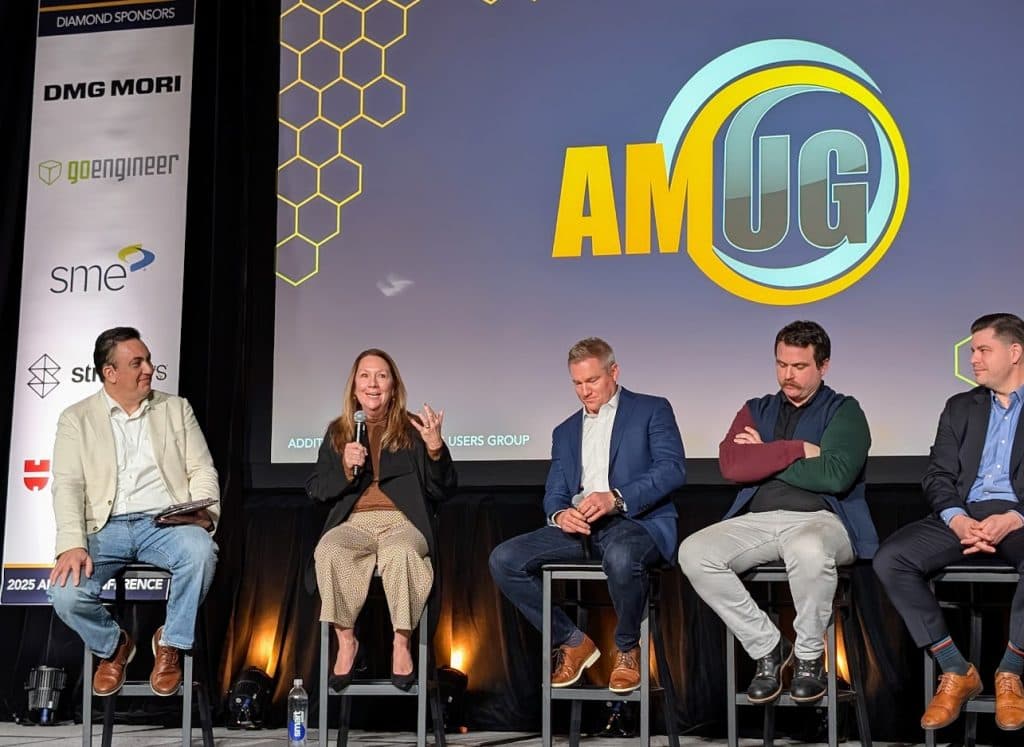
Petch amplified the piece with a LinkedIn post that reproduced his self-correction verbatim: "I got something wrong about the AMUG (Additive Manufacturing Users Group) Conference. Since my first visit in 2018, I thought I understood the structural function of this event. I thought I knew how it influenced investment and procurement. By 2025, that theory completely fell apart. Article link in the comments. #AdditiveManufacturing #3DPrinting #AMUG2026 #AdvancedManufacturing #Engineering" The photo caption accompanying his coverage reads, twice in the supplied material, "AMUG Conference 2025, the view from the top. Photo by Michael Petch," with LinkedIn noting "No alternative text description for this image."
Petch’s correction reframes how procurement teams, investors, and engineers should interpret AMUG: not as a place where new agendas are declared, but as a venue where reputations are tested and operational gaps - in alignment, standardisation, and execution - are exposed and shared outward.
Know something we missed? Have a correction or additional information?
Submit a Tip