Microsoft Labels Copilot Entertainment Only While Aggressively Pushing It for Business
Microsoft's Copilot terms warn it's "for entertainment purposes only" and require users to indemnify the company, even as 90% of Fortune 500 firms pay to run it as core business infrastructure.
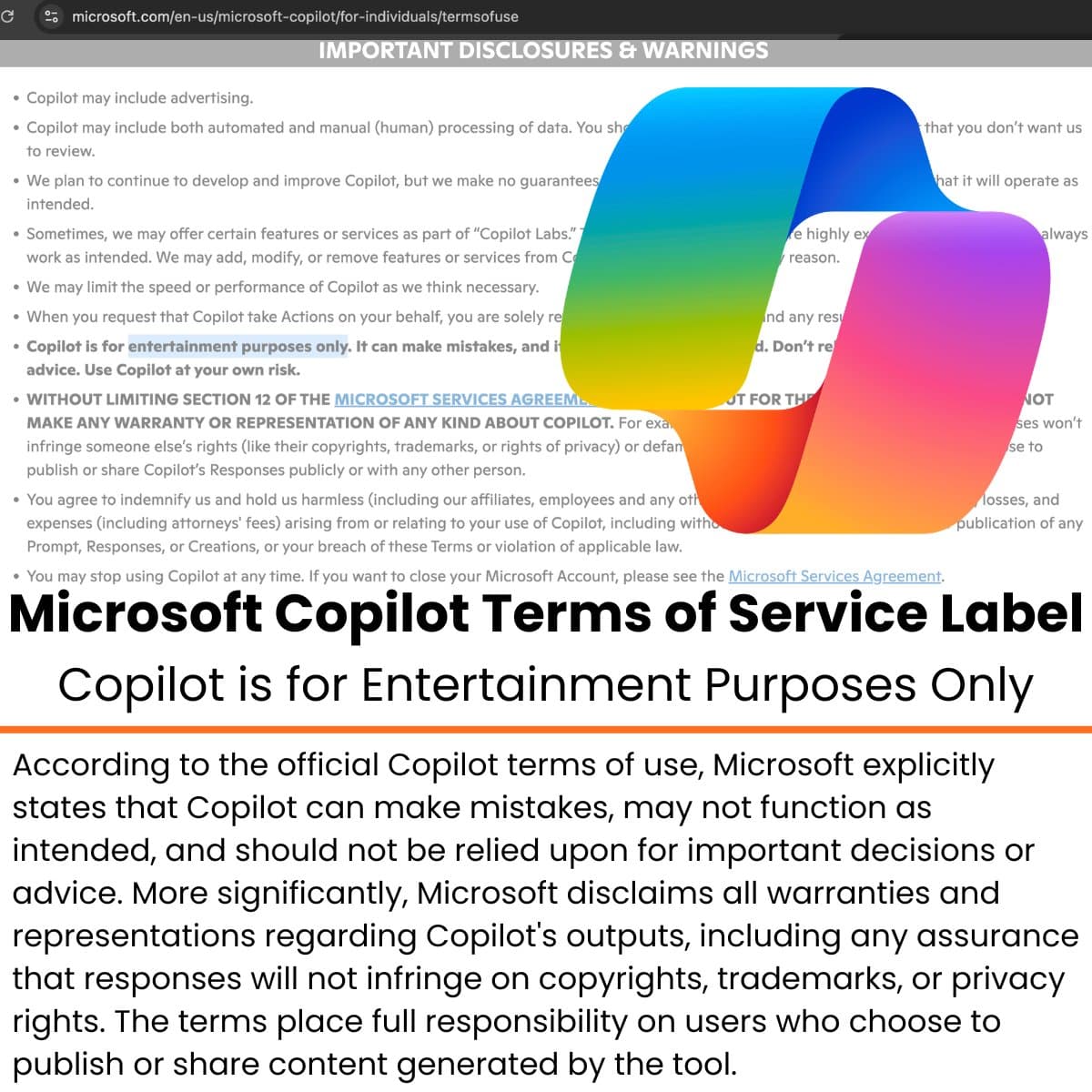
The legal language buried in Microsoft's Copilot for Individuals Terms of Use is unambiguous: "Copilot is for entertainment purposes only. It can make mistakes, and it may not work as intended. Don't rely on Copilot for important advice. Use Copilot at your own risk." That document, updated in October 2025 and thrust back into broad public view on April 2, creates a liability structure with real consequences for the more than 90 percent of Fortune 500 companies that Microsoft itself says trust Copilot as a workplace tool.
The terms go further than a hedging disclaimer. Microsoft states it makes "no warranty or representation of any kind about Copilot" and explicitly acknowledges it cannot promise outputs will avoid infringing copyrights, trademarks, or privacy rights. Users who publish or share Copilot's responses bear "sole responsibility" for the results, and the agreement requires them to indemnify Microsoft and hold the company harmless against any resulting claims, including attorneys' fees. The practical read: when Copilot gets something wrong at work, the legal exposure flows toward the user and, by extension, the employer who deployed the tool.
That transfer of risk sits in open tension with Microsoft's commercial strategy. The company has priced Microsoft 365 Copilot at $18 per user per month for business customers, reduced from a $21 starting price, and has woven the assistant into the same Excel spreadsheets and PowerPoint decks where those entertainment-only terms now apply. Microsoft has simultaneously built its Copilot+ PC hardware line around the assistant and embedded it throughout Windows 11, positioning the technology not as a novelty but as the productivity layer of modern enterprise computing. During the London leg of its own AI tour, Microsoft demonstrated Copilot to business audiences while noting that the tool's output could not be fully trusted and that human verification was required at every step. The demos and the disclaimer, it turns out, carry the same warning. The marketing does not.
The liability gap sharpens across specific use cases. A finance team using Copilot to summarize quarterly reports, a developer relying on it to generate production code, or a human resources department drafting policy documents with AI assistance all operate under terms that explicitly decline any guarantee of accuracy and shift every consequence of error onto the user. For legal or medical queries, the terms offer no carve-out: the entertainment-only label applies regardless of how consequential the underlying decision is. Procurement officers signing enterprise agreements should note that the indemnification clause does not evaporate at the business subscription tier; it travels with the product.

The contradictions arrive at a precarious commercial moment. Starting April 15, Microsoft will remove free Copilot Chat access from Word, Excel, PowerPoint, and OneNote for organizations that lack a paid Microsoft 365 Copilot license. The feature was made available at no additional charge only six months earlier, in September 2025. Millions of business users now face a forced choice: pay for a subscription to a tool Microsoft's own terms describe as unsuitable for serious reliance, or lose the AI access they had briefly been given for free.
The disclaimer, in this light, is less a safety notice than an architecture decision. Microsoft has built its growth narrative around Copilot adoption, but the terms of use clarify who owns the consequences when that adoption goes wrong.
Sources:
Know something we missed? Have a correction or additional information?
Submit a Tip