FCC Router Ban Could Create Confusion for Consumers and Retailers
The FCC's ban on new foreign-made routers, driven by national security fears, risks product shortages, higher prices, and widespread confusion for buyers and retailers.
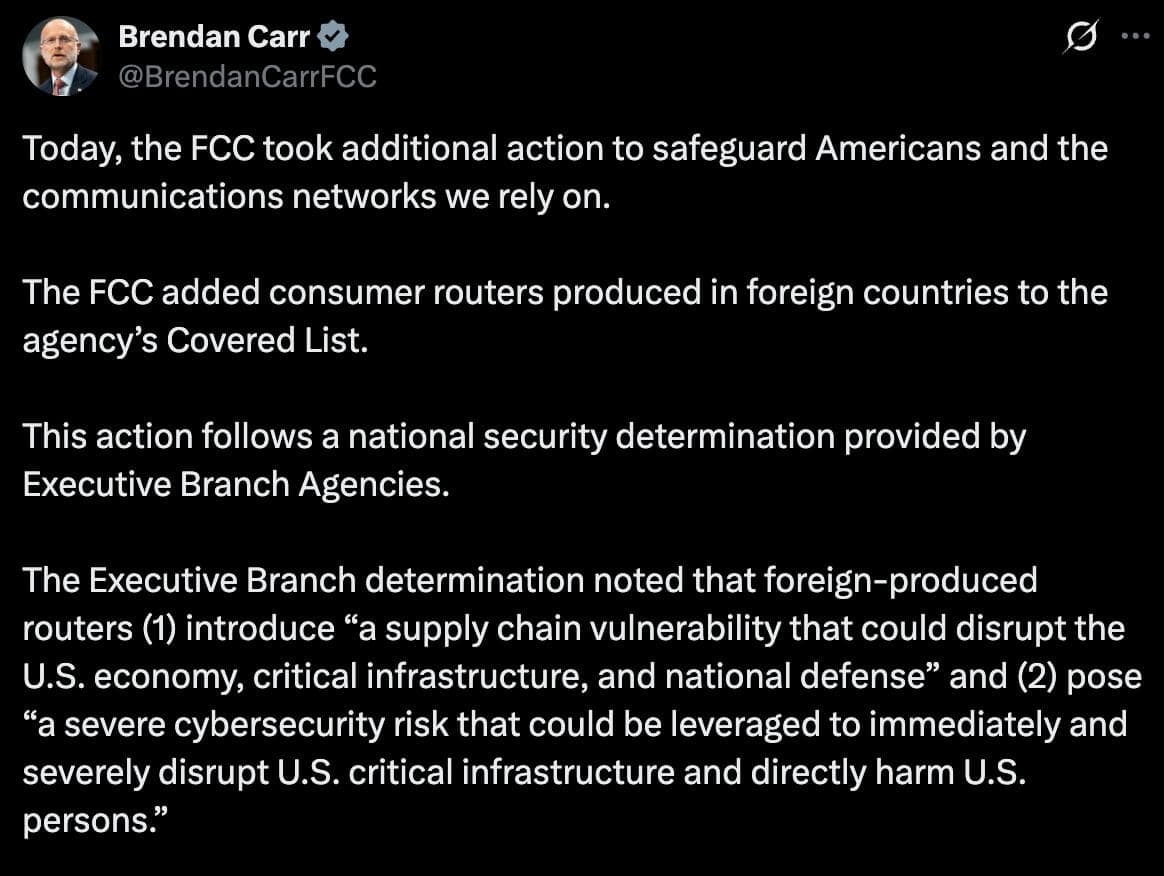
The Federal Communications Commission's sweeping ban on new foreign-manufactured consumer routers is poised to create significant disruption across the retail electronics market, with industry analysts warning of product shortages, higher prices, and a cumbersome exemption process that could leave businesses and households in limbo for months.
The FCC ban covers all new consumer routers manufactured overseas, barring them from import and sale in the United States on cybersecurity grounds. The order states the ban will "include all consumer-grade routers produced in foreign countries," though it does not affect routers already authorized and in use. New devices may be granted an exception only if the Departments of Defense or Homeland Security approve them through a "Conditional Approval" process.
FCC Chairman Brendan Carr welcomed the move, stating: "I welcome this Executive Branch national security determination, and I am pleased that the FCC has now added foreign-produced routers, which were found to pose an unacceptable national security risk, to the FCC's Covered List." Carr added that the agency would "continue to do our part in making sure that U.S. cyberspace, critical infrastructure, and supply chains are safe and secure."
The cybersecurity incidents underlying the ruling were not hypothetical. Volt Typhoon, Flax Typhoon, and Salt Typhoon, all documented Chinese state-sponsored hacking campaigns, exploited vulnerabilities in small and home office routers to gain footholds in American networks.
The practical market fallout, however, is where analysts see serious complications. Because the overwhelming majority of consumer routers sold in the United States are designed, assembled, or built using components manufactured abroad, the FCC's working definition of "foreign-made" has the potential to sweep in a broad swath of well-known brands. Industry groups and some manufacturers are already exploring legal challenges or filing expedited exemption petitions to secure conditional approvals before retail inventory runs dry.

Router makers can apply to the FCC to get on the approved list, but the process is untested at scale, and trade groups have cautioned that the agency's definition may catch companies with only partial overseas production, generating disputes over which specific models qualify. Retailers, meanwhile, may pause purchasing decisions while waiting for regulatory clarity, narrowing the options available on shelves.
The disruption extends beyond the consumer market. Network administrators at schools and small businesses face uncertainty over warranties, software support, and replacement parts for devices that may no longer have a clear path to re-authorization. Consumer advocates have urged the FCC to clarify grandfathering rules so that equipment already installed in homes and offices is not suddenly placed in a regulatory gray zone.
Critics also warn the ban could backfire, leaving millions of households with aging, unpatched equipment and no viable domestic alternatives if U.S. manufacturing capacity cannot scale quickly enough to fill the gap. Over a longer horizon, the rule could spur reshoring investment and new domestic supply chains, but that shift takes years, not months.
The FCC order follows a national security determination provided by Executive Branch agencies and builds on earlier agency moves that placed specific Chinese manufacturers on the Covered List. Those prior restrictions, dating to 2021 and 2022, targeted named companies; the new order broadens the reach to all foreign production, making it a far more expansive intervention in the consumer electronics supply chain. How aggressively the Departments of Defense and Homeland Security process exemption requests will largely determine whether the disruption is temporary or structural.
This article was produced by Prism’s automated news system from verified source data, official records, and press releases, then run through automated quality and moderation checks before publishing. The system is built and supervised by the people who set the standards it runs under. Read our full AI policy.
Did this article answer your question?