Middle East War Shocks Global Economy as Oil Markets Convulse
Oil prices hit record monthly gains as the Iran war spread into shipping, inflation and growth forecasts, forcing governments from Britain to Nigeria into emergency relief.
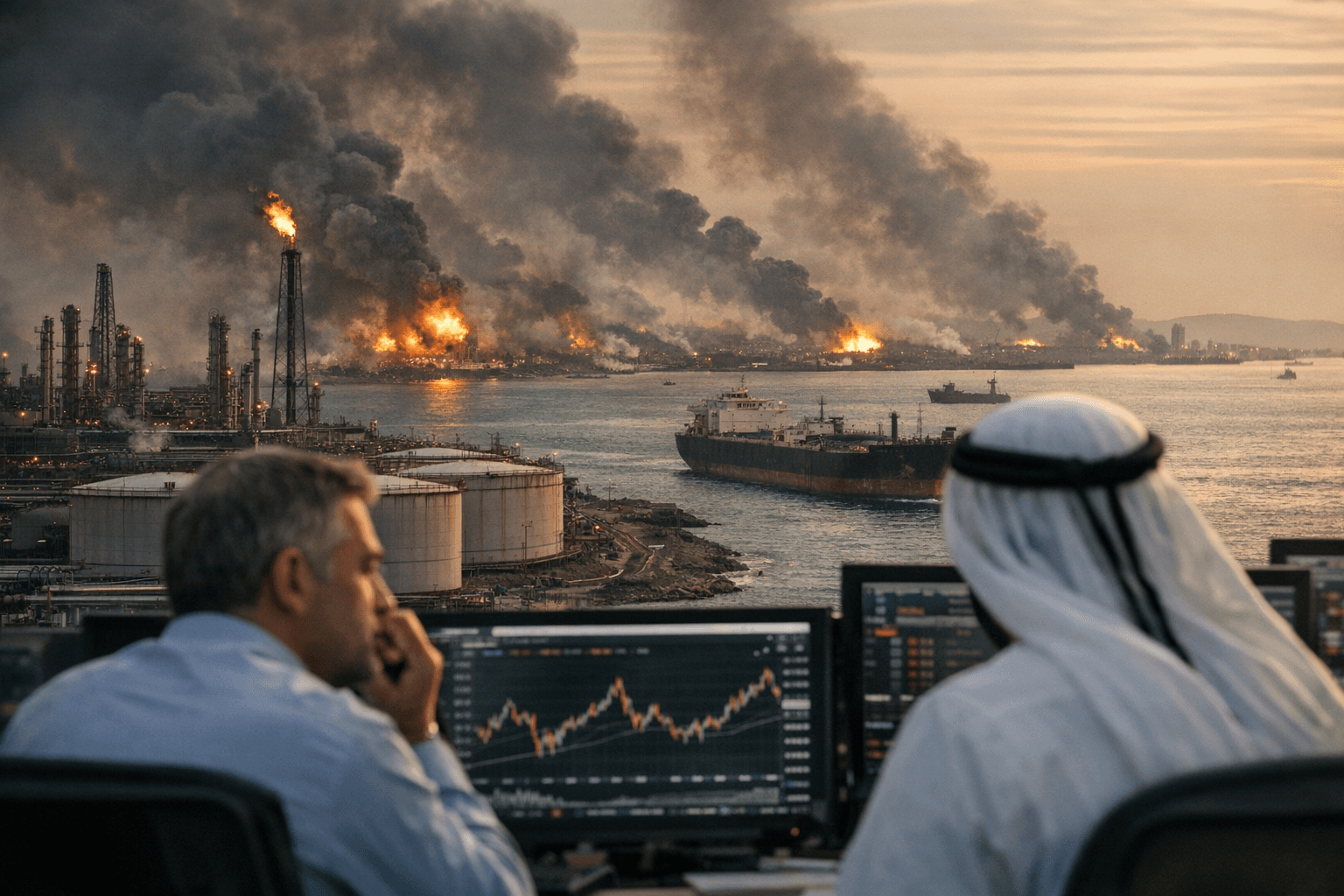
Oil markets have become the first and loudest warning signal from the Middle East war. The International Energy Agency said oil demand is expected to contract by 80 kb/d this year, while global supply fell by 10.1 mb/d to 97 mb/d in March as attacks on energy infrastructure and restrictions through the Strait of Hormuz triggered what it called the largest disruption in history.
That shock is feeding straight into the broader economy. The IMF’s April 2026 World Economic Outlook said global growth would slow to 3.1% in 2026 and 3.2% in 2027 under the assumption that the conflict stays limited in duration and scope. Even that baseline carries a warning: the fund said rising commodity prices, firmer inflation expectations and tighter financial conditions are testing the recent resilience of the world economy, and it said its projections were based on data available through April 1.
The pressure is already visible in prices and policy. The IEA said oil posted its largest-ever monthly gain in March, with North Sea Dated crude around $130 a barrel at the time of writing. It also said the announcement of a two-week ceasefire gave markets some respite, although it remained unclear whether that would lead to a lasting peace and a return to normal shipping through Hormuz.
The IMF meetings in Washington have turned into an emergency session on spillovers. Reuters reported that the IMF and World Bank were already signaling downgrades to growth forecasts and higher inflation projections, with emerging markets and developing economies expected to take the hardest hit. Nigeria said petrol prices had surged more than 50% and diesel more than 70% since the conflict began, while Germany approved 1.6 billion euros in fuel price relief and Sweden unveiled a package worth about $825 million including lower fuel taxes and higher electricity subsidies.
Europe is also absorbing a larger import bill. The European Commission said the European Union’s fossil-fuel imports had cost more than €22 billion, or $25.7 billion, more since the conflict began. The IMF singled out the United Kingdom as the most exposed major advanced economy, cutting its 2026 growth forecast to 0.8% from 1.3%. Britain was hit hardest because it is a net energy importer, while Germany was next worst affected.
In the United States, the Federal Reserve said the conflict complicated hiring, pricing and capital investment, leaving many firms in a “wait-and-see” posture. Reuters reported that the turbulence in the Strait of Hormuz affected about a fifth of the world’s oil shipments and about a third of fertilizer shipments, while U.S. gasoline prices rose above $4 a gallon and diesel moved past $5.60.
China has not escaped the fallout either. Its economy had picked up early in 2026 on strong exports, but the war has pushed energy costs higher and raised new risks for global demand. After Covid-19 and Russia’s invasion of Ukraine, the Middle East war is now being treated as the third major shock to the world economy, and the risk is that policymakers are underestimating how long the squeeze from oil, shipping and inflation can last.
This article was produced by Prism’s automated news system from verified source data, official records, and press releases, then run through automated quality and moderation checks before publishing. The system is built and supervised by the people who set the standards it runs under. Read our full AI policy.
Did this article answer your question?

