Miles Davis rose from trumpet prodigy to jazz icon and style legend
Miles Davis turned discipline, image, and sound into cultural power, helping define jazz, Black cool, and celebrity style far beyond the bandstand.
From trumpet prodigy to a new kind of authority
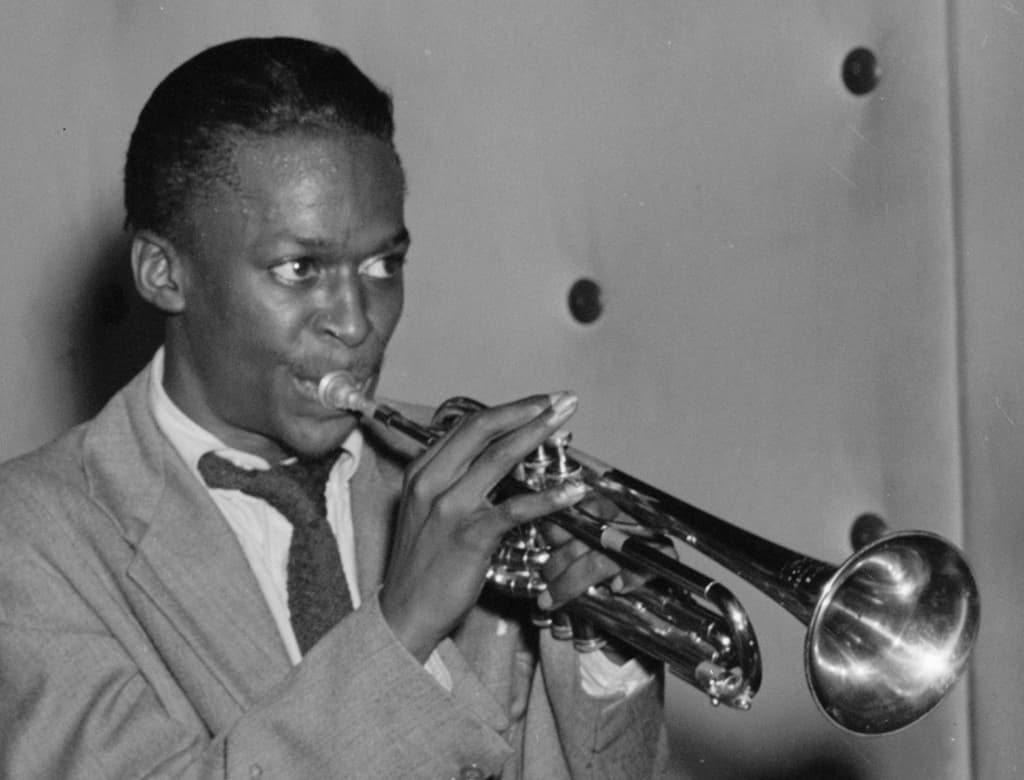
Miles Davis built his authority on restraint. The trumpet sound he chased was clear and centered, not showy for its own sake, and the image he presented, from dark sunglasses to sharply cut clothes, turned that discipline into a public language of cool. That combination made him more than a great jazz player. It made him a symbol of Black modernity in America, where style, confidence, and authorship could shape the culture as forcefully as any hit record.
Born Miles Dewey Davis III on May 26, 1926, in Alton, Illinois, and raised in East St. Louis, he came up in a Black Midwestern world that would become the foundation for one of the most consequential careers in American music. His father gave him his first trumpet at age 13, and early lessons with Elwood Buchanan shaped the sound that would later become unmistakable. Buchanan urged him to avoid vibrato and develop a clear, mid-range tone, a technical choice that sounds small on paper but became central to Davis’s voice.
How New York turned promise into momentum
Davis arrived in New York City in September 1944 to attend the Juilliard School of Music, a move that placed him in the center of the postwar jazz conversation. He secretly connected with Charlie Parker and Dizzy Gillespie, figures who helped define the modern language of the music, and by 1945 he had dropped out of Juilliard to become a regular part of New York’s modern jazz scene. That step mattered because Davis was never just chasing approval from institutions. He was learning how to build power inside the city’s living culture, where clubs, sessions, and reputation mattered as much as formal training.
That early period set up the arc that would make him one of jazz’s most influential figures. Britannica describes Davis as one of the four most important and influential figures in jazz history, alongside Louis Armstrong, Duke Ellington, and Charlie Parker. He would also be widely credited with helping define cool jazz, modal jazz, and jazz fusion, three different turning points in the genre’s evolution. Few artists have helped redirect the music so many times without losing the center of their own identity.
The Newport moment that changed his leverage
One of the clearest examples of Davis using performance as public power came at the Newport Jazz Festival on July 17, 1955. His restrained solo on “’Round Midnight” became the talk of the festival and helped bring Columbia Records executive George Avakian to him. That moment mattered because Davis was not relying on volume or flash to command attention. He was showing that control could be more magnetic than excess, and that a single well-placed phrase could change the terms of his career.
The Newport set also became part of the story of how Davis engineered his reputation. He did not just sound modern. He looked modern, and he knew how to let that image travel. The Miles Davis Official Site says much of his mystique came from how he looked, moved, and dressed, onstage and off. That mystique helped make him legible not only to jazz listeners but to anyone watching American culture evolve.
How style became part of the music
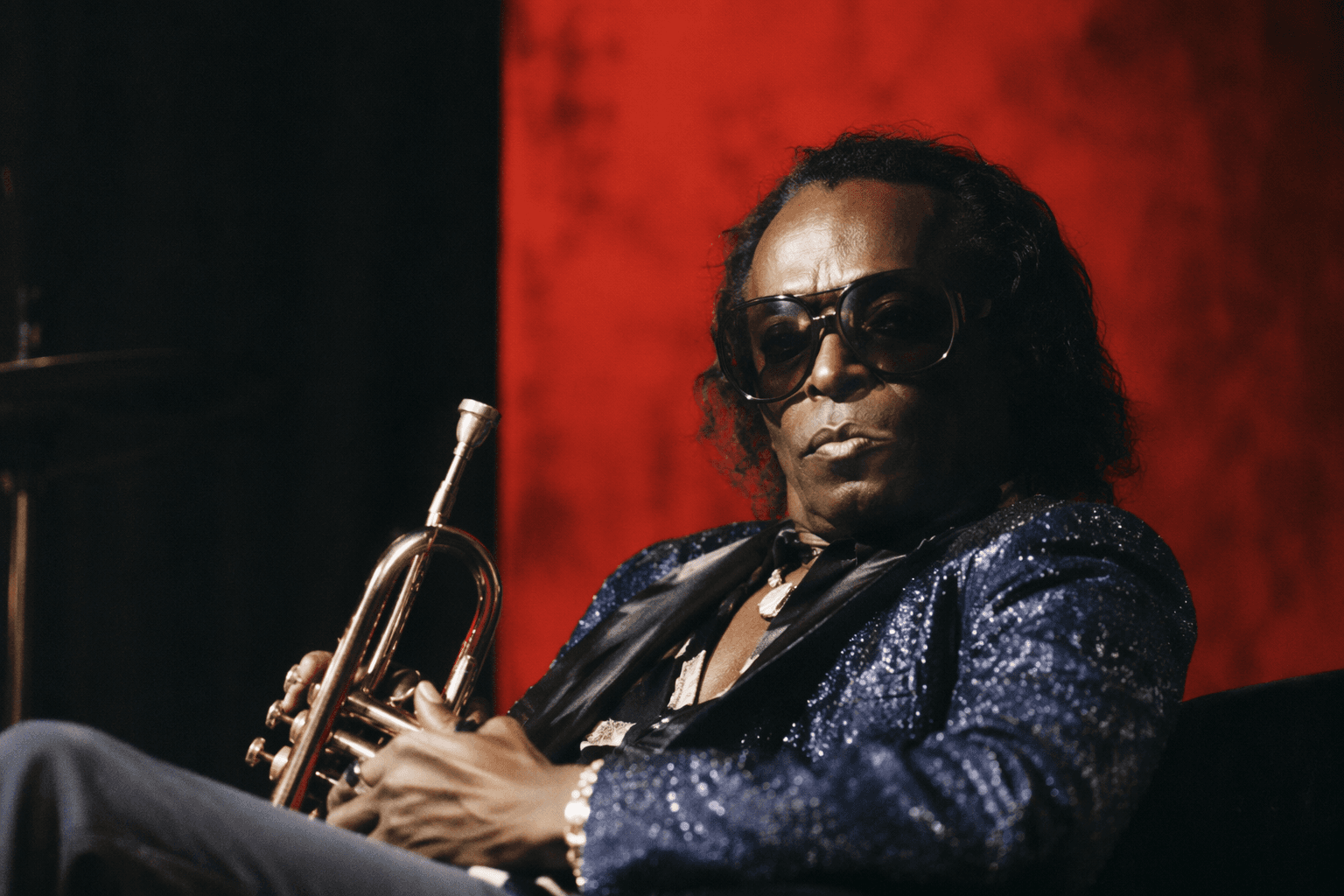
Davis’s clothes, sunglasses, and posture were not accessories to the art. They were part of the art’s public meaning. In the 1950s, his suits projected precision and discipline. By the 1970s and 1980s, his wardrobe became more flamboyant, reflecting a performer who understood that visual daring could expand his presence without weakening it. He turned fashion into a form of authorship, one that said a Black artist did not have to appear deferential to be respected.
That visual signature continued to resonate long after his peak recording years. An eyewear collaboration with his estate explicitly honored the sunglasses associated with his 1958 Newport Jazz Festival look, and the limited-edition frame series was capped at just 500 pieces. The scale was small, but the symbolism was large. It showed how fully Davis had entered the history of style, where an object as ordinary as a pair of glasses could carry the weight of a cultural era.
What Davis helped define was bigger than jazz fashion. He helped establish a model of Black cool in America that linked understatement, control, and aesthetic intelligence. In that sense, his image influenced music, fashion, and celebrity performance far beyond the club circuit. Later generations of artists learned from his ability to treat silence, clothing, and gaze as tools of authority.
Fast cars, speed, and the making of legend
Davis’s legend also traveled through motion. Verified reporting and car-history coverage tie him to a red Ferrari 275 GTB/4 photographed on New York’s West Side Highway in October 1969, a detail that fed the “fast cars” side of his persona. The car fit the rest of the image: sleek, costly, and impossible to miss. It matched the public idea of Davis as someone who moved through the world with intent and speed, never as a background figure.
That association mattered because celebrity is partly a visual economy. Davis understood that, and he used every available surface, from stagewear to automobiles, to reinforce a persona of command. The result was a career that felt cinematic without becoming hollow. The style was never separate from the music. It was a way of extending the music’s authority into everyday life.
A legacy still expanding in his centennial year
Davis died on September 28, 1991, but his influence has only widened. His centennial year in 2026 has renewed attention to both the sound and the image, and that combination is the key to understanding why he still matters. He was not only a trumpet prodigy who became a jazz giant. He was an artist who understood that public identity could be composed as carefully as a melody.
Miles Davis remains a benchmark because he changed the terms of what a Black musician could look like in American public life. He made cool feel deliberate, not accidental, and he proved that style could be a serious instrument of cultural power.
This article was produced by Prism’s automated news system from verified source data, official records, and press releases, then run through automated quality and moderation checks before publishing. The system is built and supervised by the people who set the standards it runs under. Read our full AI policy.
Did this article answer your question?