Military Archbishop Addresses Iran War, Hegseth's Religious War Rhetoric on CBS
The U.S. military's top Catholic archbishop confronted Defense Secretary Pete Hegseth's invocations of Jesus and Christian prophecy to justify Operation Epic Fury on CBS's "Face the Nation."
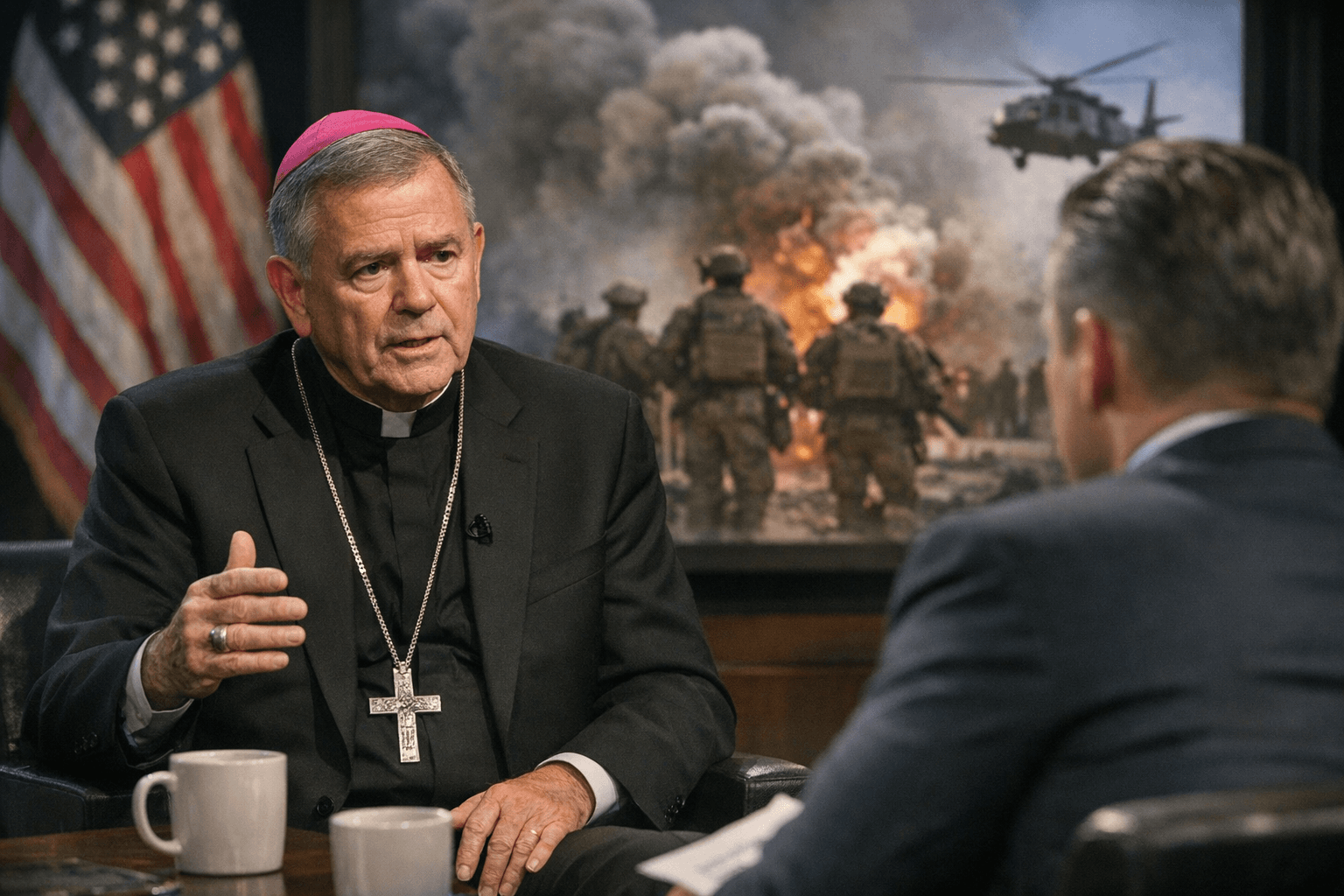
The archbishop overseeing spiritual care for all U.S. military personnel stepped into one of the most charged debates of the Iran war when Timothy Broglio, head of the Archdiocese for the Military Services, USA, sat down with "Face the Nation" to address Defense Secretary Pete Hegseth's repeated use of Christian religious language to frame Operation Epic Fury, the U.S.-Israeli air campaign against Iran that launched February 28.
During a press briefing on the Iran war, Hegseth told Americans they should take a knee and pray for victory "in the name of Jesus Christ." He elaborated in a separate CBS interview: "Our capabilities are better. Our will is better. Our troops are better. The providence of our almighty God is there protecting those troops, and we're committed to this mission." When asked whether he views the war in religious terms, Hegseth said, "We're fighting religious fanatics who seek a nuclear capability in order for some religious Armageddon. But from my perspective, I mean, obviously I'm a man of faith who encourages our troops to lean into their faith, rely on God."
That framing clashes directly with classical just-war doctrine, which Catholic tradition requires to be grounded in proportionality, discrimination between combatants and civilians, and right intention rather than theological triumphalism. Broglio, who has served as military archbishop since 2008, has been careful to uphold those distinctions. A National Catholic Reporter analysis of his prior public statements noted that any soldier facing a possibly immoral order also faces broader moral questions, and that Broglio's positions represent a commitment to the direction set by the Second Vatican Council affirming the inalienable role of individual conscience in matters of war and peace.
The stakes are immediate and concrete for the troops Broglio's archdiocese serves. Throughout the month of attacks on Iran, service members reported concerning rhetoric from their commanders invoking the idea of a holy war. The Military Religious Freedom Foundation said it received over 200 calls from active-duty personnel with complaints. Retired Army Maj. Gen. Randy Manner said "dozens and dozens" of active-duty chaplains who don't identify with Hegseth "are being marginalized" and some are "not included in staff meetings."
More than two dozen Democratic members of Congress requested an internal Department of Defense investigation regarding claims from uniformed officers that commanders painted the war in Iran as rooted in Christian biblical prophecy. A complaint shared by an anonymous non-commissioned officer to the MRFF claimed that NCOs were told the Iran war is part of "God's plan" and that President Trump was "anointed by Jesus to light the signal fire in Iran to cause Armageddon."
Sen. Mark Kelly, a retired U.S. Navy captain, called Hegseth's behavior "objectionable," saying, "I've never heard a secretary of defense say things like this. I don't think it's appropriate."
Broglio has not been uniformly critical of Hegseth. As recently as January 28, Broglio praised the defense secretary at a speech at the Catholic Information Center in Washington, D.C., saying Hegseth "definitely wants to return the chaplaincy to responsibility for religious services, religious instruction, and advising the commanders." That earlier alignment makes his Face the Nation appearance all the more significant as a signal that the rhetorical line between faith-informed leadership and sectarian war justification has, in his judgment, been crossed.
Pope Leo XIV condemned war during a Palm Sunday Mass, saying Jesus "rejects war, whom no one can use to justify war" and "does not listen to the prayers of those who wage war, but rejects them." For military chaplains caught between that theological tradition and a chain of command saturated with crusade imagery, the archbishop's public intervention may be the clearest institutional signal yet that the Catholic moral framework governing just conduct in war has limits that political rhetoric cannot dissolve.
This article was produced by Prism’s automated news system from verified source data, official records, and press releases, then run through automated quality and moderation checks before publishing. The system is built and supervised by the people who set the standards it runs under. Read our full AI policy.
Did this article answer your question?

