Trump Budget Plan Targets Bureau of Labor Statistics Funding Again
Trump's FY2026 plan targeted the Bureau of Labor Statistics with an 8% budget and staffing cut, threatening the accuracy of jobs and inflation data that drive Federal Reserve decisions.

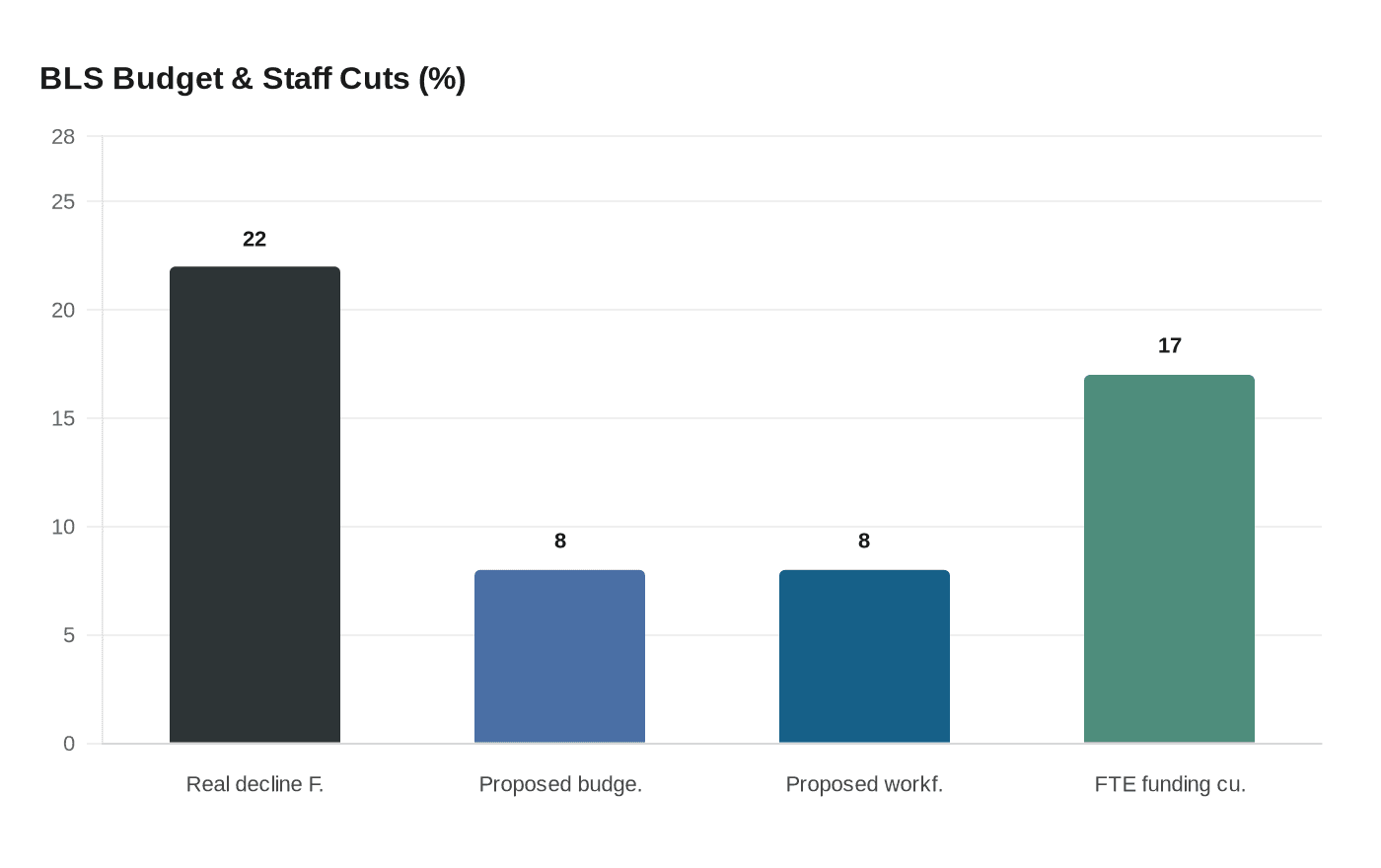
The Trump administration's fiscal year 2026 spending plan proposed cutting the Bureau of Labor Statistics budget and workforce each by roughly 8 percent, a reduction of approximately $56 million that economists and data professionals warned could degrade the reliability of government figures that move financial markets and inform Federal Reserve interest rate decisions.
The BLS, housed within the Department of Labor, publishes the monthly Employment Situation Summary on the first Friday of each month. That report covers nonfarm payrolls, the unemployment rate, average hourly earnings, and the labor force participation rate, and it ranks among the most market-moving data releases the federal government produces. The agency also publishes the Consumer Price Index and the Producer Price Index, the nation's primary measures of inflation and wholesale prices. Faced with the proposed cuts, the agency's own budget documentation indicated it would narrow its focus to those headline figures, known collectively as Principal Federal Economic Indicators, scaling back resources devoted to broader economic research and secondary data products.
The budget proposal, shaped by Office of Management and Budget Director Russell Vought, arrived as the BLS was already operating under significant financial strain. Adjusted for inflation, the agency's budget had contracted more than 22 percent between fiscal year 2010 and fiscal year 2025, a decline that had been compressing survey operations and staffing levels well before Friday's new request. The agency's congressional budget justification for fiscal year 2026 showed a 17 percent reduction in full-time equivalent funding tied to the administration's policy priorities.
The cuts did not emerge in isolation. The Department of Government Efficiency, the advisory body Elon Musk led in pursuit of sweeping federal spending reductions across the executive branch in 2025, scrutinized statistical agencies throughout the year. The administration also disbanded two unpaid expert advisory committees that had provided technical oversight for the BLS, eliminating an independent check at a moment when the agency's credibility was already under strain.
The American Statistical Association, along with economists across the political spectrum, warned that deep cuts to the BLS and to companion agencies such as the Census Bureau and the Bureau of Economic Analysis could erode the quality, frequency, and independence of data that businesses, investors, and policymakers rely upon. Reduced staffing raises the prospect of larger revisions to initially published numbers, a problem that had already drawn sharp public scrutiny in recent years as preliminary payroll estimates were revised downward significantly after release.
The proposed reductions followed an established pattern. During Trump's first term, from 2017 through 2021, the administration also sought cuts to federal statistical agencies, drawing similar objections from economists and research institutions. The BLS annual budget has historically run between $600 million and $700 million, making an 8 percent reduction a significant operational constraint for an agency that fields large-scale monthly surveys requiring hundreds of economists and statisticians to process and verify data before each release.
This article was produced by Prism’s automated news system from verified source data, official records, and press releases, then run through automated quality and moderation checks before publishing. The system is built and supervised by the people who set the standards it runs under. Read our full AI policy.
Did this article answer your question?

