Military Dog's Instincts, Not Intelligence, Cracked the Case
A military dog found 48 tons of drugs with no intelligence to guide it, revealing how much slips past the systems built to stop it.
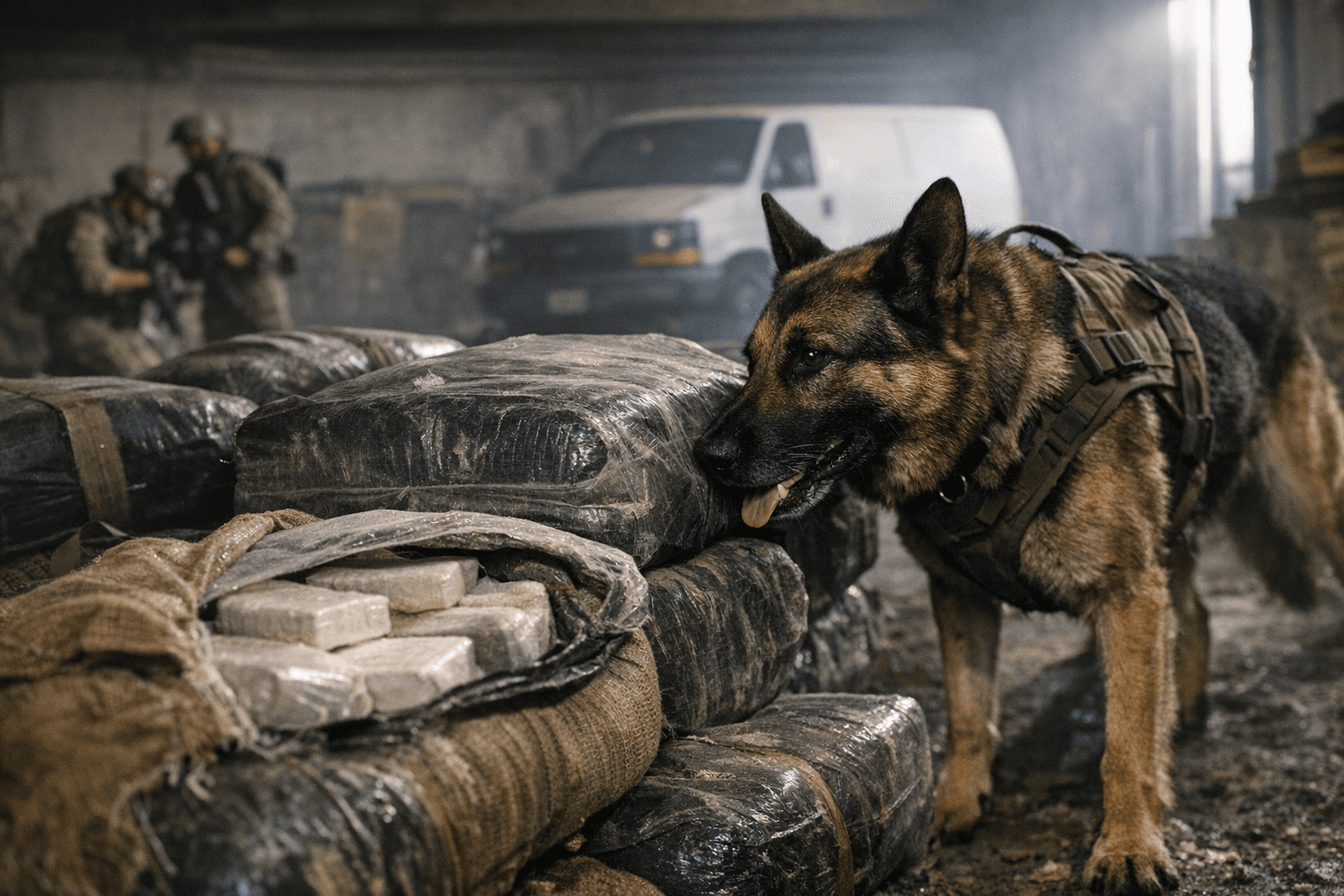
A military working dog, operating on instinct alone, led handlers to what authorities described as a record drug seizure of 48 tons on Wednesday, with the commander of the Canine Operations Battalion confirming that no prior surveillance or informant tip pointed them there.
"All of this was thanks to the work of the dog," the battalion's commander said. "It wasn't based on intelligence."
The statement carries weight beyond credit for a single animal. A 48-ton cache clearing inspection without triggering any advance warning means the network behind the shipment had either no footprint in existing databases or had successfully exploited gaps in screening protocols that human systems routinely enforce. Both possibilities are alarming.
Seizures of this scale don't move in a single container. Shipments in the tens of tons typically involve layered logistics: front companies, corrupted supply chain intermediaries, and compartmentalized couriers who handle far smaller quantities individually. The 48-ton figure suggests consolidation at some point before interdiction, meaning the operation had significant infrastructure capable of aggregating product without drawing notice.
The bust arrives against a backdrop of a deeply fractured U.S. drug market. With recreational cannabis now legal in nearly half of U.S. states, dispensary pricing has pulled street values down sharply in mature markets. That compression has pushed illicit operators toward higher volumes at thinner margins, driving up tonnage per shipment while making any individual load less financially catastrophic to lose. A 48-ton seizure represents a significant operational setback, but in a market generating hundreds of billions of dollars annually, the supply chain rarely misses a beat.
What the dog found points to a structural enforcement blind spot. Screening at high-volume transit points is largely shaped by prior knowledge: threat assessments, watchlists, known trafficker patterns. A seizure made without any of that input is a reminder that enforcement tends to catch what it already knows to look for.
The Canine Operations Battalion's commander gave full credit to the dog's nose. That candor deserves an honest follow-up: if a record-setting 48-ton haul was invisible to every other layer of the system, the more unsettling question isn't what the dog uncovered. It's what passed through while the humans weren't watching.
This article was produced by Prism’s automated news system from verified source data, official records, and press releases, then run through automated quality and moderation checks before publishing. The system is built and supervised by the people who set the standards it runs under. Read our full AI policy.
Did this article answer your question?

